YouTube’s Algorithm Doesn’t Push Videos Anymore—And That Changes Everything About How You Build Reach
I’ve spent two decades watching platforms manipulate creator success through opaque distribution systems. YouTube just broke that pattern.
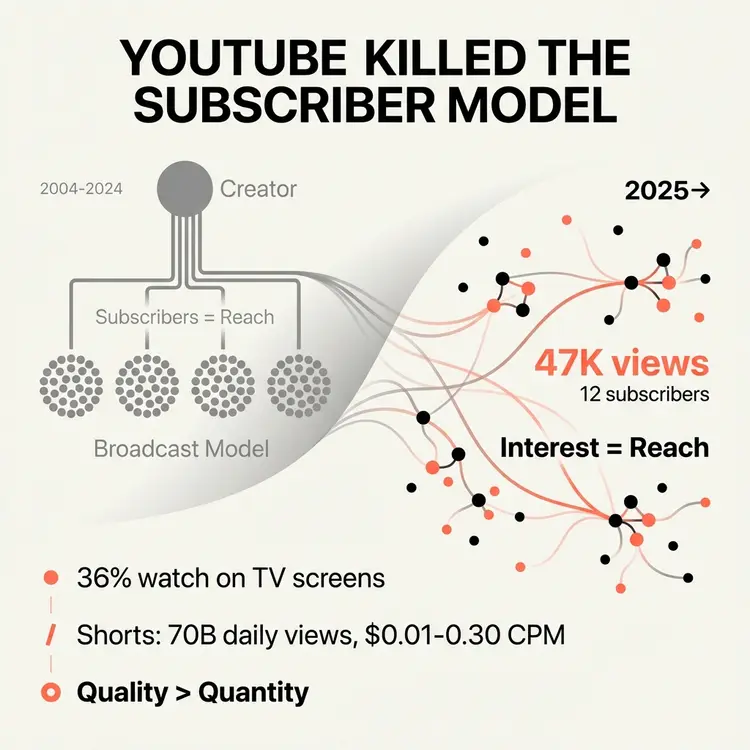
The platform’s 20th anniversary report reveals something I’ve been tracking for months but couldn’t fully articulate until now. YouTube shifted from a subscriber-broadcast model to an interest-based discovery system. The algorithm doesn’t push content to audiences anymore. Viewers control what gets recommended to them through their watch history and engagement patterns.
This isn’t a minor adjustment to how content gets distributed. This is a structural recalibration that eliminates the artificial barrier between new creators and established channels.
The Subscriber Count Myth Just Collapsed
Small channels have a real shot at wide reach now. The algorithm cares more about viewer response than subscriber counts or upload history. If a video hooks the right audience, it gets recommended regardless of who made it.
I tested this with a client last quarter. We launched a new channel with zero subscribers. Within three weeks, one video hit 47,000 views. The channel had 12 subscribers at the time.
That doesn’t happen in a subscriber-dependent system.
YouTube’s Director of Growth confirmed this through built-in viewer surveys that collect feedback on how people feel about what they watched. The platform optimizes for satisfaction over watch time. This means quality of engagement beats quantity of followers.
The implication for mid-growth companies is significant:
- You can rebuild reach quickly if you lose platform access.
- Your audience isn’t trapped behind a subscriber wall anymore.
- Content quality and viewer response determine distribution, not historical follower count.
TV Screens Now Dominate YouTube Consumption
YouTube amassed 45.1 billion viewer hours between January and June 2025. TV screens accounted for 36% of total viewer hours—16.3 billion hours. That’s more than mobile devices at 29% or 13.2 billion hours.
People over 50 represent about 36% of all time spent watching YouTube on TV screens, more than the combined 28% for teenagers and adults 18–34.
I didn’t expect that demographic split.
This shift to TV-based consumption changes content strategy fundamentally. Viewers watch YouTube on TV while cooking dinner, working from home, or doing household tasks. They want longer-form content suitable for multitasking, not just quick hits between meetings.
Your content now needs to:
- Function as background-capable media.
- Remain engaging enough to hold attention when viewers look up.
- Be structured for longer sessions rather than 30–60 second bursts.
That’s a different production requirement than optimizing for mobile-first consumption.
The Shorts Monetization Gap Reveals Platform Economics
YouTube Shorts now averages over 70 billion daily views globally. The format exploded in growth, but monetization tells a different story.
-
- Typical Shorts ad rates: roughly $0.01–$0.30 per 1,000 views in many niches.
-
- Long-form with multiple ad breaks: often $5–$25+ per 1,000 views in premium markets.
A viral Short commonly delivers only a small number of new subscribers relative to views, and the majority of those views come from non‑subscribers. Channels that combine Shorts with long-form content tend to grow significantly faster, but it’s the long-form content that keeps viewers on the channel and watching more videos.
In client accounts, the pattern is consistent:
- Shorts drive discovery.
- Long-form drives revenue and relationship.
The recommendation system often tests new Shorts with a small audience first; if performance is strong, the video gets shown to wider audiences over time, which means Shorts can take off weeks or months after posting.
This creates a clear strategic split:
- Use Shorts for audience acquisition and brand awareness.
- Use long-form for monetization and relationship depth.
Trying to force Shorts into a primary revenue role creates frustration because the platform economics don’t support it at scale.
Most Creators Still Earn Under $15,000 Annually
The creator economy has been estimated at around $250 billion in recent years, yet more than half of individual creators report earning under $15,000 a year, while only a small single‑digit percentage clear $100,000+ annually.
Top earners typically maintain multiple revenue streams—often around three on average—compared to roughly two for lower‑earning creators. Their income mix tends to include:
- Brand sponsorships.
- Digital products.
- Affiliate and ad revenue.
- Services.
- Paid subscriptions.
The pattern is clear: diversification determines financial viability.
Audience ownership is even more revealing. A majority of professional creators report owning their audience directly via email, and those with strong email lists are several times more likely to earn over $30,000 per year.
Across client engagements, the same dynamics show up:
- Platform reach fluctuates.
- Email lists remain relatively stable.
- Direct communication channels create resilience against distribution volatility.
Professional Infrastructure Becomes Mandatory
Among top‑earning creators, a large majority work on their creator business as their primary job, and most collaborate with at least one other person, compared to much lower figures among the general creator population.
As YouTube becomes more financially viable, amateur creators face pressure to professionalize. Content is increasingly viewed as infrastructure requiring dedicated resources.
After watching dozens of mid‑growth companies attempt to “wing it” with spare time and enthusiasm, one conclusion holds:
- The production quality threshold keeps rising.
- The consistency requirement keeps intensifying.
- The strategic complexity keeps expanding.
You need dedicated capacity to maintain competitive positioning. That doesn’t mean a full production team on day one, but it does mean treating content as core business infrastructure rather than marketing decoration.
Budget accordingly. Staff accordingly. Measure accordingly.
Early Monetization Signals Long-Term Success
Survey data on creators shows that nearly half of top earners made their first dollar within the first few months of starting, versus a smaller fraction among the broader creator pool.
This supports a simple principle: test small before you invest big.
- Start with one revenue stream and prove it works.
- Get your first paying customer.
- Optimize that conversion path.
- Only then add a second revenue stream.
Many creators spread effort across several income sources that each generate tiny amounts instead of focusing long enough on a single, higher‑leverage stream.
Platform Selection Determines Commercial Viability
Different platforms monetize attention in radically different ways. For example, creator surveys and platform reports suggest that LinkedIn and certain podcast ecosystems produce a higher proportion of creators earning $30,000+ compared with short‑form‑only platforms, especially in B2B and finance niches.
When asked for their primary platform, respondents often report a split along these lines:
- Podcasts as a primary platform for a significant minority.
- YouTube for another large segment.
- Newsletters, live streaming, and short‑form platforms making up the remainder.
Podcasters and B2B‑focused creators tend to outperform short‑form‑only creators in average income, largely because their audiences have budgets and buying authority.
The takeaway: platform economics matter more than pure content quality.
- If you sell to enterprise buyers, LinkedIn often beats consumer‑focused platforms regardless of follower count.
- If you need deep relationship development, podcasts and long‑form often beat Shorts regardless of production budget.
Companies that chase reach on platforms where their ideal customers lack purchasing power often build large but low‑value audiences.
Choose platforms where your audience has both attention and transaction capability.
What This Means For Your Content Strategy
YouTube’s transformation from subscriber‑dependent distribution to interest‑based discovery creates three immediate opportunities for mid‑growth companies.
- Enter without existing audience infrastructure.
The algorithm evaluates content performance independently of channel history. This lowers the barrier to building new distribution channels when you need to diversify platform risk. - Optimize for satisfaction, not vanity metrics.
Viewer response and satisfaction signals determine reach more than subscriber counts or raw view totals. This shifts focus from audience size to audience quality, which aligns better with B2B and high‑ticket models.Hiring a marketing strategy agency can be one of the highest-leverage decisions a business makes, or one of the most expensive mistakes. The difference comes down to whether the agency you choose actually ties its work to revenue, or just delivers pretty reports full of impressions and engagement metrics that never move the needle.
We built Lead Builder Marketing around that exact frustration. After 850+ projects and over 30 years in the industry, we’ve seen what separates agencies that drive real sales growth from those that burn through budgets. That experience gives us a sharp eye for what actually works, and what’s just noise. So we put together this list not as bystanders, but as practitioners who measure success in leads and closed deals.
Below, you’ll find five marketing strategy agencies worth evaluating for ROI-focused growth. Each one brings something different to the table, and we’ll break down who they’re best suited for and what makes their approach stand out so you can make a confident, informed choice.
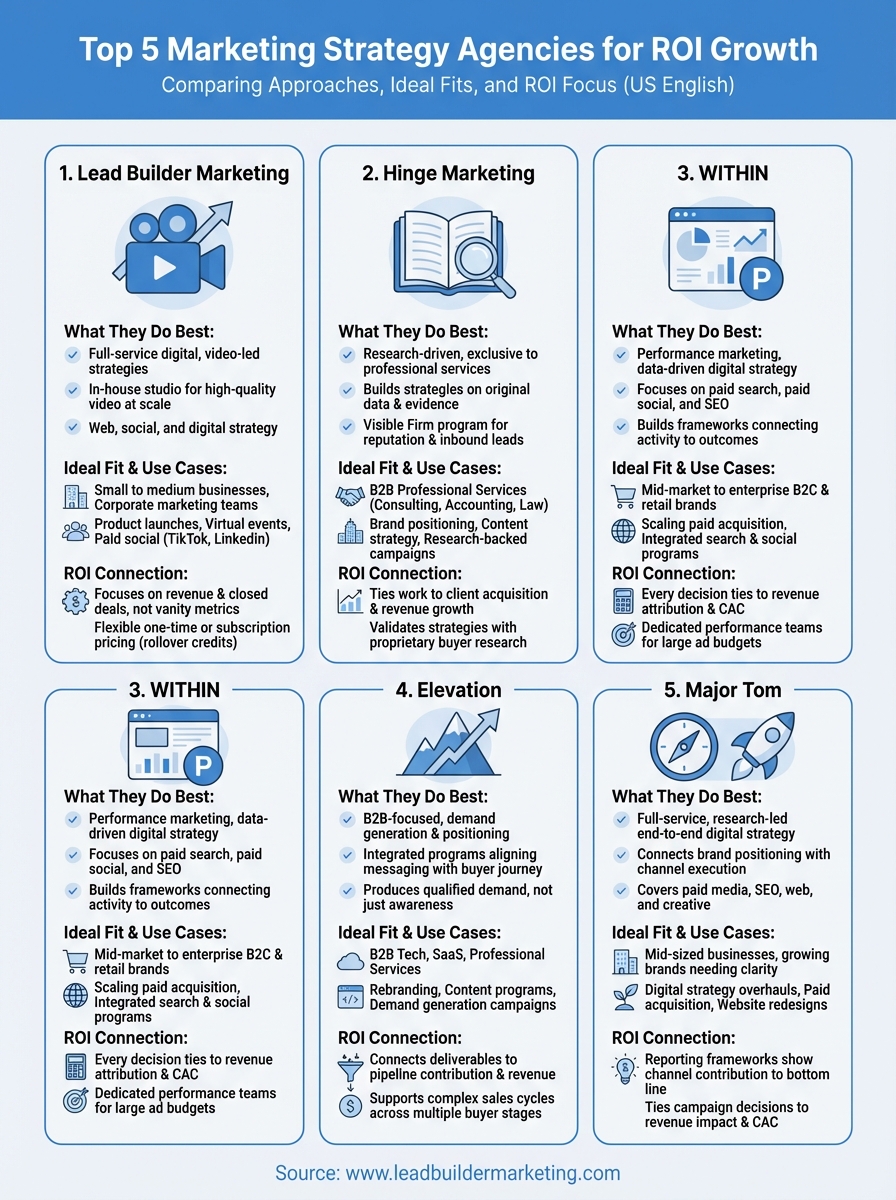
1. Lead Builder Marketing
Lead Builder Marketing is a full-service digital marketing and video production agency based in the Dallas-Fort Worth area, backed by over 30 years of experience and a portfolio of 850+ completed projects. The agency operates out of a professional studio in Plano, TX, and works with clients nationally on web, social, and digital strategy.

What they do best
Lead Builder Marketing specializes in video-led marketing strategies built around lead generation. Their in-house studio handles multi-camera shoots, podcast production, motion design, and animation, giving your brand a consistent, high-quality visual presence without requiring you to build any infrastructure of your own.
Ideal fit and common use cases
This agency is the strongest fit for small to medium-sized businesses and corporate marketing teams that need professional video content at scale. Common use cases include product launches, ongoing content subscriptions, virtual events, and paid social ad campaigns targeting customer acquisition on platforms like TikTok, Instagram, and LinkedIn.
How their strategy connects to ROI
Lead Builder Marketing positions itself as a results-driven marketing strategy agency focused on revenue, not vanity metrics. Every campaign ties back to lead generation and closed deals, not follower counts or impressions that never show up in your bottom line.
If your current agency measures success in likes and reach rather than leads and revenue, you’re paying for the wrong outcomes.
Pricing and engagement model
You can engage Lead Builder Marketing on a one-time project basis or through a monthly subscription plan that allows unused production credits to roll over. That flexibility keeps your marketing budget productive even when your calendar shifts unexpectedly.
Best questions to ask before you sign
Ask how they attribute leads back to specific campaigns and which metrics define a successful engagement. Also confirm how the rollover credit system works in practice, so there are no surprises when production timelines move.
2. Hinge Marketing
Hinge Marketing is a research-driven marketing strategy agency that focuses exclusively on professional services firms, including consultancies, accounting practices, engineering companies, and law firms. Based in the Washington, D.C. area, they bring a data-first approach that sets them apart from generalist agencies.
What they do best
Hinge conducts original research on high-growth firms to build strategies grounded in evidence rather than assumptions. Their Visible Firm program helps professional services companies grow reputation and inbound leads through structured thought leadership.
Ideal fit and common use cases
This agency works best for B2B professional services companies looking to grow through expertise-based marketing. Common use cases include brand positioning, content strategy, and research-backed campaigns built to attract high-value clients over time.
How their strategy connects to ROI
Hinge ties its work to client acquisition and revenue growth, using proprietary research to validate what actually resonates with buyers in your specific sector.
If you sell expertise, your marketing needs to demonstrate it before a prospect ever calls you.
Pricing and engagement model
Hinge offers project-based and retainer engagements, with pricing that reflects the depth of research and strategy work involved.
Best questions to ask before you sign
Ask how they use research to shape your specific strategy and what measurable outcomes past clients in your industry have achieved.
3. WITHIN
WITHIN is a performance marketing agency headquartered in New York, with a strong focus on data-driven digital strategy. They work primarily with large consumer brands and retailers looking to scale paid media and full-funnel marketing programs.
What they do best
Their work centers on paid search, paid social, and SEO for brands with significant ad budgets. The team builds performance frameworks that connect campaign activity directly to measurable revenue outcomes.
Ideal fit and common use cases
This agency fits mid-market to enterprise brands in retail, e-commerce, and consumer goods. Common use cases include scaling paid acquisition channels and building integrated digital programs across search and social platforms.
How their strategy connects to ROI
WITHIN positions itself as a marketing strategy agency built around performance data. Every campaign decision ties back to revenue attribution and customer acquisition cost.
If your growth depends on paid media efficiency, having a team that lives inside the data makes a measurable difference.
Pricing and engagement model
Retainer-based engagements are the standard model here, and they typically work with brands that carry larger marketing budgets and need dedicated performance teams.
Best questions to ask before you sign
Ask how they handle attribution across multiple channels and what specific performance benchmarks they use to define a successful engagement.
4. Elevation
Elevation is a B2B-focused marketing strategy agency with expertise in demand generation and brand positioning for companies selling to other businesses. They work across industries with a structured approach that connects brand strategy to measurable pipeline results.
What they do best
Elevation builds integrated B2B marketing programs that combine brand development with targeted lead generation campaigns. Their team focuses on aligning messaging with the buyer journey to produce qualified demand rather than surface-level awareness.
Ideal fit and common use cases
Their strongest clients are B2B companies in technology, SaaS, and professional services. Common use cases include rebranding projects, content programs, and demand generation campaigns designed to fill sales pipelines consistently over time.
How their strategy connects to ROI
Their team connects every deliverable back to pipeline contribution and revenue impact, making them a strong choice when your sales cycle is complex and needs marketing support across multiple buyer stages.
If your buyers take weeks or months to decide, your marketing needs to carry them through each stage, not just generate a single click.
Pricing and engagement model
Retainer agreements are the standard engagement model here, with project-based options available for defined work like rebrands or campaign launches.
Best questions to ask before you sign
Ask how they measure pipeline contribution from marketing activity and what reporting cadence they use to keep your team aligned on results.
5. Major Tom
Major Tom is a full-service marketing strategy agency with offices in Vancouver, New York, and Toronto. They take a research-led approach to building integrated digital programs for brands that need clarity on where to focus their growth efforts.
What they do best
Their team builds end-to-end digital strategies that cover paid media, SEO, web development, and creative. Major Tom connects brand positioning with channel execution, so your campaigns stay consistent from the first impression to the final conversion.
Ideal fit and common use cases
This agency works best with mid-sized businesses and growing brands looking to consolidate fragmented marketing efforts. Common use cases include digital strategy overhauls, paid acquisition programs, and website redesigns tied to measurable growth goals.
How their strategy connects to ROI
Every campaign decision Major Tom makes ties back to revenue impact and customer acquisition cost. Their team builds reporting frameworks that show exactly what each channel contributes to your bottom line.
If your marketing feels scattered with no clear throughline, a structured agency partner can bring the whole picture into focus.
Pricing and engagement model
They work on retainer and project-based models depending on scope, and their pricing reflects the depth of strategy work involved upfront.
Best questions to ask before you sign
Ask how they prioritize channels for your specific business and what timeline you should expect before seeing measurable results from the engagement.
Your next move
Each agency on this list takes a different approach, so the right pick depends on what your business actually needs right now. If you’re a B2B professional services firm, Hinge or Elevation may fit your pipeline goals well. If you run a consumer brand with a serious paid media budget, WITHIN or Major Tom could be the stronger match for your situation.

But if you need a marketing strategy agency that connects video production directly to lead generation, and you want a flexible engagement model that keeps your budget productive even when timelines shift, Lead Builder Marketing is worth a direct conversation. With 850+ completed projects and over 30 years of industry experience, the team focuses entirely on measurable outcomes rather than metrics that never show up in your revenue.
Visit Lead Builder Marketing to learn how a results-driven strategy can start moving your actual sales numbers in the right direction.

I spent last night downloading LM Studio and running a 7-billion parameter language model on my laptop. No subscription. No data leaving my machine. No $20 monthly fee to OpenAI.
It worked.
I’ve seen this movie before. In 2000, I bought a Digi 001 and a G3 Mac. That combination cost me about $3,500 and turned my spare room into a recording studio. Before that moment, making a professional-quality recording meant booking time at a facility with a $750,000 SSL console, paying $2,000 per day, plus another $500 for Pro Tools, plus $200 for a certified engineer.
Those studios collapsed. Not because the technology got better in the expensive facilities – it did. They collapsed because the technology got good enough everywhere else.
I’m watching the same pattern emerge in AI, and it’s happening faster than most people realize.
The Infrastructure Trap
AI companies are building data centers that cost hundreds of billions of dollars. They’re following the same playbook recording studios used – massive capital investment in centralized infrastructure, betting that the barrier to entry stays high.
But running AI locally requires only 16GB of RAM, a modern processor, and 50GB of storage. That’s not exotic hardware. That’s a three-year-old laptop.
The expensive infrastructure isn’t creating a moat anymore. It’s creating exposure.
What Changed Overnight
Hugging Face now hosts 10 million users and 600,000 models. Most of them are free. You can download a model, run it on your machine, and never send your data to anyone.
I tested this with practical queries – recipe generation, email drafting, travel planning. The local model handled everything I’d normally ask ChatGPT to do. The responses came back in seconds. The quality was comparable.
More importantly, my business contracts, financial data, and client information never left my device.
That privacy advantage isn’t minor. When you use cloud AI, you’re training someone else’s system with your proprietary information. You’re feeding your competitive intelligence into a model your competitors might query tomorrow.
The Real Winners
If AI software becomes free and distributed, the value shifts to hardware. Apple benefits when people need more powerful Macs to run local models. Nvidia benefits when everyone needs better chips. Google benefits when Android devices become AI-capable.
The companies building the data centers? They’re carrying the same burden recording studios carried – massive fixed costs in a world moving toward distributed production.
I’m not saying cloud AI disappears. Recording studios still exist for specialized work. But the everyday use cases – the queries that generate subscription revenue – those migrate to local machines once people realize the capability exists.
I figured this out in one evening. If a 64-year-old guy can download LM Studio and run AI locally without technical background, the barrier has already fallen.
The question isn’t whether this disrupts the current AI business model. The question is how fast people realize they don’t need to keep paying for something they can run themselves.
I’ve seen this pattern play out before. The technology that seemed impossible to replicate becomes accessible. The expensive infrastructure becomes a liability. The market shifts faster than the incumbents can adapt.
We’re at that inflection point right now. And I’m betting on the pattern repeating.
Most businesses publish content and hope something sticks. A blog post here, a social media carousel there, maybe even a webinar nobody attends. The problem isn’t effort. The problem is that content marketing for lead generation requires a system, not a scattershot approach. Without a clear strategy connecting each piece of content to an actual conversion path, you’re just adding noise to the internet.
Here’s what we’ve learned across 850+ projects at Lead Builder Marketing: content that generates leads looks fundamentally different from content that generates applause. Likes and shares feel good, but they don’t fill your pipeline. The businesses we work with, service companies, B2B teams, growing brands in DFW and beyond, come to us because they’re tired of marketing that can’t prove its worth. They want content tied directly to revenue.
This guide breaks down exactly how to build a content marketing strategy that attracts the right prospects and moves them toward a buying decision. We’ll cover the formats that actually convert, from video and blog content to lead magnets and webinars, along with the distribution tactics and measurement frameworks that separate real lead generation from wishful thinking. Whether you’re starting from scratch or trying to fix a strategy that’s underperforming despite consistent output, you’ll walk away with a concrete plan you can act on this quarter.
What content marketing for lead generation means
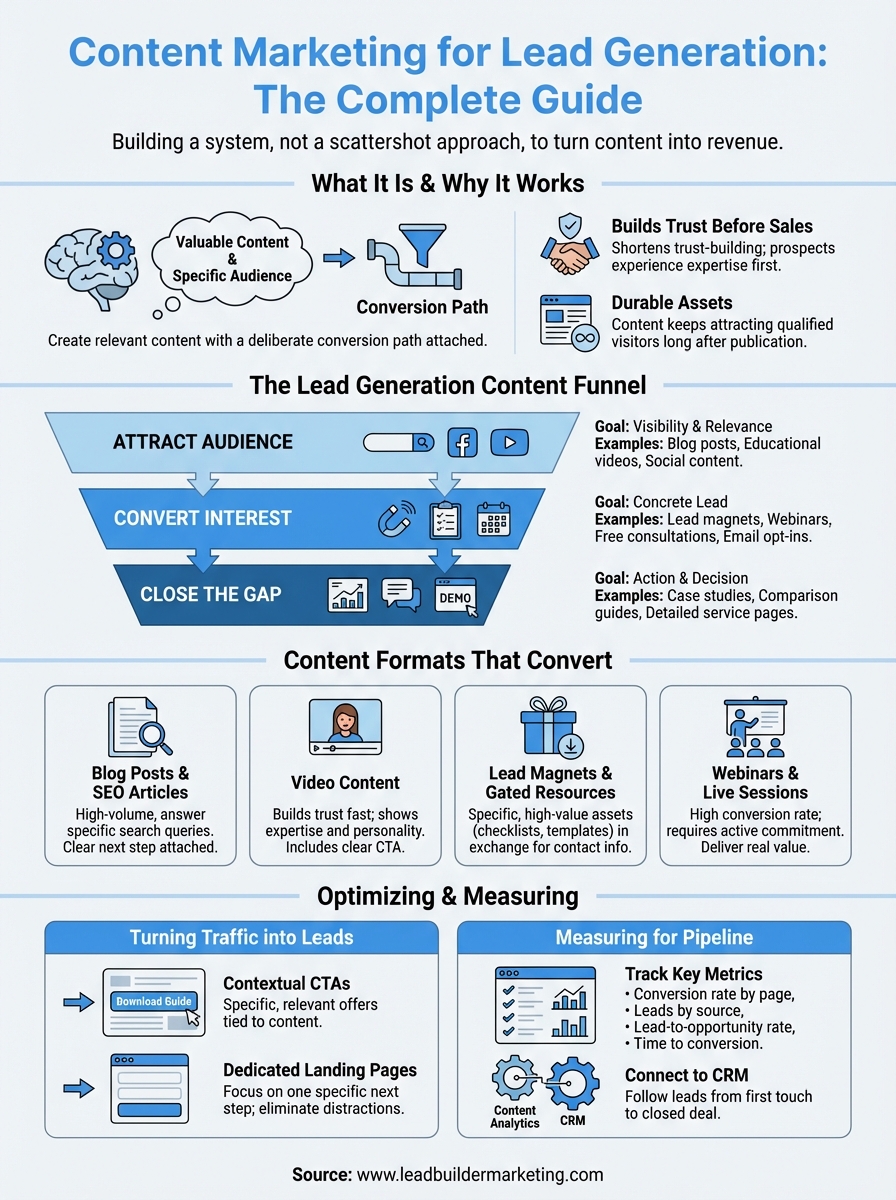
Content marketing is the practice of creating and distributing valuable, relevant content to attract a specific audience. When you add "for lead generation" to that definition, the goal sharpens considerably. You’re not just building awareness or earning goodwill. You’re creating content with a deliberate conversion path attached to every piece, one that ends with a prospect sharing their contact information or taking a concrete step toward becoming a customer.
Content marketing for lead generation treats every blog post, video, or webinar as a step in a sales conversation, not just a broadcast.
What counts as a lead
A lead is any person who has shown enough interest in your business to exchange something of value, usually their contact information, for something you offer. That exchange is the moment content marketing crosses from brand building into pipeline building. Until that exchange happens, you have an audience member, not a prospect. Your content strategy needs to create the conditions for that exchange repeatedly and at scale.
There’s an important distinction between a marketing-qualified lead (MQL) and a sales-qualified lead (SQL). An MQL has engaged with your content and fits your target profile but hasn’t signaled purchase intent yet. An SQL has taken a more direct action, like requesting a demo, booking a call, or asking for pricing. Good content marketing moves people from one stage to the other without requiring your sales team to do all the heavy lifting.
How content marketing differs from traditional advertising
Traditional advertising puts your message in front of people whether they asked for it or not. Content marketing for lead generation works the opposite way. You create content that people actively seek out because it answers a question they already have or helps them make a decision they’re already considering. By the time a prospect finds you through content, they’ve already self-selected as relevant to your business.
This pull-based model has a compounding effect that paid ads simply don’t. A well-optimized blog post or video keeps attracting qualified visitors for months or years after you publish it. A paid ad stops the moment you stop funding it. Leads you generate through content cost less over time because the content asset keeps earning long after the initial production cost is paid back.
What makes content "lead generation content" specifically
Not all content is built to generate leads. A viral social post might get thousands of views and produce zero pipeline. Lead generation content is specifically designed with a next step in mind. That next step might be downloading a guide, signing up for a webinar, scheduling a consultation, or subscribing to a newsletter. Every piece of content you create should have a clear, low-friction conversion action attached to it that matches where the reader is in their buying journey.
That doesn’t mean every piece needs to feel like a hard sell. In fact, the best lead generation content rarely feels like marketing at all. It feels like genuinely useful information. But underneath that useful information sits a structured system that captures interest, builds trust, and routes the right people toward a conversation with your team at the right moment.
Why content marketing works for lead generation
Content marketing works because it meets people at the exact moment they’re already searching for answers. When someone types a question into Google that your business can answer, your content becomes the first touchpoint in a relationship that can lead directly to a sale. Paid advertising interrupts people mid-scroll. Content earns their attention voluntarily, which means the leads you generate through content already have a reason to trust you before you ever speak to them directly.
It builds trust before the sales conversation starts
Trust is the single biggest barrier to converting a stranger into a customer. People don’t hand over their contact information or budget to companies they’ve never encountered. Content marketing for lead generation shortens the trust-building timeline by giving prospects a chance to experience your expertise before any money changes hands. A well-written guide or an in-depth video demonstrates real competence in a way that a sales pitch simply cannot replicate.
The leads who arrive through content have already decided you know what you’re talking about, which makes every subsequent conversation shorter and easier to close.
When you consistently publish content that helps your target audience solve real problems, you stop being a vendor in their mind and start being a trusted resource. That shift in perception is what separates businesses with strong conversion rates from those that rely entirely on cold outreach to fill their pipeline.
It creates durable lead generation assets
A single piece of well-optimized content can pull in qualified leads for years after you publish it. That’s fundamentally different from how paid advertising works. When you stop paying for an ad, the lead flow stops immediately. When you invest in a blog post, a video, or a detailed how-to guide, the asset keeps working independently of your ongoing budget.
This durability matters especially for service businesses and B2B companies where the sales cycle stretches over weeks or months. A prospect might read your article today, bookmark it, and return three months later when their budget opens up, ready to buy. Your content kept the relationship alive without any manual effort from your team. Over time, a library of strong content assets compounds into a pipeline that becomes less dependent on paid channels and more self-sustaining quarter over quarter.
How the lead generation content funnel works
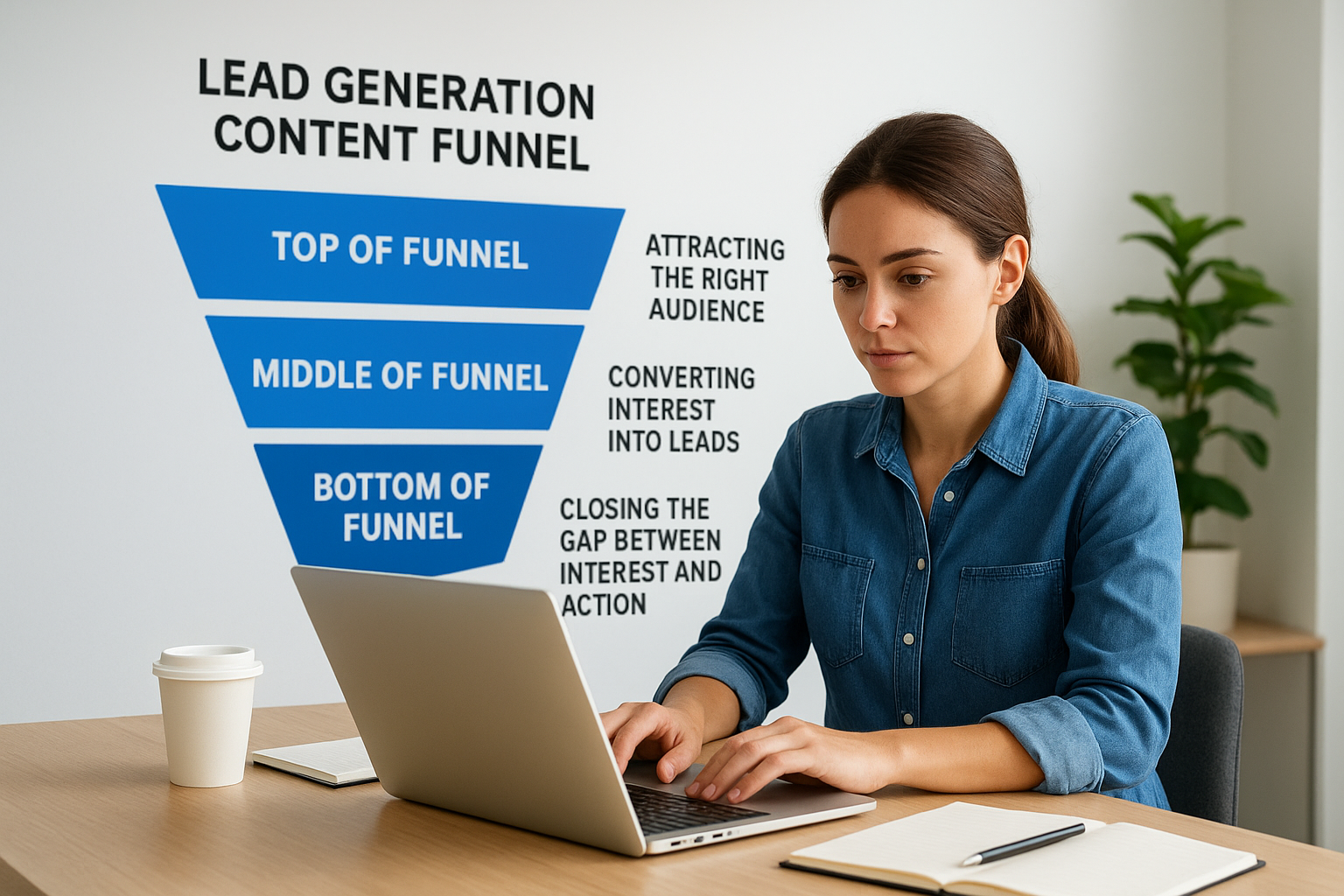
Most people think of content as a single touchpoint. In reality, content marketing for lead generation works across three distinct stages, each one designed to meet a prospect at a different point in their decision-making process. Understanding which stage your content belongs to changes how you write it, what action you attach to it, and how you measure whether it’s working.
Top of funnel: attracting the right audience
Top-of-funnel content targets people who have a problem or question but aren’t yet looking for a specific solution. Blog posts that answer common search queries, educational videos, and social content all fit here. The goal is visibility and relevance, not a sales pitch. Your job at this stage is to show up when someone types their frustration into a search bar and give them something genuinely useful in return.
The top of the funnel isn’t where you close deals. It’s where you earn the right to keep the conversation going.
Middle of funnel: converting interest into leads
Once someone knows your brand exists and trusts that you understand your subject, the middle of the funnel turns that awareness into a concrete lead. This is where lead magnets, webinars, free consultations, and email opt-ins live. You’re asking for contact information in exchange for something that delivers immediate, specific value, like a checklist, a video series, or access to a live training session. The exchange has to feel fair, which means the offer needs to solve a real, specific problem your audience already knows they have.
The quality of your middle-of-funnel content determines whether your pipeline fills with qualified prospects or random contacts who never convert. A strong offer attracts people who are genuinely considering a solution like yours. A weak or generic offer attracts everyone and converts no one.
Bottom of funnel: closing the gap between interest and action
Bottom-of-funnel content speaks directly to people who are close to making a decision. Case studies, comparison guides, detailed service pages, and testimonial videos all belong here. These pieces address the specific objections and questions a prospect has right before they commit. At this stage, your content should make the next step obvious and low-risk, whether that’s booking a call, requesting a proposal, or watching a demo. Every word should reduce friction, not add to it.
How to choose topics that attract qualified leads
Topic selection is where most content strategies quietly fail. Businesses pick subjects that feel interesting, chase trending headlines, or copy whatever competitors are writing about, and then wonder why their content brings in traffic that never converts. The right topic for content marketing for lead generation isn’t the one with the highest search volume. It’s the one your ideal buyer is actively searching for right before they’re ready to spend money.
Start with the questions your buyers already ask
Your sales team is sitting on the most valuable topic research available to you. Every question a prospect asks during a discovery call, every objection that comes up before a contract is signed, and every hesitation that slows down a deal is a content topic waiting to be written. These questions represent real, active demand from people who are already considering a purchase.
The questions that slow down your sales process are exactly the topics your content should answer first.
Start by pulling a list of the ten most common questions your team hears from prospects. Then look at what people type into Google using a tool like Google Search Console if you already have site traffic. You want topics where the searcher’s intent is clearly commercial, meaning they’re looking for a solution, comparing options, or trying to justify a decision, not just satisfying idle curiosity.
- "How much does [your service] cost?"
- "What’s the difference between [option A] and [option B]?"
- "How do I know if I need [your service]?"
- "What should I look for in a [provider type]?"
These question-based topics pull in prospects who are already in buying mode, which is exactly the audience you want landing on your site.
Check whether the topic attracts buyers or browsers
Not every topic that draws traffic builds your pipeline. A high-traffic topic aimed at beginners who will never become customers wastes your production time and clutters your analytics. Before you commit to a topic, ask yourself who specifically would search for this and whether that person has a budget problem you can solve.
One reliable test: imagine the person who types that search query. Are they a business owner trying to fix a real operational issue, or are they a student doing research? If you can’t picture a qualified buyer on the other side of that search, move to a different topic. Traffic from the wrong audience has zero conversion value regardless of how well the content performs.
Content formats that generate leads
Not every content format earns its place in a lead generation strategy. Some formats build awareness efficiently. Others convert that awareness into pipeline. The most effective approach to content marketing for lead generation uses a mix of formats that work at different stages of the funnel, each matched to what your buyer needs at that moment.

Blog posts and SEO-optimized articles
Blog posts are your highest-volume top-of-funnel asset when written with search intent in mind. A well-optimized article targeting a specific question your buyer types into Google brings in qualified traffic consistently over time, without ongoing ad spend. The key is writing posts that answer a real question completely, then attaching a clear next step at the end, whether that’s downloading a related resource or booking a consultation.
Treat every blog post as a landing page with a job to do, not just a publishing exercise.
Video content
Video builds trust faster than any other format because it shows your actual expertise and personality rather than just describing them. A short explainer video addressing a specific pain point, a behind-the-scenes look at how you deliver results, or a client testimonial in their own words all create credibility that written content struggles to match. Pair your videos with a clear call to action pointing to a lead capture page, and they become a direct pipeline driver rather than just brand content.
Lead magnets and gated resources
A lead magnet is a specific, high-value resource you offer in exchange for contact information. Checklists, templates, detailed guides, and video training series all work well here. The format matters less than the specificity. A generic "ultimate guide" attracts everyone and converts few. A narrowly focused resource that solves one precise problem your ideal buyer has right now will consistently outperform broader content that tries to appeal to a wide audience.
- Checklists your buyer can use immediately
- Templates that replace work they’d otherwise do manually
- Short video series that walk through a specific process
- Calculators or tools that help them size a decision
Webinars and live sessions
Webinars convert at a higher rate than almost any other content format because attendance requires active commitment. Someone who registers for and shows up to a live event has already demonstrated serious interest in the topic. Use the session to deliver real value, not a thinly veiled pitch, and close with a specific offer that makes the logical next step obvious for attendees who are ready to act.
How to turn traffic into leads on your website
Getting traffic to your site is only half the job. The other half is converting that traffic into actual leads, and most websites fail at this step completely. A well-structured conversion path takes someone who landed on your page with a question and gives them a clear, low-friction reason to stay engaged. Without it, even the strongest content marketing for lead generation strategy bleeds qualified prospects out the back door every single day.

Traffic without a conversion path is just an audience you’ll never speak to again.
Make your calls to action specific and contextual
Generic calls to action like "Contact us" or "Learn more" don’t give visitors a reason to act right now. Specific, contextual CTAs tied to what someone just read perform significantly better because they feel like a direct continuation of the content the visitor just consumed. If someone reads a blog post about video production budgets, the right CTA is an offer to download a production cost breakdown or book a budget consultation, not a vague link to your homepage.
Place your CTA in at least two spots: once mid-article after you’ve established real value, and again at the end after the reader has absorbed the full piece. Test both placement and offer copy regularly. Small wording changes can shift conversion rates meaningfully without requiring any additional traffic to your site.
Use dedicated landing pages for lead capture
Sending traffic to your homepage and hoping visitors find the right path on their own is one of the most expensive habits a business can develop. Dedicated landing pages built around a single offer and a single action convert at dramatically higher rates because they eliminate every possible distraction. Every element on the page, the headline, the supporting copy, the form, and the button, should focus on one specific next step and nothing else.
Your landing page form length matters more than most businesses realize. Asking for too much information up front adds enough friction to lose people who were otherwise ready to convert. Start with name and email only, then gather additional qualifying details once you’ve earned the relationship through follow-up. The goal of that first conversion is to start a conversation, not run a complete qualification interview before you’ve delivered anything of value to the person on the other side of the form.
How to nurture leads with email and video
Capturing a lead is the beginning of a relationship, not the end of the process. Most prospects who give you their contact information are not ready to buy immediately, and if you stop communicating after that first exchange, you lose them to competitors who stay in front of them consistently. Effective content marketing for lead generation includes a deliberate nurture sequence that moves leads from initial interest toward a buying decision using email and video as the primary tools.
Build an email sequence that delivers value first
A nurture email sequence is a series of planned messages sent after someone converts on your site or downloads a lead magnet. The goal isn’t to sell on every email. The goal is to keep delivering useful content that reinforces your expertise and keeps your business relevant in your prospect’s mind while their buying timeline matures.
Your first email sets the tone for the entire relationship, so lead with something immediately useful rather than a pitch.
Each email in your sequence should do one specific job: answer a question, introduce a relevant piece of content, share a client result, or address a common objection. Keep the sequence focused on what you know your target buyer cares about based on the topic that originally brought them to you. A prospect who downloaded a guide about video production costs wants to hear about budgeting, timelines, and ROI, not a general overview of every service you offer. Relevance drives engagement, and engagement drives replies, meetings, and sales.
Use video inside your nurture emails
Plain-text emails get opened, but video thumbnails inside emails get clicked at dramatically higher rates because they stand out visually and promise a richer experience than reading another block of text. Embedding a short video, even just two to three minutes, where you address a specific concern your lead likely has creates a personal connection that written content cannot replicate.
Record short, direct videos that speak to one concern per message: how you handle a specific part of your process, what a typical project outcome looks like, or how to evaluate vendors in your category. These don’t require studio-grade production quality to be effective. What they do require is clarity and a clear next step at the end, pointing your viewer toward booking a call or replying with their biggest question. That single action is what separates nurture content that builds pipeline from content that just fills inboxes.
How to measure and optimize lead gen content
Running content marketing for lead generation without tracking the right numbers is the same as running a sales team without a CRM. You’re doing real work with no way to know what’s actually paying off. Measurement isn’t the final step in your content process. It’s the feedback loop that tells you where to invest more and where to stop wasting time and budget.
Track the metrics that connect content to pipeline
Most content teams default to traffic and page views as their primary success indicators, which tells you almost nothing about whether your content is generating revenue. The metrics that actually matter are the ones that tie directly to lead volume and quality. Focus on these instead:
Metric What it tells you Conversion rate by page Which content pieces are turning visitors into leads Leads by source Which channels and topics are driving the most qualified contacts Lead-to-opportunity rate Whether the leads your content generates are actually sales-ready Time to conversion How long it takes a lead to move from first content touch to a sales conversation If a piece of content drives high traffic but zero conversions, it’s an audience asset, not a pipeline asset, and your strategy should treat it differently.
Tracking these numbers requires connecting your content analytics to your CRM so you can follow a lead from the blog post or video that first brought them in all the way through to a closed deal. Without that connection, you’re measuring output instead of outcomes.
Optimize based on what the data actually shows
Once you have the right data, optimization becomes specific instead of speculative. Start with your highest-traffic pages that convert at below-average rates. These are your biggest leverage points because the audience is already there. A stronger CTA, a more relevant lead magnet, or clearer next-step language can lift conversion rates on existing traffic without requiring you to publish anything new.
Run one change at a time on each page so you can isolate what actually moved the needle. Testing headline copy, CTA placement, and offer type separately gives you clean data to act on. Once a page is converting well, document what worked and apply the same principles to new content from the start rather than waiting to fix underperformance after the fact. That’s how a content library compounds into a lead generation engine that gets more efficient over time instead of just larger.
Common mistakes that kill lead generation
Even businesses that invest heavily in content marketing for lead generation end up with a pipeline that doesn’t grow. The reason is rarely a lack of content. It’s almost always a handful of recurring, fixable mistakes that break the conversion path before a lead ever has a chance to form.
Publishing content without a conversion path
The single most common mistake is creating content that educates readers and then lets them leave with no clear next step. Every piece of content you publish needs a specific, relevant offer attached to it that gives the reader a reason to exchange their contact information for something of greater value. Without that offer, even your best-performing traffic just bounces.
Content without a conversion path is brand building with none of the pipeline benefit.
You don’t need a hard sell on every page. What you do need is a clear, contextual CTA that feels like a natural continuation of what the reader just consumed. A blog post about video production ROI should end with an offer tied to measuring production results, not a generic contact link that gives your visitor no reason to act right now.
Targeting search volume instead of buyer intent
Chasing high-volume keywords that attract beginners, students, or casual researchers might grow your traffic numbers, but it won’t grow your pipeline. When your content topics don’t match the questions your actual buyers ask before making a purchase decision, the leads your strategy produces either never convert or take years to get anywhere near a sale.
Focus instead on topics where the searcher’s intent is clearly commercial. Questions about pricing, comparisons between options, and "how do I know if I need this" searches come from people who are already close to buying. Those topics may attract less traffic than broad educational posts, but the traffic they bring converts at a fraction of the effort and a much higher rate.
Letting leads go cold after the first conversion
Capturing a lead and then failing to follow up consistently is one of the most expensive habits in content marketing. Most prospects aren’t ready to buy immediately, and a gap in your nurture sequence is all it takes for a competitor who communicates more regularly to close a deal you generated. Build a structured follow-up sequence before you launch any lead magnet or gated resource, so every new contact enters a path that keeps your business relevant until their buying timeline catches up.
Next steps
You now have a complete picture of how content marketing for lead generation works, from choosing topics that attract buyers to measuring which content pieces are actually driving pipeline. The system only produces results when you put it into motion. Start by identifying the three most common questions your prospects ask before they buy, then build one piece of content around each question with a specific conversion offer attached.
From there, set up a simple email nurture sequence and connect your content analytics to your CRM so you can track leads from first touch to closed deal. That connection is what separates a content strategy that grows your business from one that just fills your publishing calendar. If you want experienced help building this kind of system from the ground up, talk to the team at Lead Builder Marketing and find out what a results-driven content strategy looks like in practice.
Your Google Business Profile manager dashboard is the control center for how your business appears in local search results and Google Maps. If customers can’t find accurate hours, photos, or contact info when they search for you, you’re losing leads before they ever reach your website.
At Lead Builder Marketing, we help businesses across the DFW area and beyond turn their digital presence into an actual sales engine. That starts with the basics, and few things are more basic (or more overlooked) than keeping your Google Business Profile updated and optimized. We’ve seen firsthand how a well-managed profile drives phone calls, direction requests, and qualified leads straight to your door.
This guide walks you through how to access the Google Business Profile manager, what each feature does, and how to use it so your listing works harder for your business.
What Google Business Profile Manager is now
Google retired the Google My Business app in 2022 and folded all management features directly into Google Search and Google Maps. The standalone dashboard at business.google.com still exists as a backup option, but for most owners today, the fastest way to reach your google business profile manager is to search your business name while signed in to your Google account and click "Edit profile" in the search results panel. This single change removed the need to juggle a separate app just to update your hours or swap out a photo.
If older guides still reference "Google My Business," that product no longer exists as a standalone app. Everything now runs inside Google’s own search and maps products.
What changed with the rebrand
The shift from Google My Business to Google Business Profile was not just a name change. Google pushed all management tools into Search and Maps so business owners could make quick edits without switching between platforms. You can now update your hours, reply to reviews, and publish posts directly from a standard search results page without logging into a separate product.
Old experience (Google My Business) New experience (Google Business Profile) Separate mobile app required Managed in Google Search or Maps Standalone dashboard only Dashboard at business.google.com App available on iOS and Android App discontinued in 2022 What you actually control here
Your profile covers every piece of information Google displays about your business in local results: name, address, phone number, hours, website, photos, products, services, and customer reviews. Beyond the basic details, you also manage how you respond to reviews and answer customer questions, publish updates, and track how many people clicked your website, called your number, or asked for directions. Each of those actions feeds the signals Google uses to rank local listings.
Step 1. Find the official access points and sign in
Before you can manage anything, you need to reach the right place. Google gives you three official access points to open your google business profile manager, and each one requires that you sign in with the Google account tied to your business listing.
The three official access points
Pick whichever option fits your workflow. All three land you in the same management interface.

Access point How to get there Google Search Search your business name while signed in, then click "Edit profile" Google Maps Find your listing in Maps, tap your profile photo, then select "Your Business Profiles" Business dashboard Go to business.google.com and sign in The Google Search method is the fastest for quick edits like updating hours or posting a new photo.
Sign in with the right account
This step trips up more business owners than you might expect. Your profile connects to one specific Google account, and signing in with a personal Gmail instead of your business account will show you nothing. Check which email address your profile uses by visiting business.google.com and reviewing the account listed in the top-right corner. If you see the wrong account, switch users before making any changes.
Step 2. Claim, verify, and fix ownership issues
Before you can edit anything, Google needs to confirm you own or represent the business. If your business appears in search results but was never claimed, or if someone else claimed it first, you need to resolve that before the google business profile manager unlocks full editing access for you.
How to claim and verify your listing
Search your business name while signed in, then click "Own this business?" on an unclaimed listing. Google walks you through a verification process using one of these methods:
- Postcard by mail: Google sends a PIN to your address (5-7 business days)
- Phone or text: Google calls or texts your listed number with a PIN
- Email: A code sent to a verified business email
- Video verification: A short walkthrough of your location
- Live video call: A Google agent verifies your identity in real time
Fixing ownership conflicts
If another person already owns your listing, click "Request access" in the search results panel and complete the short form. The current owner receives an email and has seven days to respond. If they don’t reply, Google automatically transfers access to you.
Keep your verification PIN private. Anyone with that code can take control of your listing.
Step 3. Add managers and set the right permissions
You should never share your primary Google account login with an employee or agency just so they can update your listing. The google business profile manager lets you add team members with defined permission levels, so each person gets only the access they actually need.
How to add a manager
Open your profile by searching your business name, click "Business Profile settings," then select "Managers." From there, hit the person-plus icon, enter the email address of the person you want to add, choose their role, and click "Invite." They will receive an email and must accept before access is granted.
Invited managers must accept using the same Google account you sent the invitation to, so confirm their email address before sending.
Permission levels explained
Google gives you three roles to choose from when adding someone to your profile. Pick the one that matches what that person actually needs to do.

Role What they can do Owner Full access, including removing other managers and deleting the profile Manager Edit profile details, respond to reviews, and post updates Site Manager Limited editing access, cannot manage users or delete the profile Step 4. Optimize and maintain your profile weekly
Claiming your profile is only the start. The google business profile manager rewards active listings, meaning Google gives more visibility to businesses that update their information regularly, upload fresh photos, and respond to reviews. If you leave it untouched after setup, your listing will quietly slide down local rankings over time.
What to update each week
Spend 10 to 15 minutes each week on the tasks below. Consistent small actions compound into stronger local rankings over several months.
- Reply to all new reviews, both positive and negative, within 48 hours
- Post one update or offer to keep your profile active in Google’s eyes
- Confirm your hours are accurate, especially around holidays or schedule changes
- Upload at least one new photo of your team, work, or location
What improves your ranking
Google uses three main factors to rank local listings: relevance, distance, and prominence. You control relevance and prominence directly through your profile. Fill in every available field, use your actual service keywords in the business description, and build a steady stream of verified customer reviews to signal authority to Google.
Profiles with more than 10 photos receive significantly more clicks and direction requests than listings with fewer images.

Your simple upkeep plan
The google business profile manager is not a set-and-forget tool. Your listing needs consistent, small actions every week to maintain visibility and keep customers coming to you instead of a competitor. Block 15 minutes on your calendar each week to reply to reviews, upload a fresh photo, and confirm your hours are still accurate. Over 90 days, that habit builds a profile that Google treats as active and trustworthy.
Treat your profile like a front door to your business. Customers check it before they call, before they visit, and before they buy. An outdated listing with no recent photos or unanswered reviews sends the wrong signal at the exact moment someone is ready to take action.
If you want a team that handles the full picture, from your Google presence to lead-generating video and digital campaigns, talk to Lead Builder Marketing about what a results-driven strategy looks like for your business.
Your Google Business Profile is one of the first things potential customers see when they search for services like yours. If it’s incomplete, outdated, or poorly managed, you’re handing leads to your competitors. A Google Business Profile optimization service can fix that, but picking the wrong one can waste your budget and leave you stuck with the same results.
The problem is that dozens of agencies and freelancers offer this service, and they’re not all built the same. Some focus on surface-level tweaks. Others deliver measurable improvements in local search visibility that actually drive calls, form fills, and foot traffic. Knowing the difference before you sign a contract matters, a lot.
At Lead Builder Marketing, we’ve spent over 30 years helping businesses in the DFW area and beyond turn their digital presence into a reliable lead generation engine. That experience taught us exactly what separates a good optimization partner from a bad one.
This guide breaks down what to look for in a Google Business Profile optimization service, what red flags to avoid, and how to make a decision that actually moves the needle for your local search performance.
What a GBP optimization service should do
A Google Business Profile optimization service should do more than just fill in your business name and hours. The right provider treats your profile as a living marketing asset that needs consistent attention, accurate data, and strategic content to compete in local search results.
Core profile setup and accuracy
Before anything else, a provider should audit your existing profile and fix the foundation. That means verifying your NAP consistency (name, address, phone number) across your profile and other directories, selecting the correct primary and secondary business categories, and writing a keyword-rich business description that tells searchers what you do and where you operate. These elements directly affect how Google decides to surface your listing.
Choosing the wrong business category is one of the most common GBP mistakes, and it can suppress your ranking in searches you should be winning.
A complete setup should include:
- Verified business name, address, phone number, and website URL
- Primary and secondary category selection based on your core services
- Business description with relevant local keywords
- Service and product listings with descriptions and pricing where applicable
Ongoing management and content
Setup alone won’t keep you competitive. A strong service should also handle the ongoing tasks that most business owners skip: publishing regular Google Posts, uploading fresh photos, monitoring and responding to reviews, updating hours for holidays, and managing the Q&A section. Each of these actions signals to Google that your profile is active and relevant, which factors directly into your local pack ranking.

Look for a provider that delivers:
- Weekly or biweekly Google Posts tied to your offers or updates
- Photo uploads showing your team, location, or completed work
- Review responses within 24 to 48 hours of submission
- Monthly reporting on profile views, direction requests, and call clicks
Step 1. Define your goals and baseline
Before you reach out to a single provider, you need to know what you’re trying to achieve and where you currently stand. Walking into a sales call without this information makes it easy for a vendor to set vague targets that don’t align with your actual business needs.
Know what success looks like
Your goals should tie directly to revenue-driving actions, not just profile views. A good google business profile optimization service can improve multiple metrics, but you need to decide which ones matter most to your business before you compare proposals.
Common goals to define upfront:
- Increase calls from your profile by a specific percentage within 90 days
- Rank in the local 3-pack for your top two or three service keywords
- Improve your average review rating from your current score to 4.5 or higher
Pull your current baseline data
Log into your Google Business Profile dashboard and screenshot your current performance metrics before you start any outreach. You want to capture your profile views, search queries driving impressions, call click volume, and direction requests over the past 90 days.
Without a documented baseline, you have no way to measure whether any optimization service actually moved the needle.
Step 2. Vet providers and compare pricing
Once you have your baseline and goals documented, start building a shortlist of candidates. Search for providers who specialize in local SEO rather than general digital marketing, and look for case studies that show actual ranking improvements, not just polished testimonials.
A provider who can’t show you a before-and-after result from a previous client likely can’t guarantee one for you.
What to look for in pricing
Most google business profile optimization service providers charge in one of three common ways: a one-time setup fee, a monthly retainer, or a bundled local SEO package. Each model has tradeoffs you need to understand before committing.

Pricing Model Typical Range Best For One-time setup $300 – $800 New profiles needing a clean foundation Monthly retainer $150 – $600/month Ongoing management and content Bundled local SEO $500 – $1,500/month GBP plus citations and link building Avoid any provider who locks you out of your own profile or requires ownership transfer as a condition of service. You should retain full admin access at all times, regardless of who handles the day-to-day work.
Step 3. Ask for a clear scope and process
Once you have a shortlist, push each provider to explain exactly what they will do, when they will do it, and who is responsible for each task. A reputable google business profile optimization service should hand you a written scope of work before you sign anything. If a provider gets vague when you ask specific questions, that’s a clear signal they don’t have a repeatable process behind their pitch.
A clear scope protects you from paying for work that never gets done or deliverables that weren’t defined before the contract started.
What a solid scope document should include
Your scope document should spell out every deliverable and its delivery timeline in plain language. Providers who run a real operation will have no problem putting this in writing, and most will already have a standard template they use with new clients.
Ask for a scope that covers:
- Which profile elements they will audit and update in the first 30 days
- How often they will publish Google Posts and what the approval process looks like
- Who handles review responses and what the expected turnaround time is
- How they will communicate progress and flag any issues that come up on your listing
Step 4. Set KPIs, reporting, and access
Before your engagement starts, lock in the metrics you will track, how often you will receive reports, and who controls what inside your profile. Skipping this step turns your optimization investment into a guessing game with no clear way to hold anyone accountable when results stall.
Define your KPIs upfront
Your KPIs should connect directly to the goals you defined in Step 1. A quality google business profile optimization service will push back if your targets aren’t realistic, and that response is actually a good sign. Build your tracking list around the metrics available in your Google Business Profile performance dashboard.
Track these four metrics every month:
- Search impressions by query type (direct, discovery, and branded)
- Call clicks and direction requests as lead proxies
- Photo views compared to your competitor averages
- Review count and average rating over time
Protect your profile access
Never hand over ownership of your Google Business Profile to a third-party provider, no matter how their contract is worded.
Keep primary owner access in your own Google account at all times. Grant your provider manager-level access only, which gives them full operational control without the ability to remove you from your own listing. If a provider resists this structure, walk away and move to the next candidate on your shortlist.

Next steps
You now have a clear framework for evaluating any google business profile optimization service before you hand over a dollar. Start by pulling your baseline metrics today, then define two or three specific goals tied to calls, rankings, or reviews. Use those numbers to drive every conversation you have with potential providers.
When you reach out to candidates, bring your scope checklist, your KPI list, and your access requirements in writing. Providers who balk at any of those three items are telling you something important about how they actually operate.
Your Google Business Profile is one of the highest-ROI local marketing assets available to your business right now, and it costs nothing to own. The right service partner makes it work harder for you every single month. If you want a team with a proven track record of building local visibility that drives real leads, contact Lead Builder Marketing to talk through what your profile needs.
I’ve watched the same pattern repeat for years now.
A business hits a growth plateau. Revenue stalls. So leadership does what feels productive—they launch campaigns, post content, run ads, build funnels.
Six months later, they’re back where they started.
The problem is sequencing.
Most businesses skip the one phase that determines whether everything else works—the phase where you actually understand what makes someone buy. I call it Strategy First.
The Expensive Mistake Hiding in Plain Sight
Here’s what I’ve observed: businesses treat strategy like optional decoration. Something you do after you’ve already started running.
Strategy feels abstract by comparison. It’s thinking work. Research work. Pattern recognition work. It doesn’t produce a deliverable you can screenshot and post.
Strategic marketing produces a 5.8:1 return on investment compared to just 2.1:1 for tactical-only marketing. For a $50,000 marketing budget, that’s the difference between generating $105,000 versus $290,000 in returns.
That’s not a rounding error. That’s 2.76x performance difference that represents real money.
And yet 84% of CMOs report high levels of strategic dysfunction within their marketing function. The absence of clear strategic direction isn’t an edge case problem. It’s the norm.
What Strategy First Actually Means
Strategy First isn’t about writing a vision statement or defining your mission. It’s not a branding exercise or a positioning workshop.
It’s about understanding the mechanical reality of how your customer makes decisions before you try to influence those decisions.
Specifically, you need to map three things with precision:
Customer triggers — what creates the initial recognition that a problem exists worth solving
Customer objections — what psychological and practical barriers prevent forward movement toward a solution
Customer motivations — what underlying forces drive someone to choose one solution over another, or to choose action over inaction
I’m talking about understanding the actual psychology that governs purchasing behavior in your specific context.
Because 95% of purchasing decisions are made subconsciously. Your customer isn’t evaluating feature matrices. They’re responding to triggers you need to identify and objections you need to address before they articulate them.
Why Tactics Without Strategy Produce Noise
When you skip Strategy First and jump straight to tactics, you’re essentially guessing.
I’ve seen businesses waste months running ads to audiences that were never going to convert because they never identified the actual trigger that creates purchase intent. I’ve watched companies produce content that gets engagement but generates zero revenue because it doesn’t address the core objections preventing conversion.
Your strategist doesn’t understand execution constraints. Your media buyer doesn’t understand psychological barriers. Your content creator doesn’t connect material to actual decision-making mechanics.
Each specialist optimizes in isolation, and the gaps between them is where your money disappears.
The Mechanics of Strategy First
Here’s how this actually works in practice.
You analyze existing customer conversations. You identify language patterns that appear repeatedly. You map objections that surface during sales calls. You track triggers that correlate with purchase timing.
You’re looking for mechanisms—patterns that produce consistent outcomes across variable contexts. Not noise that requires context-specific customization to function.
Once you identify these mechanisms, everything downstream becomes dramatically more efficient.
The result is compression of the cycle between conception and conversion.
What This Looks Like When You Get It Right
I worked with a client who came to me after burning through $80,000 in ad spend with minimal return. They had great creative, solid targeting, competitive offers.
Their messaging focused on features. But when we mapped actual customer triggers, we discovered something different. Their customers weren’t motivated by capability expansion. They were motivated by risk reduction.
The trigger wasn’t “I need more functionality.” It was “I’m afraid of what happens if I don’t solve this problem.”
Once we identified that mechanism, we rebuilt their entire communication architecture around it. Same channels, same budget allocation, completely different strategic foundation.
That’s not because we became better at running ads. It’s because we stopped guessing and started operating from verified understanding.
The Integration Principle
Here’s what I’ve learned after years of pattern observation: you cannot separate strategic conception from execution accountability and expect optimal outcomes.
Strategy First means establishing continuity from insight through implementation. No handoffs. No translation layers. No value leakage.
No handoffs. No translation layers. No value leakage.
Why This Matters More Now
You can’t afford to waste budget on assumptions. You can’t afford coordination loss between strategy and execution.
The businesses that win in this environment are the ones that establish strategic clarity before tactical deployment.
And then—only then—do they build campaigns.
What You Should Do Next
If you’re currently running marketing campaigns, ask yourself this: can you articulate the specific trigger that creates purchase intent for your customer?
Can you list the top three objections that prevent conversion, even when someone is interested?
Can you identify the underlying motivation that makes someone choose you over alternatives, or choose action over inaction?
If you can’t answer those questions with specificity, you’re operating without strategic foundation. You’re making noise instead of resonating.
Strategy First isn’t about adding more process. It’s about establishing the understanding that makes everything else work.
Clarity must precede campaigns—not because it feels responsible, but because the data proves it produces dramatically better outcomes.
If you skip that step, you’re not marketing. You’re just making noise and hoping someone hears it.
Click here to book a free 30 minute discovery session.
I’ve watched the same pattern repeat for years. A business leader calls me, frustrated. They’ve spent thousands on marketing systems. They’ve hired specialists. They’ve built automation. They’ve created content calendars and tracking dashboards.
And nothing works.
The problem isn’t execution. It’s not that they picked the wrong tools or hired the wrong people. The problem is they skipped the foundation entirely and went straight to building the house.
Here’s what I mean.
The Three-Phase Framework Nobody Follows
There are three phases to building marketing systems that actually convert. Most businesses skip the first two and wonder why the third one collapses.
Phase One: Strategic Foundation
This is where you determine what you’re actually trying to accomplish and who you’re trying to reach. Not in vague terms like “grow revenue” or “get more leads.” I mean the specific choices that define what your business does and what it refuses to do.
You identify the gap between how the market currently perceives you and where you need to be positioned. You determine which messages will close that gap. You map the conversion path from first contact to revenue.
This phase has no deliverables. No content. No campaigns. Just decisions.
Phase Two: System Architecture
Once you know where you’re going, you build the infrastructure to get there. This is where you design the communication channels, the content types, the distribution mechanisms, and the feedback loops that will carry your strategic decisions into the market.
You’re not creating content yet. You’re building the production system that will generate the right content consistently. You’re establishing the processes that connect strategic intention to tactical execution without value leakage at every handoff.
Phase Three: Tactical Execution
Only now do you start producing. Writing posts. Recording videos. Running ads. Sending emails. All the visible activity that most businesses mistake for strategy.
When you execute in Phase Three with Phase One and Phase Two underneath it, your tactics compound. When you execute without that foundation, you’re just creating noise.
Why Businesses Skip Phase One
I used to think businesses skipped strategic planning because they didn’t understand its value. After working with dozens of mid-growth companies, I realized the reason is more psychological than logical.
Phase One produces nothing visible.
You can’t show it to your board. You can’t post it on social media. You can’t point to it and say “look what we built.” In a business environment that rewards visible activity, strategic thinking feels like inactivity.
There’s also the urgency trap. When you have a revenue problem, your brain screams for immediate action. Strategy feels slow. Tactics feel fast. So you jump to what appears to solve problems—execution.
The data backs this up. According to Harvard Business School, 90 percent of organizations fail to execute their strategies successfully. But here’s the revealing part: only 28% of executives responsible for executing strategy can list their organization’s top three strategic priorities.
That means 72% of the people supposed to implement your business strategy don’t actually know what it is.
You can’t skip Phase One and expect Phase Three to work. But businesses try it constantly because Phase One requires patience, and patience feels like a luxury when you’re bleeding revenue.
What Happens When You Build Without Strategy
I watched a landscape lighting company spend $3,000 on advertising and get two unqualified leads. They had beautiful creative. They targeted the right demographics. They followed all the tactical best practices.
But they had no strategic foundation. They hadn’t clarified their positioning. They hadn’t identified what actually differentiated them in their market. They just started running ads because ads are what you do when you want leads.
The result was predictable—they attracted people who cared about price, not value. Because their messaging had no strategic anchor, it defaulted to the lowest common denominator.
This pattern shows up everywhere. Businesses create content calendars without knowing what narrative they’re building. They launch email sequences without mapping the psychological journey from stranger to customer. They hire specialists to execute tactics that aren’t connected to any coherent strategic direction.
The cost isn’t just wasted money. It’s wasted organizational capacity.
Nothing kills employee engagement faster than watching initiatives fail repeatedly. When your team sees strategic plans collapse over and over, they stop believing in leadership’s vision. The most talented people—the ones you need most for successful execution—become cynical and disengaged.
I’ve seen this erosion happen in real time. A company launches a new positioning. The sales team gets excited. Marketing creates materials. Everyone aligns around the message.
Then six months later, leadership pivots to a completely different approach because the first one “wasn’t working.” Except it wasn’t the strategy that failed. It was the lack of commitment to see it through the full cycle from conception to market validation.
The team learns the wrong lesson. They conclude that strategy doesn’t matter. So next time, they don’t invest emotionally. They just execute mechanically and wait for the next pivot.
The Structural Problem With Skipping Strategy
Here’s what I’ve observed across enough repetitions to call it a pattern: tactics without strategy create the illusion of progress while preventing actual advancement.
You’re busy. You’re producing content. You’re running campaigns. You’re tracking metrics. But you’re not moving toward a defined competitive position because you never established what that position should be.
Research shows that 67% of well-formulated strategies failed due to poor execution. But I’d argue most businesses don’t even have well-formulated strategies to execute poorly. They have tactical plans dressed up in strategic language.
A real strategy involves clear choices about what you will do and what you won’t do. It requires saying no to opportunities that don’t align with your positioning. It demands consistency over time, even when you’re not seeing immediate results.
Most businesses can’t sustain that level of discipline. So they chase every new tactic. They pivot every quarter. They rebuild their marketing systems annually.
And they wonder why nothing compounds.
How Strategic Foundation Changes Execution
I worked with a client who needed to reach affluent buyers. Their product was premium. Their service was exceptional. But their messaging positioned them as a commodity.
We didn’t change their product. We didn’t rebuild their team. We didn’t even change most of their tactics. We realigned their strategic positioning to match the audience they actually wanted to serve.
The result was a 40% increase in their lead-to-sale conversion ratio. Same team. Same basic marketing channels. Different strategic foundation.
That’s what Phase One does. It changes how every tactical decision gets made. When you know exactly who you’re serving and what gap you’re filling in their perception, your content becomes sharper. Your targeting becomes more precise. Your messaging becomes more resonant.
You stop trying to be everything to everyone and start being the only option for someone specific.
The businesses that win aren’t necessarily the ones with the best tactics. They’re the ones with the clearest strategy that their tactics actually serve.
What Phase One Actually Requires
Building strategic foundation isn’t complicated, but it is uncomfortable. It requires making choices that feel limiting.
You have to identify your actual competitive advantage—not the one you wish you had, but the one you can defend through consistent delivery. You have to determine which segment of the market you can dominate rather than trying to capture everyone. You have to articulate what you won’t do, which means accepting that some opportunities aren’t for you.
This is why most businesses avoid it. Strategy forces clarity, and clarity exposes gaps.
If you can’t articulate your strategic positioning in three sentences, you don’t have one. If your team can’t explain what makes you different without using generic terms like “quality” or “service,” you haven’t done the strategic work.
Phase One also requires temporal thinking. You’re not optimizing for this quarter’s revenue. You’re building the foundation for sustained competitive advantage over years. That’s a different calculation than most tactical decisions allow for.
The Integration Problem
Even when businesses attempt strategic planning, they often separate it from execution. Strategy becomes a document that sits in a drawer while the marketing team runs tactics based on whatever seems to be working this month.
This is the gap I’ve built my entire practice around closing—the artificial separation between strategic conception and tactical execution.
Strategy isn’t something you do once and then hand off to executors. It’s the continuous thread that connects every tactical decision back to your competitive positioning. When that thread breaks, you get the fragmentation that most businesses mistake for diversification.
You end up with a social media presence that says one thing, a website that says another, and sales conversations that contradict both. Not because anyone is incompetent, but because there’s no strategic continuity holding the pieces together.
The solution isn’t better project management. It’s integrated thinking from conception through execution, where the person making strategic decisions understands execution constraints, and the person executing tactics understands strategic intent.
What This Means For Your Next Move
If you’re reading this and recognizing your business in these patterns, you have a choice to make.
You can keep doing what you’ve been doing—jumping to tactics, chasing the next marketing trend, rebuilding your systems every year when they fail to deliver. That path is familiar. It feels like action. It produces visible activity.
Or you can stop. Back up to Phase One. Do the uncomfortable work of defining your actual strategic positioning before you build another system on top of a cracked foundation.
I highly recommend you start by asking three questions:
1. What specific gap in market perception are we trying to close?
Not “we want more revenue.” What is the distance between how prospects currently perceive you and where you need to be positioned to win your ideal clients?2. What choices define what we will and won’t do?
Real strategy requires exclusion. What opportunities will you reject because they don’t serve your positioning?3. How will we maintain strategic continuity from conception through execution?
Who ensures that tactical decisions remain aligned with strategic intent? How do you prevent fragmentation as you scale?These questions don’t have easy answers. That’s the point. If strategy were easy, 90% of organizations wouldn’t fail to execute it.
But the businesses that do this work—that build Phase One before jumping to Phase Three—create compounding advantages that tactical execution alone can never achieve. They don’t just get better results from their marketing. They build systems that elevate their entire organization’s performance ceiling.
That’s the difference between activity and advancement. Between looking busy and actually moving forward.
The three-phase framework isn’t revolutionary. It’s just the logical sequence that most businesses skip because patience feels expensive and tactics feel productive.
But if you want marketing systems that actually work, you have to build them in order.
Strategy first. System second. Execution third.
Everything else is just expensive noise.
We used to optimize for crawlers. Now we’re optimizing for systems that actually read.
ChatGPT doesn’t care about your meta description. Gemini isn’t impressed by keyword density. Google AI Overviews won’t surface your content just because you stuffed the right phrases into your H2 tags.
The game changed when search engines started understanding context instead of just matching strings.
This isn’t a minor algorithm update you can hack around. It’s a structural shift in how information gets retrieved, evaluated, and presented to users. Large language models don’t crawl and index – they synthesize and cite.
That citation mechanism is the new battleground.
What Actually Gets Cited
We’ve been watching this pattern emerge across ChatGPT, Gemini, Copilot, and Google AI Overviews. The content that surfaces shares specific characteristics.
It demonstrates authority through depth, not through claiming authority. It provides complete context instead of optimized fragments. It answers questions humans actually ask, not questions keyword tools suggest.
Most importantly – it’s structured in a way that allows AI systems to extract discrete, verifiable information and attribute it properly.
Your old SEO playbook assumed you were talking to an algorithm. Your new reality requires you to produce work that earns trust from systems designed to evaluate credibility.
The Integration Problem
Here’s where most content strategies fracture. Teams try to optimize for traditional SEO and AI visibility as separate initiatives. Different processes, different standards, different production cycles.
That separation creates exactly the kind of value leakage that kills performance.
Ryan Law, Director of Content at Ahrefs, has been testing a content-first approach that supports both traditional search and AI retrieval simultaneously. Not through duplication – through integration.
The webinar he’s leading cuts through the theoretical noise. How do LLMs actually retrieve information? What evaluation criteria determine whether your content gets cited? Which structural elements increase visibility across both traditional and AI search?
What We’re Building Toward
This isn’t about adapting to a temporary trend. AI-powered search represents a permanent recalibration of how authority gets established and distributed online.
The opportunity exists for teams willing to rebuild their content production around citation-worthiness instead of optimization tricks. The risk compounds for anyone treating this as a secondary consideration.
We’re hosting this session because the gap between understanding this shift and implementing effective response continues to widen. Theory without execution mechanics produces nothing.
The webinar delivers practical guidance – not aspirational frameworks, but testable approaches for creating content that functions in both traditional SEO and AI citation contexts.
Your content either earns trust from systems designed to evaluate credibility, or it doesn’t. There’s no middle position anymore.
The question isn’t whether AI search matters. The question is whether your current content strategy can function in an environment where being citation-worthy determines visibility.

I’ve watched this pattern repeat for two decades.
A company builds something genuinely better. The product works. The engineering is solid. The solution actually solves the problem it claims to solve.
Then they lose to a competitor with an inferior product but professional video.
The buyer never even knew the better solution existed.
The Selection Happens Before You Know You’re Being Evaluated
Here’s what the data shows us about how B2B buying actually works now.
Buyers complete two-thirds of their research before contacting any vendor. The typical journey involves 10+ stakeholders evaluating 4-5 vendors over nearly a year. And buyers initiate vendor contact 80% of the time.
Your solution is being evaluated in your absence.
The assets that exist in that dark funnel determine whether you’re contacted at all. Video operates as your proxy when you’re not in the room.
I’ve seen companies with genuinely superior solutions never make it past this initial filter. The buying committee looked at five options, watched the videos that existed, and moved forward with three. The other two never knew they were being considered and eliminated.
Decision Fatigue Creates Pattern Recognition Shortcuts
The modern B2B buying environment runs on cognitive overload.
74% of B2B buyers report facing too many competing options in their last major purchase. 70% worked with so many different supplier contacts they couldn’t track who everyone was.
When buyers face this level of overwhelm, they default to pattern recognition. Professional presentation signals operational competence. It’s not shallow. It’s survival.
The buying committee doesn’t have time to dig through poorly produced materials to find your technical superiority. They’re making rapid filtering decisions based on what’s immediately apparent.
Production quality differentiates from marketplace clutter. Low production quality creates the problem you’re trying to solve—getting lost in the noise.
Memory Architecture Determines What Survives Committee Discussion
Here’s where the retention asymmetry becomes critical.
Viewers retain 95% of a message when watching video compared to 10% when reading text.
Your technical superiority documented in PDFs creates nearly no memory footprint. Video embeds your solution in the decision-maker’s cognition.
I’ve observed this play out in buying committees. The person who watched your video can articulate your value proposition three weeks later. The person who read your white paper struggles to remember which vendor you were.
When the committee reconvenes to narrow the field, the solutions people remember are the solutions that advance. The ones that created no lasting impression get filtered out.
Internal Circulation Patterns Reveal Format Hierarchy
The format that gets circulated is the format that shapes consensus.
B2B buyers are 44% more likely to share product videos with colleagues internally compared to brochures (18% sharing rate).
Video becomes the artifact that travels through buying committees. Text-based materials die in inboxes.
This circulation pattern matters because B2B decisions require consensus building across multiple stakeholders. The asset that moves through the organization is the asset that builds that consensus.
Your engineering advantage needs a transmission mechanism. Without it, the advantage exists but doesn’t propagate through the decision-making system.
Shortlist Mechanics Operate on Presentation Quality
The selection mechanism operates earlier than most companies realize.
72% of B2B buyers report that vendor video content directly influences their shortlist decisions.
Professional video is a selection mechanism. When evaluating similar solutions, the difference between making the cut and being filtered out often comes down to presentation quality.
I’ve seen this pattern in competitive analysis work. The company with the best product doesn’t always make the shortlist. The company with the best presentation of their product does.
The shortlist is where your competitive advantage either survives or dies. If you’re not on it, your technical superiority becomes irrelevant.
Conversion Velocity Compounds Over Time
The speed at which you move prospects through the pipeline determines how many opportunities competitors have to interfere.
Companies using video marketing grow revenue 49% faster than non-users, with conversion rates jumping from 2.9% to 4.8%.
Faster velocity means fewer opportunities for competitive interference and reduced cost of customer acquisition.
Video functions as a compression mechanism in the sales cycle. It clarifies complex solutions faster than text can. It builds trust more efficiently than documentation. It moves prospects from awareness to consideration to decision with less friction.
The companies that compress this cycle win more deals because they give competitors less time to insert themselves into the conversation.
Complexity Demands Translation, Not More Documentation
The instinct when selling complex B2B solutions is to add more documentation. More technical specs. More detailed white papers. More comprehensive case studies.
This approach fails because complexity doesn’t demand more information. It demands better translation.
70% of B2B buyers engage with video content during purchasing decisions, with 61% reporting video helps them understand complex products better than written materials.
Video functions as the clarification layer that text cannot provide at scale. It shows rather than tells. It demonstrates rather than describes. It makes abstract concepts concrete through visual representation.
I’ve watched companies with genuinely complex, sophisticated solutions struggle to communicate their value through traditional materials. Then they produce one well-structured video that makes the complexity comprehensible, and suddenly prospects understand what they’re buying.
The Presentation Gap Signals Operational Gaps
Here’s the pattern buyers recognize, even if they don’t articulate it explicitly.
If you can’t present your solution professionally, they question whether you can deliver it professionally.
The presentation quality becomes a proxy signal for operational competence. Amateur presentation problems suggest potential execution problems. Professional presentation suggests systematic capability.
This isn’t about superficial polish. It’s about demonstrating that you have the organizational capacity to execute at the level required for enterprise relationships.
Trust enables purchase decisions. Professional video builds that trust by demonstrating competence before the first conversation happens.
Your Product Doesn’t Speak for Itself
The belief that superior products naturally win in the market is a comfortable fiction.
Products don’t speak for themselves. They require translation into formats that buying committees can process, remember, and circulate.Your engineering advantage exists in the technical specifications. But buying decisions happen in the cognitive space of overwhelmed stakeholders trying to make sense of too many options with too little time.
The gap between your product’s capability and the buyer’s perception of that capability is where deals are won and lost.
Professional video closes that gap. It doesn’t replace your technical superiority. It ensures that superiority actually reaches the people making decisions.
The companies that understand this distinction are the ones that make the shortlist, get remembered in committee discussions, and convert prospects at higher rates.
The ones that don’t end up with better products that nobody buys.

We need to talk about what’s happening to lead generation. The numbers coming out of 2024 and early 2025 aren’t just bad – they reveal a structural collapse that most teams haven’t recognized yet.
97% of cold calls now get ignored. Not declined. Ignored. Cold email conversion sits at 0.7%, meaning you need to send 142 emails to close a single customer. Open rates dropped from 36% to 27.7% in one year, with only 8.5% of outreach emails getting any response at all.
These aren’t temporary dips. They’re pattern breaks.
The Coordination Cost Crisis
Here’s what the data actually shows – 80% of marketers admit their lead generation efforts are only “slightly or somewhat effective.” That’s not a performance problem. That’s a system problem.
79% of marketing leads never convert into sales. The primary cause? Lack of effective nurturing. Translation: massive value dissipation between lead acquisition and revenue actualization.
We’ve been watching this play out across dozens of implementations. The issue isn’t effort or ideas. The issue is that campaigns get layered on top of broken infrastructure. When handoffs between teams are misaligned and data lives in disconnected systems, performance becomes unpredictable.
The Buying Cycle Shifted Without Permission
The buying cycle changed so dramatically that traditional playbooks lost their power. 58% of B2B buyers now prefer to engage with sales representatives only after conducting their own research online.
That fundamentally undermines the premise of early-stage outbound interruption tactics.
By 2025, an estimated 80% of B2B sales interactions between suppliers and buyers occur in digital channels. The transaction moved. The trust-building moved. The entire conversion architecture moved.
But most lead generation systems still operate like it’s 2019.
What Actually Works Now
The data points to a clear pattern. Content marketing produces triple the leads of traditional outbound strategies while slashing expenses by 62%. Companies with strong lead nurturing strategies generate 50% more sales-ready leads at 33% lower cost.
That’s not theory. That’s structural competitive advantage through continuity preservation.
90% of buyers say they’re more likely to engage with content from a brand they already know and trust. 88% trust a vendor more when content actually delivers value. The trust has to exist before the transaction attempt.
We’ve seen this pattern repeat across implementations – the teams that build integrated systems connecting strategic conception to execution mechanics consistently outperform fragmented specialist models. Not by 10%. By multiples.
The Integration Advantage
Only 21% of B2B marketers feel confident in their ability to track ROI. That gap between activity and outcome measurement reveals the core problem – most systems can’t connect what they do to what actually converts.
87% of organizations plan to integrate all capabilities supporting full data and AI flow into unified platforms by 2026. The industry recognizes that fragmentation is unsustainable.
The question isn’t whether to adapt. The question is whether you’ll adapt before your competitors do.
Close to half of B2B professionals felt generating enough leads to meet sales targets was a real challenge in 2024. Longer sales cycles. Increased competition. Saturated traditional channels. The old playbook doesn’t just work less well – it actively creates the dangerous illusion that market demand is strong while conversion rates collapse.
What This Means For You
If you’re still running cold outreach as your primary lead generation mechanism, you’re competing with a 0.7% conversion rate. If you’re measuring success by open rates, you’re tracking a metric that dropped 23% in twelve months.
The teams winning right now built systems that eliminate coordination loss between strategy and execution. They prioritized continuity over specialist depth. They connected communication quality to commercial conversion mechanics.
That’s not a prediction. That’s pattern recognition across sufficient repetition to establish validity.
The lead generation playbook everyone’s running is already dead. The only question is how long it takes your competition to figure that out.
Ready to Build a System That Actually Converts?
If you’re tired of watching lead generation budgets evaporate into metrics that don’t matter, let’s talk. We offer a free 30-minute review of your company’s current lead generation system – no pitch, no obligation. Just a straightforward analysis of where value is leaking and what integrated approach could fix it.
Schedule your free review now and find out what’s actually possible when strategy and execution operate as one continuous system.

I’ve been watching something strange happen in B2B marketing.
Everyone talks about starting a podcast. Half actually do it. Then 82% go silent within 90 days.
The pattern repeats across industries. Companies launch with energy, record a few episodes, then disappear. The problem isn’t production quality or topic selection.
It’s that most brands quit right before the mechanism starts working.
The Market Reality Nobody Mentions
Here’s what changed while traditional marketing teams were optimizing email subject lines: 80% of B2B decision-making now happens before a seller enters the room.
Your prospects complete 60-70% of their research independently. They’re listening to podcasts during commutes, watching YouTube videos at lunch, reading long-form content after hours.
And here’s the part that matters—83% of senior executives listened to a podcast in the past week. These aren’t casual listeners. They’re consuming 5+ hours weekly, using audio content to inform strategic decisions.
The buying committee you’re trying to reach is already in learning mode. The question is whether they’re learning from you or your competition.
Why Video Podcasts Work Differently
I used to think podcasts were just another content channel. Then I looked at the retention data.
Podcasts command 80%+ listener retention through entire episodes. Compare that to 12% completion rates for typical video content. Over 90% of people who start a podcast listen to most or all of an episode.
This creates something traditional marketing can’t replicate—sustained attention from budget-controlling decision-makers.
When someone spends 45 minutes listening to you explain how you think about their problem, something shifts. They’re not just aware of your brand. They trust your perspective before you ever speak.
The mechanism works because it mirrors how expertise actually transfers. You can’t build authority in 30-second clips. You need time to demonstrate depth, show your reasoning process, reveal how you approach problems differently.
The Repurposing Economics
Here’s where the efficiency multiplier kicks in.
One 45-minute recording session generates 10-15 derivative assets. You extract the full episode for YouTube. You pull 8-10 short clips for LinkedIn and Twitter. You transcribe it into a 2,000-word blog post. You create an email newsletter. You build a slide deck for your sales team.
Content repurposing saves 60-80% of content creation time compared to starting from scratch for each platform. More importantly, it boosts content reach by 300% by meeting audiences where they naturally consume information.
This changes the resource allocation model. Instead of your team creating 15 separate pieces of content, they’re extracting 15 pieces from one strategic conversation.
The production physics matter. When you understand that one recording session can fuel your entire content engine for two weeks, the math on consistency becomes manageable.
The Patience Arbitrage
Most companies approach podcasting like they approach ad campaigns—expecting immediate results, measuring success in weeks.
That’s the wrong frame.
Authority building operates on a different timeline. You need 6-12 months of consistent execution before meaningful momentum appears. The first few months build your content library. Months 3-6 establish your presence across platforms. Months 6-12 is when the compounding effects start showing up in your pipeline.
This extended timeline creates a natural competitive moat. While your competitors chase quarterly metrics and abandon strategies that don’t produce instant results, you’re building an asset that appreciates over time.
The data supports this. You only need 30 downloads in the first 7 days to crack the top 50% of podcasts. Get to 1,100 downloads and you’re in the top 5%. The bar for success is accessible—if you can sustain the discipline.
Strategic patience becomes the filter that eliminates competitors unwilling to commit. Your ability to delay gratification transforms into competitive advantage.
What Actually Drives Results
I’ve noticed something across the brands that make this work.
They prioritize 10% monthly download growth indefinitely rather than chasing viral spikes. They focus on audience retention rates over total view counts. They measure how their content influences sales conversations, not just how many people clicked.
The successful ones also understand that 61% of podcast listeners feel more favorable toward a brand after hearing episodes. They’re not trying to close deals through content. They’re building the trust infrastructure that makes closing deals easier.
Companies with branded podcasts achieve 89% higher brand awareness and 57% higher brand consideration. But the real value shows up in sales cycle compression—when prospects arrive already trusting your expertise, already familiar with your thinking, already predisposed to work with you.
The Execution Reality
Here’s what I tell people who ask about starting.
You don’t need a professional studio. You need decent gear and a quiet room. You don’t need a massive audience. You need the right 100 people paying attention. You don’t need viral episodes. You need consistent value delivery over extended periods.
The mechanism works when you show up weekly with genuine insight. When you share operational realities instead of polished marketing messages. When you demonstrate how you think about problems rather than just promoting solutions.
Most brands fail because they treat podcasting like content creation when it’s actually relationship infrastructure. They optimize for downloads when they should optimize for depth. They chase audience size when they should chase audience quality.
The brands that win understand they’re building long-term assets. Every episode becomes searchable, evergreen content that generates compounding returns. The content library grows. The trust accumulates. The market position strengthens.
And while 82% of competitors quit before the momentum hits, you’re still showing up—building the authority that becomes impossible to replicate.

I used to think SEO was about keywords and backlinks.
Then I watched nearly 60% of Google searches end with zero clicks. ChatGPT took 4.3% of total search share. AI Overviews started appearing in 18% of global searches.
The traffic didn’t disappear. It just stopped arriving through the mechanisms we’d spent a decade optimizing.
This isn’t a trend. It’s a structural recalibration of how discovery works—and most B2B brands are still operating on legacy assumptions that stopped producing results six months ago.
The Search Behavior Pattern I’m Observing
People aren’t typing queries and scrolling through blue links anymore.
They’re asking ChatGPT to research vendors. They’re using Perplexity to compare solutions. They’re getting synthesized answers from Google’s AI Overview before they ever see your website in the results.
The shift is quantifiable. When I analyze traffic patterns for mid-growth B2B companies, I’m seeing a consistent erosion in traditional organic discovery paired with increasing referrals from AI platforms—but only for brands that understand how these systems actually work.
Here’s what I’ve learned through direct testing: AI search doesn’t replace traditional SEO. It requires a fundamentally different optimization strategy, and video content is emerging as the highest-leverage asset in this new environment.
Not because AI can “watch” your videos. It can’t.
Because video, when properly structured, provides the multi-dimensional context that AI systems prioritize when synthesizing answers.
Why Video Ranks 50X Higher Than Text in AI Search
The data surprised me at first.
Videos rank organically 50 times more than text-based content. Pages with video drive 157% more organic traffic. Video content has a 41% higher click-through rate than text-only pages.
I tested this pattern across multiple client implementations. The results held.
But here’s the mechanism most people miss: AI doesn’t prioritize video because of visual content. It prioritizes video because of the textual infrastructure surrounding it.
Every video you publish should function as a data package that includes:
- Full transcript – Making spoken content machine-readable
- Descriptive metadata – Title, description, tags that explicitly define content
- Structured data markup – Schema.org VideoObject that translates content into machine language
- Chapter markers – Segmenting content into discrete, searchable topics
- Contextual embedding – Surrounding the video with relevant text on the host page
AI systems analyze this textual layer to understand what your video contains, who it serves, and when to recommend it. The video itself is essentially invisible without these signals.
This creates an optimization requirement that most brands aren’t meeting. You can have exceptional video content, but if it’s not wrapped in machine-readable context, it doesn’t exist in AI search.
The Citation Mechanism That Changes Everything
Traditional SEO focused on ranking position. AI search focuses on citation probability.
The average AI-generated answer contains 12.6 source links. Google’s AI Overview cites an average of 13.3 sources. These aren’t ranked in order—they’re selected based on relevance, authority, and structural clarity.
What I’ve observed through pattern analysis: 76% of AI Overview citations come from pages ranking in Google’s top 10 organic results, but traditional ranking position shows only moderate correlation with citation frequency.
Authority matters more than position.
Brands in the top 25% for web mentions earn over 10 times more AI Overview citations than the next quartile. This means your optimization strategy can’t focus solely on your owned properties. You need systematic presence across third-party environments where AI systems learn to recognize your expertise.
For B2B brands, this represents a fundamental shift. Your website is no longer the primary asset. It’s one node in a distributed authority network that includes:
- YouTube channel with optimized video library
- LinkedIn presence with native video content
- Industry publication contributions
- Podcast appearances with transcripts
- Case study repositories on review platforms
- Third-party mentions in credible industry sources
Each presence point creates additional training data that teaches AI systems to recognize your brand as authoritative on specific topics.
The Technical Infrastructure AI Systems Require
I’m going to get specific here because vague optimization advice doesn’t produce results.
Every video you publish needs structured data markup. This isn’t optional. It’s the translation layer between your content and machine understanding.
At minimum, implement VideoObject schema that defines:
- Video name and description
- Thumbnail URL
- Upload date
- Duration
- Content URL
- Embed URL
- Transcript availability
This markup removes ambiguity. It tells AI systems exactly what your video contains, eliminating the need for interpretation.
Beyond schema markup, you need a video sitemap submitted to Google Search Console. This accelerates discovery and indexing, ensuring AI systems can access your content when synthesizing answers.
The technical implementation takes about 15 minutes per video once you establish the workflow. Most brands skip this step because it feels tedious. That’s exactly why it creates competitive advantage.
Your competitors aren’t doing this work. The brands that systematically implement technical optimization compound advantages over time as AI systems learn to preferentially cite their content.
Content Strategy for Full-Funnel AI Discovery
AI search prioritizes informational intent. Nearly 88% of queries triggering AI Overviews are informational—people trying to learn about something, not ready to buy.
This concentration reveals strategic territory most B2B brands are ignoring.
Top-of-funnel content optimized for AI environments captures buyers during problem definition, before they’ve even identified potential solutions. You’re not competing against other vendors at this stage. You’re competing for mindshare in the problem space itself.
Here’s the content architecture I’ve tested across multiple implementations:
Top-of-Funnel: Problem Definition Content
Create comprehensive video content that addresses complex industry challenges without pitching solutions. Focus on:
- Emerging problems your buyers haven’t fully articulated yet
- Common misconceptions that prevent effective problem-solving
- Framework content that helps buyers think differently about their challenges
- Industry trend analysis that positions future implications
These videos should be 8-15 minutes long, providing sufficient depth to establish authority while remaining accessible. Optimize titles for question-based queries: “Why does [problem] keep happening?” or “What causes [challenge] in [industry]?”
Mid-Funnel: Solution Evaluation Content
Once buyers understand their problem, they research approaches. Create video content that demonstrates your methodology without requiring commitment:
- Case studies showing before/after transformations
- Process walkthroughs explaining how you solve specific problems
- Comparison content addressing “X vs Y” evaluation queries
- Expert interviews validating your approach through third-party authority
Mid-funnel content should be 5-10 minutes, balancing depth with accessibility. The goal is building confidence in your approach, not closing deals.
Bottom-of-Funnel: Enablement Content
Buyers ready to purchase need friction reduction. Create short-form video content (2-5 minutes) that addresses final hesitations:
- Implementation timelines and process expectations
- ROI calculators and value quantification
- Common objections and how you address them
- Customer testimonials focused on transformation outcomes
This content rarely appears in AI search results, but it’s essential for conversion once buyers arrive at your properties through top or mid-funnel discovery.
The Hub-and-Spoke Distribution Model
Creating video content is expensive. Most B2B brands can’t sustain publishing frequency required for AI visibility if every piece requires full production.
The solution is treating each long-form video as a content hub that generates dozens of derivative assets.
Here’s the workflow I use:
1. Record one comprehensive video (15-30 minutes)
This becomes your hub content. Choose a substantive topic that addresses a significant buyer challenge. Optimize for depth over production polish—AI systems don’t evaluate video quality, they evaluate content relevance.
2. Generate the transcript immediately
Use tools like Descript or Otter.ai to create a full transcript. This becomes source material for everything else.
3. Create derivative assets from the hub
- 5-7 short clips (60-90 seconds) for social distribution
- Blog article (1,200-1,500 words) using transcript as foundation
- LinkedIn carousel breaking down key frameworks
- Quote graphics highlighting compelling statements
- Email sequence addressing subtopics from the video
- Podcast episode using the same recording
4. Distribute across multiple platforms
Each platform where you publish creates an additional discovery point for AI systems:
- YouTube with full optimization (schema, chapters, transcript)
- LinkedIn native video with captions
- Website embed with surrounding contextual text
- Industry publication syndication when applicable
This model transforms one recording session into 20+ content assets distributed across multiple environments. Each asset trains AI systems to recognize your expertise on the topic, compounding citation probability over time.
Platform-Specific Optimization That Actually Matters
AI systems pull content from diverse sources. Optimization requirements vary by platform.
YouTube
YouTube remains the highest-leverage platform for AI discovery because Google owns it and preferentially indexes video content from its own properties.
Essential optimization elements:
- Question-based titles matching search intent
- Comprehensive descriptions (200+ words) with timestamp chapters
- Full transcript uploaded through YouTube’s caption system
- Strategic tagging focused on topic clusters, not individual keywords
- Thumbnail optimization for click-through (though less critical for AI discovery)
- Playlist organization by topic to establish topical authority
LinkedIn
LinkedIn video performs differently than YouTube. The platform prioritizes native uploads over external links, and AI systems increasingly cite LinkedIn content for B2B topics.
Optimization approach:
- Upload video directly to LinkedIn, don’t share YouTube links
- Write comprehensive captions (150-300 words) that provide context
- Use document posts to share full transcripts
- Tag relevant connections to increase initial engagement signals
- Repurpose long-form content into LinkedIn Articles with embedded video
Website Embedding
Your website remains important, but the optimization requirements have changed.
Critical elements:
- Embed video high on page, above the fold
- Surround video with 500+ words of contextual text
- Include full transcript below the video
- Implement VideoObject schema markup
- Create internal linking structure connecting related video content
- Ensure fast page load speeds (video hosting impacts this significantly)
The Measurement Shift You Need to Make
Traditional analytics focused on traffic and conversions. AI search requires different measurement frameworks.
I track these metrics for clients:
Citation Frequency – How often does your content appear in AI-generated answers? This requires manual monitoring across ChatGPT, Perplexity, and Google AI Overviews using queries relevant to your expertise.
Brand Mention Density – How frequently does your brand appear in industry content consumed by AI systems? Track mentions across publications, podcasts, and third-party platforms.
Referral Source Diversification – Are you seeing traffic from AI platforms? Google Analytics won’t automatically categorize these referrals, so create custom segments for ChatGPT, Perplexity, and other AI tools.
Video Engagement Depth – Average view duration matters more than view count. AI systems likely prioritize content that demonstrates sustained engagement.
Transcript Download Frequency – If you offer transcript downloads, tracking this metric indicates content depth and utility—signals that correlate with AI citation probability.
These metrics require more manual tracking than traditional SEO, but they reveal optimization effectiveness in ways traffic data no longer can.
What I’m Testing Next
AI search optimization is evolving faster than any channel I’ve worked with in 20 years. Here’s what I’m currently testing:
Conversational query optimization – Queries of 8 words or longer have a 57% chance of triggering AI Overviews. I’m creating content specifically structured to answer complex, multi-part questions.
Cross-platform content fingerprinting – Publishing identical core content across multiple platforms with platform-specific optimization to test whether distribution density increases citation probability.
Structured data expansion – Beyond VideoObject schema, testing FAQ, HowTo, and Article schema to determine which markup types most reliably trigger AI citations.
Temporal freshness signals – Systematically updating existing video metadata and surrounding content to test whether recency signals impact AI citation frequency.
Authority network mapping – Building systematic processes for earning third-party mentions in publications that AI systems demonstrably cite frequently.
The patterns I’m observing suggest that early adopters of comprehensive video optimization will compound advantages over the next 12-18 months as AI search adoption accelerates and citation algorithms stabilize.
Most B2B brands are still optimizing for search behaviors that stopped producing results months ago. The opportunity exists precisely because the technical requirements create friction that prevents widespread adoption.
If you’re willing to implement systematic video optimization with proper technical infrastructure, you’re operating in an environment where competitive intensity remains low and citation probability remains disproportionately high.
That window won’t stay open indefinitely.
- Build compounding content assets, not disposable posts.
YouTube videos can keep generating views months after publication. Your output becomes an asset base, not just a stream of quickly‑expiring content.Hiring a marketing strategy agency can be one of the highest-leverage decisions a business makes, or one of the most expensive mistakes. The difference comes down to whether the agency you choose actually ties its work to revenue, or just delivers pretty reports full of impressions and engagement metrics that never move the needle.
We built Lead Builder Marketing around that exact frustration. After 850+ projects and over 30 years in the industry, we’ve seen what separates agencies that drive real sales growth from those that burn through budgets. That experience gives us a sharp eye for what actually works, and what’s just noise. So we put together this list not as bystanders, but as practitioners who measure success in leads and closed deals.
Below, you’ll find five marketing strategy agencies worth evaluating for ROI-focused growth. Each one brings something different to the table, and we’ll break down who they’re best suited for and what makes their approach stand out so you can make a confident, informed choice.
1. Lead Builder Marketing
Lead Builder Marketing is a full-service digital marketing and video production agency based in the Dallas-Fort Worth area, backed by over 30 years of experience and a portfolio of 850+ completed projects. The agency operates out of a professional studio in Plano, TX, and works with clients nationally on web, social, and digital strategy.
What they do best
Lead Builder Marketing specializes in video-led marketing strategies built around lead generation. Their in-house studio handles multi-camera shoots, podcast production, motion design, and animation, giving your brand a consistent, high-quality visual presence without requiring you to build any infrastructure of your own.
Ideal fit and common use cases
This agency is the strongest fit for small to medium-sized businesses and corporate marketing teams that need professional video content at scale. Common use cases include product launches, ongoing content subscriptions, virtual events, and paid social ad campaigns targeting customer acquisition on platforms like TikTok, Instagram, and LinkedIn.
How their strategy connects to ROI
Lead Builder Marketing positions itself as a results-driven marketing strategy agency focused on revenue, not vanity metrics. Every campaign ties back to lead generation and closed deals, not follower counts or impressions that never show up in your bottom line.
If your current agency measures success in likes and reach rather than leads and revenue, you’re paying for the wrong outcomes.
Pricing and engagement model
You can engage Lead Builder Marketing on a one-time project basis or through a monthly subscription plan that allows unused production credits to roll over. That flexibility keeps your marketing budget productive even when your calendar shifts unexpectedly.
Best questions to ask before you sign
Ask how they attribute leads back to specific campaigns and which metrics define a successful engagement. Also confirm how the rollover credit system works in practice, so there are no surprises when production timelines move.
2. Hinge Marketing
Hinge Marketing is a research-driven marketing strategy agency that focuses exclusively on professional services firms, including consultancies, accounting practices, engineering companies, and law firms. Based in the Washington, D.C. area, they bring a data-first approach that sets them apart from generalist agencies.
What they do best
Hinge conducts original research on high-growth firms to build strategies grounded in evidence rather than assumptions. Their Visible Firm program helps professional services companies grow reputation and inbound leads through structured thought leadership.
Ideal fit and common use cases
This agency works best for B2B professional services companies looking to grow through expertise-based marketing. Common use cases include brand positioning, content strategy, and research-backed campaigns built to attract high-value clients over time.
How their strategy connects to ROI
Hinge ties its work to client acquisition and revenue growth, using proprietary research to validate what actually resonates with buyers in your specific sector.
If you sell expertise, your marketing needs to demonstrate it before a prospect ever calls you.
Pricing and engagement model
Hinge offers project-based and retainer engagements, with pricing that reflects the depth of research and strategy work involved.
Best questions to ask before you sign
Ask how they use research to shape your specific strategy and what measurable outcomes past clients in your industry have achieved.
3. WITHIN
WITHIN is a performance marketing agency headquartered in New York, with a strong focus on data-driven digital strategy. They work primarily with large consumer brands and retailers looking to scale paid media and full-funnel marketing programs.
What they do best
Their work centers on paid search, paid social, and SEO for brands with significant ad budgets. The team builds performance frameworks that connect campaign activity directly to measurable revenue outcomes.
Ideal fit and common use cases
This agency fits mid-market to enterprise brands in retail, e-commerce, and consumer goods. Common use cases include scaling paid acquisition channels and building integrated digital programs across search and social platforms.
How their strategy connects to ROI
WITHIN positions itself as a marketing strategy agency built around performance data. Every campaign decision ties back to revenue attribution and customer acquisition cost.
If your growth depends on paid media efficiency, having a team that lives inside the data makes a measurable difference.
Pricing and engagement model
Retainer-based engagements are the standard model here, and they typically work with brands that carry larger marketing budgets and need dedicated performance teams.
Best questions to ask before you sign
Ask how they handle attribution across multiple channels and what specific performance benchmarks they use to define a successful engagement.
4. Elevation
Elevation is a B2B-focused marketing strategy agency with expertise in demand generation and brand positioning for companies selling to other businesses. They work across industries with a structured approach that connects brand strategy to measurable pipeline results.
What they do best
Elevation builds integrated B2B marketing programs that combine brand development with targeted lead generation campaigns. Their team focuses on aligning messaging with the buyer journey to produce qualified demand rather than surface-level awareness.
Ideal fit and common use cases
Their strongest clients are B2B companies in technology, SaaS, and professional services. Common use cases include rebranding projects, content programs, and demand generation campaigns designed to fill sales pipelines consistently over time.
How their strategy connects to ROI
Their team connects every deliverable back to pipeline contribution and revenue impact, making them a strong choice when your sales cycle is complex and needs marketing support across multiple buyer stages.
If your buyers take weeks or months to decide, your marketing needs to carry them through each stage, not just generate a single click.
Pricing and engagement model
Retainer agreements are the standard engagement model here, with project-based options available for defined work like rebrands or campaign launches.
Best questions to ask before you sign
Ask how they measure pipeline contribution from marketing activity and what reporting cadence they use to keep your team aligned on results.
5. Major Tom
Major Tom is a full-service marketing strategy agency with offices in Vancouver, New York, and Toronto. They take a research-led approach to building integrated digital programs for brands that need clarity on where to focus their growth efforts.
What they do best
Their team builds end-to-end digital strategies that cover paid media, SEO, web development, and creative. Major Tom connects brand positioning with channel execution, so your campaigns stay consistent from the first impression to the final conversion.
Ideal fit and common use cases
This agency works best with mid-sized businesses and growing brands looking to consolidate fragmented marketing efforts. Common use cases include digital strategy overhauls, paid acquisition programs, and website redesigns tied to measurable growth goals.
How their strategy connects to ROI
Every campaign decision Major Tom makes ties back to revenue impact and customer acquisition cost. Their team builds reporting frameworks that show exactly what each channel contributes to your bottom line.
If your marketing feels scattered with no clear throughline, a structured agency partner can bring the whole picture into focus.
Pricing and engagement model
They work on retainer and project-based models depending on scope, and their pricing reflects the depth of strategy work involved upfront.
Best questions to ask before you sign
Ask how they prioritize channels for your specific business and what timeline you should expect before seeing measurable results from the engagement.
Your next move
Each agency on this list takes a different approach, so the right pick depends on what your business actually needs right now. If you’re a B2B professional services firm, Hinge or Elevation may fit your pipeline goals well. If you run a consumer brand with a serious paid media budget, WITHIN or Major Tom could be the stronger match for your situation.
But if you need a marketing strategy agency that connects video production directly to lead generation, and you want a flexible engagement model that keeps your budget productive even when timelines shift, Lead Builder Marketing is worth a direct conversation. With 850+ completed projects and over 30 years of industry experience, the team focuses entirely on measurable outcomes rather than metrics that never show up in your revenue.
Visit Lead Builder Marketing to learn how a results-driven strategy can start moving your actual sales numbers in the right direction.
I spent last night downloading LM Studio and running a 7-billion parameter language model on my laptop. No subscription. No data leaving my machine. No $20 monthly fee to OpenAI.
It worked.
I’ve seen this movie before. In 2000, I bought a Digi 001 and a G3 Mac. That combination cost me about $3,500 and turned my spare room into a recording studio. Before that moment, making a professional-quality recording meant booking time at a facility with a $750,000 SSL console, paying $2,000 per day, plus another $500 for Pro Tools, plus $200 for a certified engineer.
Those studios collapsed. Not because the technology got better in the expensive facilities – it did. They collapsed because the technology got good enough everywhere else.
I’m watching the same pattern emerge in AI, and it’s happening faster than most people realize.
The Infrastructure Trap
AI companies are building data centers that cost hundreds of billions of dollars. They’re following the same playbook recording studios used – massive capital investment in centralized infrastructure, betting that the barrier to entry stays high.
But running AI locally requires only 16GB of RAM, a modern processor, and 50GB of storage. That’s not exotic hardware. That’s a three-year-old laptop.
The expensive infrastructure isn’t creating a moat anymore. It’s creating exposure.
What Changed Overnight
Hugging Face now hosts 10 million users and 600,000 models. Most of them are free. You can download a model, run it on your machine, and never send your data to anyone.
I tested this with practical queries – recipe generation, email drafting, travel planning. The local model handled everything I’d normally ask ChatGPT to do. The responses came back in seconds. The quality was comparable.
More importantly, my business contracts, financial data, and client information never left my device.
That privacy advantage isn’t minor. When you use cloud AI, you’re training someone else’s system with your proprietary information. You’re feeding your competitive intelligence into a model your competitors might query tomorrow.
The Real Winners
If AI software becomes free and distributed, the value shifts to hardware. Apple benefits when people need more powerful Macs to run local models. Nvidia benefits when everyone needs better chips. Google benefits when Android devices become AI-capable.
The companies building the data centers? They’re carrying the same burden recording studios carried – massive fixed costs in a world moving toward distributed production.
I’m not saying cloud AI disappears. Recording studios still exist for specialized work. But the everyday use cases – the queries that generate subscription revenue – those migrate to local machines once people realize the capability exists.
I figured this out in one evening. If a 64-year-old guy can download LM Studio and run AI locally without technical background, the barrier has already fallen.
The question isn’t whether this disrupts the current AI business model. The question is how fast people realize they don’t need to keep paying for something they can run themselves.
I’ve seen this pattern play out before. The technology that seemed impossible to replicate becomes accessible. The expensive infrastructure becomes a liability. The market shifts faster than the incumbents can adapt.
We’re at that inflection point right now. And I’m betting on the pattern repeating.
Most businesses publish content and hope something sticks. A blog post here, a social media carousel there, maybe even a webinar nobody attends. The problem isn’t effort. The problem is that content marketing for lead generation requires a system, not a scattershot approach. Without a clear strategy connecting each piece of content to an actual conversion path, you’re just adding noise to the internet.
Here’s what we’ve learned across 850+ projects at Lead Builder Marketing: content that generates leads looks fundamentally different from content that generates applause. Likes and shares feel good, but they don’t fill your pipeline. The businesses we work with, service companies, B2B teams, growing brands in DFW and beyond, come to us because they’re tired of marketing that can’t prove its worth. They want content tied directly to revenue.
This guide breaks down exactly how to build a content marketing strategy that attracts the right prospects and moves them toward a buying decision. We’ll cover the formats that actually convert, from video and blog content to lead magnets and webinars, along with the distribution tactics and measurement frameworks that separate real lead generation from wishful thinking. Whether you’re starting from scratch or trying to fix a strategy that’s underperforming despite consistent output, you’ll walk away with a concrete plan you can act on this quarter.
What content marketing for lead generation means
Content marketing is the practice of creating and distributing valuable, relevant content to attract a specific audience. When you add "for lead generation" to that definition, the goal sharpens considerably. You’re not just building awareness or earning goodwill. You’re creating content with a deliberate conversion path attached to every piece, one that ends with a prospect sharing their contact information or taking a concrete step toward becoming a customer.
Content marketing for lead generation treats every blog post, video, or webinar as a step in a sales conversation, not just a broadcast.
What counts as a lead
A lead is any person who has shown enough interest in your business to exchange something of value, usually their contact information, for something you offer. That exchange is the moment content marketing crosses from brand building into pipeline building. Until that exchange happens, you have an audience member, not a prospect. Your content strategy needs to create the conditions for that exchange repeatedly and at scale.
There’s an important distinction between a marketing-qualified lead (MQL) and a sales-qualified lead (SQL). An MQL has engaged with your content and fits your target profile but hasn’t signaled purchase intent yet. An SQL has taken a more direct action, like requesting a demo, booking a call, or asking for pricing. Good content marketing moves people from one stage to the other without requiring your sales team to do all the heavy lifting.
How content marketing differs from traditional advertising
Traditional advertising puts your message in front of people whether they asked for it or not. Content marketing for lead generation works the opposite way. You create content that people actively seek out because it answers a question they already have or helps them make a decision they’re already considering. By the time a prospect finds you through content, they’ve already self-selected as relevant to your business.
This pull-based model has a compounding effect that paid ads simply don’t. A well-optimized blog post or video keeps attracting qualified visitors for months or years after you publish it. A paid ad stops the moment you stop funding it. Leads you generate through content cost less over time because the content asset keeps earning long after the initial production cost is paid back.
What makes content "lead generation content" specifically
Not all content is built to generate leads. A viral social post might get thousands of views and produce zero pipeline. Lead generation content is specifically designed with a next step in mind. That next step might be downloading a guide, signing up for a webinar, scheduling a consultation, or subscribing to a newsletter. Every piece of content you create should have a clear, low-friction conversion action attached to it that matches where the reader is in their buying journey.
That doesn’t mean every piece needs to feel like a hard sell. In fact, the best lead generation content rarely feels like marketing at all. It feels like genuinely useful information. But underneath that useful information sits a structured system that captures interest, builds trust, and routes the right people toward a conversation with your team at the right moment.
Why content marketing works for lead generation
Content marketing works because it meets people at the exact moment they’re already searching for answers. When someone types a question into Google that your business can answer, your content becomes the first touchpoint in a relationship that can lead directly to a sale. Paid advertising interrupts people mid-scroll. Content earns their attention voluntarily, which means the leads you generate through content already have a reason to trust you before you ever speak to them directly.
It builds trust before the sales conversation starts
Trust is the single biggest barrier to converting a stranger into a customer. People don’t hand over their contact information or budget to companies they’ve never encountered. Content marketing for lead generation shortens the trust-building timeline by giving prospects a chance to experience your expertise before any money changes hands. A well-written guide or an in-depth video demonstrates real competence in a way that a sales pitch simply cannot replicate.
The leads who arrive through content have already decided you know what you’re talking about, which makes every subsequent conversation shorter and easier to close.
When you consistently publish content that helps your target audience solve real problems, you stop being a vendor in their mind and start being a trusted resource. That shift in perception is what separates businesses with strong conversion rates from those that rely entirely on cold outreach to fill their pipeline.
It creates durable lead generation assets
A single piece of well-optimized content can pull in qualified leads for years after you publish it. That’s fundamentally different from how paid advertising works. When you stop paying for an ad, the lead flow stops immediately. When you invest in a blog post, a video, or a detailed how-to guide, the asset keeps working independently of your ongoing budget.
This durability matters especially for service businesses and B2B companies where the sales cycle stretches over weeks or months. A prospect might read your article today, bookmark it, and return three months later when their budget opens up, ready to buy. Your content kept the relationship alive without any manual effort from your team. Over time, a library of strong content assets compounds into a pipeline that becomes less dependent on paid channels and more self-sustaining quarter over quarter.
How the lead generation content funnel works
Most people think of content as a single touchpoint. In reality, content marketing for lead generation works across three distinct stages, each one designed to meet a prospect at a different point in their decision-making process. Understanding which stage your content belongs to changes how you write it, what action you attach to it, and how you measure whether it’s working.
Top of funnel: attracting the right audience
Top-of-funnel content targets people who have a problem or question but aren’t yet looking for a specific solution. Blog posts that answer common search queries, educational videos, and social content all fit here. The goal is visibility and relevance, not a sales pitch. Your job at this stage is to show up when someone types their frustration into a search bar and give them something genuinely useful in return.
The top of the funnel isn’t where you close deals. It’s where you earn the right to keep the conversation going.
Middle of funnel: converting interest into leads
Once someone knows your brand exists and trusts that you understand your subject, the middle of the funnel turns that awareness into a concrete lead. This is where lead magnets, webinars, free consultations, and email opt-ins live. You’re asking for contact information in exchange for something that delivers immediate, specific value, like a checklist, a video series, or access to a live training session. The exchange has to feel fair, which means the offer needs to solve a real, specific problem your audience already knows they have.
The quality of your middle-of-funnel content determines whether your pipeline fills with qualified prospects or random contacts who never convert. A strong offer attracts people who are genuinely considering a solution like yours. A weak or generic offer attracts everyone and converts no one.
Bottom of funnel: closing the gap between interest and action
Bottom-of-funnel content speaks directly to people who are close to making a decision. Case studies, comparison guides, detailed service pages, and testimonial videos all belong here. These pieces address the specific objections and questions a prospect has right before they commit. At this stage, your content should make the next step obvious and low-risk, whether that’s booking a call, requesting a proposal, or watching a demo. Every word should reduce friction, not add to it.
How to choose topics that attract qualified leads
Topic selection is where most content strategies quietly fail. Businesses pick subjects that feel interesting, chase trending headlines, or copy whatever competitors are writing about, and then wonder why their content brings in traffic that never converts. The right topic for content marketing for lead generation isn’t the one with the highest search volume. It’s the one your ideal buyer is actively searching for right before they’re ready to spend money.
Start with the questions your buyers already ask
Your sales team is sitting on the most valuable topic research available to you. Every question a prospect asks during a discovery call, every objection that comes up before a contract is signed, and every hesitation that slows down a deal is a content topic waiting to be written. These questions represent real, active demand from people who are already considering a purchase.
The questions that slow down your sales process are exactly the topics your content should answer first.
Start by pulling a list of the ten most common questions your team hears from prospects. Then look at what people type into Google using a tool like Google Search Console if you already have site traffic. You want topics where the searcher’s intent is clearly commercial, meaning they’re looking for a solution, comparing options, or trying to justify a decision, not just satisfying idle curiosity.
- "How much does [your service] cost?"
- "What’s the difference between [option A] and [option B]?"
- "How do I know if I need [your service]?"
- "What should I look for in a [provider type]?"
These question-based topics pull in prospects who are already in buying mode, which is exactly the audience you want landing on your site.
Check whether the topic attracts buyers or browsers
Not every topic that draws traffic builds your pipeline. A high-traffic topic aimed at beginners who will never become customers wastes your production time and clutters your analytics. Before you commit to a topic, ask yourself who specifically would search for this and whether that person has a budget problem you can solve.
One reliable test: imagine the person who types that search query. Are they a business owner trying to fix a real operational issue, or are they a student doing research? If you can’t picture a qualified buyer on the other side of that search, move to a different topic. Traffic from the wrong audience has zero conversion value regardless of how well the content performs.
Content formats that generate leads
Not every content format earns its place in a lead generation strategy. Some formats build awareness efficiently. Others convert that awareness into pipeline. The most effective approach to content marketing for lead generation uses a mix of formats that work at different stages of the funnel, each matched to what your buyer needs at that moment.
Blog posts and SEO-optimized articles
Blog posts are your highest-volume top-of-funnel asset when written with search intent in mind. A well-optimized article targeting a specific question your buyer types into Google brings in qualified traffic consistently over time, without ongoing ad spend. The key is writing posts that answer a real question completely, then attaching a clear next step at the end, whether that’s downloading a related resource or booking a consultation.
Treat every blog post as a landing page with a job to do, not just a publishing exercise.
Video content
Video builds trust faster than any other format because it shows your actual expertise and personality rather than just describing them. A short explainer video addressing a specific pain point, a behind-the-scenes look at how you deliver results, or a client testimonial in their own words all create credibility that written content struggles to match. Pair your videos with a clear call to action pointing to a lead capture page, and they become a direct pipeline driver rather than just brand content.
Lead magnets and gated resources
A lead magnet is a specific, high-value resource you offer in exchange for contact information. Checklists, templates, detailed guides, and video training series all work well here. The format matters less than the specificity. A generic "ultimate guide" attracts everyone and converts few. A narrowly focused resource that solves one precise problem your ideal buyer has right now will consistently outperform broader content that tries to appeal to a wide audience.
- Checklists your buyer can use immediately
- Templates that replace work they’d otherwise do manually
- Short video series that walk through a specific process
- Calculators or tools that help them size a decision
Webinars and live sessions
Webinars convert at a higher rate than almost any other content format because attendance requires active commitment. Someone who registers for and shows up to a live event has already demonstrated serious interest in the topic. Use the session to deliver real value, not a thinly veiled pitch, and close with a specific offer that makes the logical next step obvious for attendees who are ready to act.
How to turn traffic into leads on your website
Getting traffic to your site is only half the job. The other half is converting that traffic into actual leads, and most websites fail at this step completely. A well-structured conversion path takes someone who landed on your page with a question and gives them a clear, low-friction reason to stay engaged. Without it, even the strongest content marketing for lead generation strategy bleeds qualified prospects out the back door every single day.
Traffic without a conversion path is just an audience you’ll never speak to again.
Make your calls to action specific and contextual
Generic calls to action like "Contact us" or "Learn more" don’t give visitors a reason to act right now. Specific, contextual CTAs tied to what someone just read perform significantly better because they feel like a direct continuation of the content the visitor just consumed. If someone reads a blog post about video production budgets, the right CTA is an offer to download a production cost breakdown or book a budget consultation, not a vague link to your homepage.
Place your CTA in at least two spots: once mid-article after you’ve established real value, and again at the end after the reader has absorbed the full piece. Test both placement and offer copy regularly. Small wording changes can shift conversion rates meaningfully without requiring any additional traffic to your site.
Use dedicated landing pages for lead capture
Sending traffic to your homepage and hoping visitors find the right path on their own is one of the most expensive habits a business can develop. Dedicated landing pages built around a single offer and a single action convert at dramatically higher rates because they eliminate every possible distraction. Every element on the page, the headline, the supporting copy, the form, and the button, should focus on one specific next step and nothing else.
Your landing page form length matters more than most businesses realize. Asking for too much information up front adds enough friction to lose people who were otherwise ready to convert. Start with name and email only, then gather additional qualifying details once you’ve earned the relationship through follow-up. The goal of that first conversion is to start a conversation, not run a complete qualification interview before you’ve delivered anything of value to the person on the other side of the form.
How to nurture leads with email and video
Capturing a lead is the beginning of a relationship, not the end of the process. Most prospects who give you their contact information are not ready to buy immediately, and if you stop communicating after that first exchange, you lose them to competitors who stay in front of them consistently. Effective content marketing for lead generation includes a deliberate nurture sequence that moves leads from initial interest toward a buying decision using email and video as the primary tools.
Build an email sequence that delivers value first
A nurture email sequence is a series of planned messages sent after someone converts on your site or downloads a lead magnet. The goal isn’t to sell on every email. The goal is to keep delivering useful content that reinforces your expertise and keeps your business relevant in your prospect’s mind while their buying timeline matures.
Your first email sets the tone for the entire relationship, so lead with something immediately useful rather than a pitch.
Each email in your sequence should do one specific job: answer a question, introduce a relevant piece of content, share a client result, or address a common objection. Keep the sequence focused on what you know your target buyer cares about based on the topic that originally brought them to you. A prospect who downloaded a guide about video production costs wants to hear about budgeting, timelines, and ROI, not a general overview of every service you offer. Relevance drives engagement, and engagement drives replies, meetings, and sales.
Use video inside your nurture emails
Plain-text emails get opened, but video thumbnails inside emails get clicked at dramatically higher rates because they stand out visually and promise a richer experience than reading another block of text. Embedding a short video, even just two to three minutes, where you address a specific concern your lead likely has creates a personal connection that written content cannot replicate.
Record short, direct videos that speak to one concern per message: how you handle a specific part of your process, what a typical project outcome looks like, or how to evaluate vendors in your category. These don’t require studio-grade production quality to be effective. What they do require is clarity and a clear next step at the end, pointing your viewer toward booking a call or replying with their biggest question. That single action is what separates nurture content that builds pipeline from content that just fills inboxes.
How to measure and optimize lead gen content
Running content marketing for lead generation without tracking the right numbers is the same as running a sales team without a CRM. You’re doing real work with no way to know what’s actually paying off. Measurement isn’t the final step in your content process. It’s the feedback loop that tells you where to invest more and where to stop wasting time and budget.
Track the metrics that connect content to pipeline
Most content teams default to traffic and page views as their primary success indicators, which tells you almost nothing about whether your content is generating revenue. The metrics that actually matter are the ones that tie directly to lead volume and quality. Focus on these instead:
Metric What it tells you Conversion rate by page Which content pieces are turning visitors into leads Leads by source Which channels and topics are driving the most qualified contacts Lead-to-opportunity rate Whether the leads your content generates are actually sales-ready Time to conversion How long it takes a lead to move from first content touch to a sales conversation If a piece of content drives high traffic but zero conversions, it’s an audience asset, not a pipeline asset, and your strategy should treat it differently.
Tracking these numbers requires connecting your content analytics to your CRM so you can follow a lead from the blog post or video that first brought them in all the way through to a closed deal. Without that connection, you’re measuring output instead of outcomes.
Optimize based on what the data actually shows
Once you have the right data, optimization becomes specific instead of speculative. Start with your highest-traffic pages that convert at below-average rates. These are your biggest leverage points because the audience is already there. A stronger CTA, a more relevant lead magnet, or clearer next-step language can lift conversion rates on existing traffic without requiring you to publish anything new.
Run one change at a time on each page so you can isolate what actually moved the needle. Testing headline copy, CTA placement, and offer type separately gives you clean data to act on. Once a page is converting well, document what worked and apply the same principles to new content from the start rather than waiting to fix underperformance after the fact. That’s how a content library compounds into a lead generation engine that gets more efficient over time instead of just larger.
Common mistakes that kill lead generation
Even businesses that invest heavily in content marketing for lead generation end up with a pipeline that doesn’t grow. The reason is rarely a lack of content. It’s almost always a handful of recurring, fixable mistakes that break the conversion path before a lead ever has a chance to form.
Publishing content without a conversion path
The single most common mistake is creating content that educates readers and then lets them leave with no clear next step. Every piece of content you publish needs a specific, relevant offer attached to it that gives the reader a reason to exchange their contact information for something of greater value. Without that offer, even your best-performing traffic just bounces.
Content without a conversion path is brand building with none of the pipeline benefit.
You don’t need a hard sell on every page. What you do need is a clear, contextual CTA that feels like a natural continuation of what the reader just consumed. A blog post about video production ROI should end with an offer tied to measuring production results, not a generic contact link that gives your visitor no reason to act right now.
Targeting search volume instead of buyer intent
Chasing high-volume keywords that attract beginners, students, or casual researchers might grow your traffic numbers, but it won’t grow your pipeline. When your content topics don’t match the questions your actual buyers ask before making a purchase decision, the leads your strategy produces either never convert or take years to get anywhere near a sale.
Focus instead on topics where the searcher’s intent is clearly commercial. Questions about pricing, comparisons between options, and "how do I know if I need this" searches come from people who are already close to buying. Those topics may attract less traffic than broad educational posts, but the traffic they bring converts at a fraction of the effort and a much higher rate.
Letting leads go cold after the first conversion
Capturing a lead and then failing to follow up consistently is one of the most expensive habits in content marketing. Most prospects aren’t ready to buy immediately, and a gap in your nurture sequence is all it takes for a competitor who communicates more regularly to close a deal you generated. Build a structured follow-up sequence before you launch any lead magnet or gated resource, so every new contact enters a path that keeps your business relevant until their buying timeline catches up.
Next steps
You now have a complete picture of how content marketing for lead generation works, from choosing topics that attract buyers to measuring which content pieces are actually driving pipeline. The system only produces results when you put it into motion. Start by identifying the three most common questions your prospects ask before they buy, then build one piece of content around each question with a specific conversion offer attached.
From there, set up a simple email nurture sequence and connect your content analytics to your CRM so you can track leads from first touch to closed deal. That connection is what separates a content strategy that grows your business from one that just fills your publishing calendar. If you want experienced help building this kind of system from the ground up, talk to the team at Lead Builder Marketing and find out what a results-driven content strategy looks like in practice.
Your Google Business Profile manager dashboard is the control center for how your business appears in local search results and Google Maps. If customers can’t find accurate hours, photos, or contact info when they search for you, you’re losing leads before they ever reach your website.
At Lead Builder Marketing, we help businesses across the DFW area and beyond turn their digital presence into an actual sales engine. That starts with the basics, and few things are more basic (or more overlooked) than keeping your Google Business Profile updated and optimized. We’ve seen firsthand how a well-managed profile drives phone calls, direction requests, and qualified leads straight to your door.
This guide walks you through how to access the Google Business Profile manager, what each feature does, and how to use it so your listing works harder for your business.
What Google Business Profile Manager is now
Google retired the Google My Business app in 2022 and folded all management features directly into Google Search and Google Maps. The standalone dashboard at business.google.com still exists as a backup option, but for most owners today, the fastest way to reach your google business profile manager is to search your business name while signed in to your Google account and click "Edit profile" in the search results panel. This single change removed the need to juggle a separate app just to update your hours or swap out a photo.
If older guides still reference "Google My Business," that product no longer exists as a standalone app. Everything now runs inside Google’s own search and maps products.
What changed with the rebrand
The shift from Google My Business to Google Business Profile was not just a name change. Google pushed all management tools into Search and Maps so business owners could make quick edits without switching between platforms. You can now update your hours, reply to reviews, and publish posts directly from a standard search results page without logging into a separate product.
Old experience (Google My Business) New experience (Google Business Profile) Separate mobile app required Managed in Google Search or Maps Standalone dashboard only Dashboard at business.google.com App available on iOS and Android App discontinued in 2022 What you actually control here
Your profile covers every piece of information Google displays about your business in local results: name, address, phone number, hours, website, photos, products, services, and customer reviews. Beyond the basic details, you also manage how you respond to reviews and answer customer questions, publish updates, and track how many people clicked your website, called your number, or asked for directions. Each of those actions feeds the signals Google uses to rank local listings.
Step 1. Find the official access points and sign in
Before you can manage anything, you need to reach the right place. Google gives you three official access points to open your google business profile manager, and each one requires that you sign in with the Google account tied to your business listing.
The three official access points
Pick whichever option fits your workflow. All three land you in the same management interface.
Access point How to get there Google Search Search your business name while signed in, then click "Edit profile" Google Maps Find your listing in Maps, tap your profile photo, then select "Your Business Profiles" Business dashboard Go to business.google.com and sign in The Google Search method is the fastest for quick edits like updating hours or posting a new photo.
Sign in with the right account
This step trips up more business owners than you might expect. Your profile connects to one specific Google account, and signing in with a personal Gmail instead of your business account will show you nothing. Check which email address your profile uses by visiting business.google.com and reviewing the account listed in the top-right corner. If you see the wrong account, switch users before making any changes.
Step 2. Claim, verify, and fix ownership issues
Before you can edit anything, Google needs to confirm you own or represent the business. If your business appears in search results but was never claimed, or if someone else claimed it first, you need to resolve that before the google business profile manager unlocks full editing access for you.
How to claim and verify your listing
Search your business name while signed in, then click "Own this business?" on an unclaimed listing. Google walks you through a verification process using one of these methods:
- Postcard by mail: Google sends a PIN to your address (5-7 business days)
- Phone or text: Google calls or texts your listed number with a PIN
- Email: A code sent to a verified business email
- Video verification: A short walkthrough of your location
- Live video call: A Google agent verifies your identity in real time
Fixing ownership conflicts
If another person already owns your listing, click "Request access" in the search results panel and complete the short form. The current owner receives an email and has seven days to respond. If they don’t reply, Google automatically transfers access to you.
Keep your verification PIN private. Anyone with that code can take control of your listing.
Step 3. Add managers and set the right permissions
You should never share your primary Google account login with an employee or agency just so they can update your listing. The google business profile manager lets you add team members with defined permission levels, so each person gets only the access they actually need.
How to add a manager
Open your profile by searching your business name, click "Business Profile settings," then select "Managers." From there, hit the person-plus icon, enter the email address of the person you want to add, choose their role, and click "Invite." They will receive an email and must accept before access is granted.
Invited managers must accept using the same Google account you sent the invitation to, so confirm their email address before sending.
Permission levels explained
Google gives you three roles to choose from when adding someone to your profile. Pick the one that matches what that person actually needs to do.
Role What they can do Owner Full access, including removing other managers and deleting the profile Manager Edit profile details, respond to reviews, and post updates Site Manager Limited editing access, cannot manage users or delete the profile Step 4. Optimize and maintain your profile weekly
Claiming your profile is only the start. The google business profile manager rewards active listings, meaning Google gives more visibility to businesses that update their information regularly, upload fresh photos, and respond to reviews. If you leave it untouched after setup, your listing will quietly slide down local rankings over time.
What to update each week
Spend 10 to 15 minutes each week on the tasks below. Consistent small actions compound into stronger local rankings over several months.
- Reply to all new reviews, both positive and negative, within 48 hours
- Post one update or offer to keep your profile active in Google’s eyes
- Confirm your hours are accurate, especially around holidays or schedule changes
- Upload at least one new photo of your team, work, or location
What improves your ranking
Google uses three main factors to rank local listings: relevance, distance, and prominence. You control relevance and prominence directly through your profile. Fill in every available field, use your actual service keywords in the business description, and build a steady stream of verified customer reviews to signal authority to Google.
Profiles with more than 10 photos receive significantly more clicks and direction requests than listings with fewer images.
Your simple upkeep plan
The google business profile manager is not a set-and-forget tool. Your listing needs consistent, small actions every week to maintain visibility and keep customers coming to you instead of a competitor. Block 15 minutes on your calendar each week to reply to reviews, upload a fresh photo, and confirm your hours are still accurate. Over 90 days, that habit builds a profile that Google treats as active and trustworthy.
Treat your profile like a front door to your business. Customers check it before they call, before they visit, and before they buy. An outdated listing with no recent photos or unanswered reviews sends the wrong signal at the exact moment someone is ready to take action.
If you want a team that handles the full picture, from your Google presence to lead-generating video and digital campaigns, talk to Lead Builder Marketing about what a results-driven strategy looks like for your business.
Your Google Business Profile is one of the first things potential customers see when they search for services like yours. If it’s incomplete, outdated, or poorly managed, you’re handing leads to your competitors. A Google Business Profile optimization service can fix that, but picking the wrong one can waste your budget and leave you stuck with the same results.
The problem is that dozens of agencies and freelancers offer this service, and they’re not all built the same. Some focus on surface-level tweaks. Others deliver measurable improvements in local search visibility that actually drive calls, form fills, and foot traffic. Knowing the difference before you sign a contract matters, a lot.
At Lead Builder Marketing, we’ve spent over 30 years helping businesses in the DFW area and beyond turn their digital presence into a reliable lead generation engine. That experience taught us exactly what separates a good optimization partner from a bad one.
This guide breaks down what to look for in a Google Business Profile optimization service, what red flags to avoid, and how to make a decision that actually moves the needle for your local search performance.
What a GBP optimization service should do
A Google Business Profile optimization service should do more than just fill in your business name and hours. The right provider treats your profile as a living marketing asset that needs consistent attention, accurate data, and strategic content to compete in local search results.
Core profile setup and accuracy
Before anything else, a provider should audit your existing profile and fix the foundation. That means verifying your NAP consistency (name, address, phone number) across your profile and other directories, selecting the correct primary and secondary business categories, and writing a keyword-rich business description that tells searchers what you do and where you operate. These elements directly affect how Google decides to surface your listing.
Choosing the wrong business category is one of the most common GBP mistakes, and it can suppress your ranking in searches you should be winning.
A complete setup should include:
- Verified business name, address, phone number, and website URL
- Primary and secondary category selection based on your core services
- Business description with relevant local keywords
- Service and product listings with descriptions and pricing where applicable
Ongoing management and content
Setup alone won’t keep you competitive. A strong service should also handle the ongoing tasks that most business owners skip: publishing regular Google Posts, uploading fresh photos, monitoring and responding to reviews, updating hours for holidays, and managing the Q&A section. Each of these actions signals to Google that your profile is active and relevant, which factors directly into your local pack ranking.
Look for a provider that delivers:
- Weekly or biweekly Google Posts tied to your offers or updates
- Photo uploads showing your team, location, or completed work
- Review responses within 24 to 48 hours of submission
- Monthly reporting on profile views, direction requests, and call clicks
Step 1. Define your goals and baseline
Before you reach out to a single provider, you need to know what you’re trying to achieve and where you currently stand. Walking into a sales call without this information makes it easy for a vendor to set vague targets that don’t align with your actual business needs.
Know what success looks like
Your goals should tie directly to revenue-driving actions, not just profile views. A good google business profile optimization service can improve multiple metrics, but you need to decide which ones matter most to your business before you compare proposals.
Common goals to define upfront:
- Increase calls from your profile by a specific percentage within 90 days
- Rank in the local 3-pack for your top two or three service keywords
- Improve your average review rating from your current score to 4.5 or higher
Pull your current baseline data
Log into your Google Business Profile dashboard and screenshot your current performance metrics before you start any outreach. You want to capture your profile views, search queries driving impressions, call click volume, and direction requests over the past 90 days.
Without a documented baseline, you have no way to measure whether any optimization service actually moved the needle.
Step 2. Vet providers and compare pricing
Once you have your baseline and goals documented, start building a shortlist of candidates. Search for providers who specialize in local SEO rather than general digital marketing, and look for case studies that show actual ranking improvements, not just polished testimonials.
A provider who can’t show you a before-and-after result from a previous client likely can’t guarantee one for you.
What to look for in pricing
Most google business profile optimization service providers charge in one of three common ways: a one-time setup fee, a monthly retainer, or a bundled local SEO package. Each model has tradeoffs you need to understand before committing.
Pricing Model Typical Range Best For One-time setup $300 – $800 New profiles needing a clean foundation Monthly retainer $150 – $600/month Ongoing management and content Bundled local SEO $500 – $1,500/month GBP plus citations and link building Avoid any provider who locks you out of your own profile or requires ownership transfer as a condition of service. You should retain full admin access at all times, regardless of who handles the day-to-day work.
Step 3. Ask for a clear scope and process
Once you have a shortlist, push each provider to explain exactly what they will do, when they will do it, and who is responsible for each task. A reputable google business profile optimization service should hand you a written scope of work before you sign anything. If a provider gets vague when you ask specific questions, that’s a clear signal they don’t have a repeatable process behind their pitch.
A clear scope protects you from paying for work that never gets done or deliverables that weren’t defined before the contract started.
What a solid scope document should include
Your scope document should spell out every deliverable and its delivery timeline in plain language. Providers who run a real operation will have no problem putting this in writing, and most will already have a standard template they use with new clients.
Ask for a scope that covers:
- Which profile elements they will audit and update in the first 30 days
- How often they will publish Google Posts and what the approval process looks like
- Who handles review responses and what the expected turnaround time is
- How they will communicate progress and flag any issues that come up on your listing
Step 4. Set KPIs, reporting, and access
Before your engagement starts, lock in the metrics you will track, how often you will receive reports, and who controls what inside your profile. Skipping this step turns your optimization investment into a guessing game with no clear way to hold anyone accountable when results stall.
Define your KPIs upfront
Your KPIs should connect directly to the goals you defined in Step 1. A quality google business profile optimization service will push back if your targets aren’t realistic, and that response is actually a good sign. Build your tracking list around the metrics available in your Google Business Profile performance dashboard.
Track these four metrics every month:
- Search impressions by query type (direct, discovery, and branded)
- Call clicks and direction requests as lead proxies
- Photo views compared to your competitor averages
- Review count and average rating over time
Protect your profile access
Never hand over ownership of your Google Business Profile to a third-party provider, no matter how their contract is worded.
Keep primary owner access in your own Google account at all times. Grant your provider manager-level access only, which gives them full operational control without the ability to remove you from your own listing. If a provider resists this structure, walk away and move to the next candidate on your shortlist.
Next steps
You now have a clear framework for evaluating any google business profile optimization service before you hand over a dollar. Start by pulling your baseline metrics today, then define two or three specific goals tied to calls, rankings, or reviews. Use those numbers to drive every conversation you have with potential providers.
When you reach out to candidates, bring your scope checklist, your KPI list, and your access requirements in writing. Providers who balk at any of those three items are telling you something important about how they actually operate.
Your Google Business Profile is one of the highest-ROI local marketing assets available to your business right now, and it costs nothing to own. The right service partner makes it work harder for you every single month. If you want a team with a proven track record of building local visibility that drives real leads, contact Lead Builder Marketing to talk through what your profile needs.
I’ve watched the same pattern repeat for years now.
A business hits a growth plateau. Revenue stalls. So leadership does what feels productive—they launch campaigns, post content, run ads, build funnels.
Six months later, they’re back where they started.
The problem is sequencing.
Most businesses skip the one phase that determines whether everything else works—the phase where you actually understand what makes someone buy. I call it Strategy First.
The Expensive Mistake Hiding in Plain Sight
Here’s what I’ve observed: businesses treat strategy like optional decoration. Something you do after you’ve already started running.
Strategy feels abstract by comparison. It’s thinking work. Research work. Pattern recognition work. It doesn’t produce a deliverable you can screenshot and post.
Strategic marketing produces a 5.8:1 return on investment compared to just 2.1:1 for tactical-only marketing. For a $50,000 marketing budget, that’s the difference between generating $105,000 versus $290,000 in returns.
That’s not a rounding error. That’s 2.76x performance difference that represents real money.
And yet 84% of CMOs report high levels of strategic dysfunction within their marketing function. The absence of clear strategic direction isn’t an edge case problem. It’s the norm.
What Strategy First Actually Means
Strategy First isn’t about writing a vision statement or defining your mission. It’s not a branding exercise or a positioning workshop.
It’s about understanding the mechanical reality of how your customer makes decisions before you try to influence those decisions.
Specifically, you need to map three things with precision:
Customer triggers — what creates the initial recognition that a problem exists worth solving
Customer objections — what psychological and practical barriers prevent forward movement toward a solution
Customer motivations — what underlying forces drive someone to choose one solution over another, or to choose action over inaction
I’m talking about understanding the actual psychology that governs purchasing behavior in your specific context.
Because 95% of purchasing decisions are made subconsciously. Your customer isn’t evaluating feature matrices. They’re responding to triggers you need to identify and objections you need to address before they articulate them.
Why Tactics Without Strategy Produce Noise
When you skip Strategy First and jump straight to tactics, you’re essentially guessing.
I’ve seen businesses waste months running ads to audiences that were never going to convert because they never identified the actual trigger that creates purchase intent. I’ve watched companies produce content that gets engagement but generates zero revenue because it doesn’t address the core objections preventing conversion.
Your strategist doesn’t understand execution constraints. Your media buyer doesn’t understand psychological barriers. Your content creator doesn’t connect material to actual decision-making mechanics.
Each specialist optimizes in isolation, and the gaps between them is where your money disappears.
The Mechanics of Strategy First
Here’s how this actually works in practice.
You analyze existing customer conversations. You identify language patterns that appear repeatedly. You map objections that surface during sales calls. You track triggers that correlate with purchase timing.
You’re looking for mechanisms—patterns that produce consistent outcomes across variable contexts. Not noise that requires context-specific customization to function.
Once you identify these mechanisms, everything downstream becomes dramatically more efficient.
The result is compression of the cycle between conception and conversion.
What This Looks Like When You Get It Right
I worked with a client who came to me after burning through $80,000 in ad spend with minimal return. They had great creative, solid targeting, competitive offers.
Their messaging focused on features. But when we mapped actual customer triggers, we discovered something different. Their customers weren’t motivated by capability expansion. They were motivated by risk reduction.
The trigger wasn’t “I need more functionality.” It was “I’m afraid of what happens if I don’t solve this problem.”
Once we identified that mechanism, we rebuilt their entire communication architecture around it. Same channels, same budget allocation, completely different strategic foundation.
That’s not because we became better at running ads. It’s because we stopped guessing and started operating from verified understanding.
The Integration Principle
Here’s what I’ve learned after years of pattern observation: you cannot separate strategic conception from execution accountability and expect optimal outcomes.
Strategy First means establishing continuity from insight through implementation. No handoffs. No translation layers. No value leakage.
No handoffs. No translation layers. No value leakage.
Why This Matters More Now
You can’t afford to waste budget on assumptions. You can’t afford coordination loss between strategy and execution.
The businesses that win in this environment are the ones that establish strategic clarity before tactical deployment.
And then—only then—do they build campaigns.
What You Should Do Next
If you’re currently running marketing campaigns, ask yourself this: can you articulate the specific trigger that creates purchase intent for your customer?
Can you list the top three objections that prevent conversion, even when someone is interested?
Can you identify the underlying motivation that makes someone choose you over alternatives, or choose action over inaction?
If you can’t answer those questions with specificity, you’re operating without strategic foundation. You’re making noise instead of resonating.
Strategy First isn’t about adding more process. It’s about establishing the understanding that makes everything else work.
Clarity must precede campaigns—not because it feels responsible, but because the data proves it produces dramatically better outcomes.
If you skip that step, you’re not marketing. You’re just making noise and hoping someone hears it.
Click here to book a free 30 minute discovery session.
I’ve watched the same pattern repeat for years. A business leader calls me, frustrated. They’ve spent thousands on marketing systems. They’ve hired specialists. They’ve built automation. They’ve created content calendars and tracking dashboards.
And nothing works.
The problem isn’t execution. It’s not that they picked the wrong tools or hired the wrong people. The problem is they skipped the foundation entirely and went straight to building the house.
Here’s what I mean.
The Three-Phase Framework Nobody Follows
There are three phases to building marketing systems that actually convert. Most businesses skip the first two and wonder why the third one collapses.
Phase One: Strategic Foundation
This is where you determine what you’re actually trying to accomplish and who you’re trying to reach. Not in vague terms like “grow revenue” or “get more leads.” I mean the specific choices that define what your business does and what it refuses to do.
You identify the gap between how the market currently perceives you and where you need to be positioned. You determine which messages will close that gap. You map the conversion path from first contact to revenue.
This phase has no deliverables. No content. No campaigns. Just decisions.
Phase Two: System Architecture
Once you know where you’re going, you build the infrastructure to get there. This is where you design the communication channels, the content types, the distribution mechanisms, and the feedback loops that will carry your strategic decisions into the market.
You’re not creating content yet. You’re building the production system that will generate the right content consistently. You’re establishing the processes that connect strategic intention to tactical execution without value leakage at every handoff.
Phase Three: Tactical Execution
Only now do you start producing. Writing posts. Recording videos. Running ads. Sending emails. All the visible activity that most businesses mistake for strategy.
When you execute in Phase Three with Phase One and Phase Two underneath it, your tactics compound. When you execute without that foundation, you’re just creating noise.
Why Businesses Skip Phase One
I used to think businesses skipped strategic planning because they didn’t understand its value. After working with dozens of mid-growth companies, I realized the reason is more psychological than logical.
Phase One produces nothing visible.
You can’t show it to your board. You can’t post it on social media. You can’t point to it and say “look what we built.” In a business environment that rewards visible activity, strategic thinking feels like inactivity.
There’s also the urgency trap. When you have a revenue problem, your brain screams for immediate action. Strategy feels slow. Tactics feel fast. So you jump to what appears to solve problems—execution.
The data backs this up. According to Harvard Business School, 90 percent of organizations fail to execute their strategies successfully. But here’s the revealing part: only 28% of executives responsible for executing strategy can list their organization’s top three strategic priorities.
That means 72% of the people supposed to implement your business strategy don’t actually know what it is.
You can’t skip Phase One and expect Phase Three to work. But businesses try it constantly because Phase One requires patience, and patience feels like a luxury when you’re bleeding revenue.
What Happens When You Build Without Strategy
I watched a landscape lighting company spend $3,000 on advertising and get two unqualified leads. They had beautiful creative. They targeted the right demographics. They followed all the tactical best practices.
But they had no strategic foundation. They hadn’t clarified their positioning. They hadn’t identified what actually differentiated them in their market. They just started running ads because ads are what you do when you want leads.
The result was predictable—they attracted people who cared about price, not value. Because their messaging had no strategic anchor, it defaulted to the lowest common denominator.
This pattern shows up everywhere. Businesses create content calendars without knowing what narrative they’re building. They launch email sequences without mapping the psychological journey from stranger to customer. They hire specialists to execute tactics that aren’t connected to any coherent strategic direction.
The cost isn’t just wasted money. It’s wasted organizational capacity.
Nothing kills employee engagement faster than watching initiatives fail repeatedly. When your team sees strategic plans collapse over and over, they stop believing in leadership’s vision. The most talented people—the ones you need most for successful execution—become cynical and disengaged.
I’ve seen this erosion happen in real time. A company launches a new positioning. The sales team gets excited. Marketing creates materials. Everyone aligns around the message.
Then six months later, leadership pivots to a completely different approach because the first one “wasn’t working.” Except it wasn’t the strategy that failed. It was the lack of commitment to see it through the full cycle from conception to market validation.
The team learns the wrong lesson. They conclude that strategy doesn’t matter. So next time, they don’t invest emotionally. They just execute mechanically and wait for the next pivot.
The Structural Problem With Skipping Strategy
Here’s what I’ve observed across enough repetitions to call it a pattern: tactics without strategy create the illusion of progress while preventing actual advancement.
You’re busy. You’re producing content. You’re running campaigns. You’re tracking metrics. But you’re not moving toward a defined competitive position because you never established what that position should be.
Research shows that 67% of well-formulated strategies failed due to poor execution. But I’d argue most businesses don’t even have well-formulated strategies to execute poorly. They have tactical plans dressed up in strategic language.
A real strategy involves clear choices about what you will do and what you won’t do. It requires saying no to opportunities that don’t align with your positioning. It demands consistency over time, even when you’re not seeing immediate results.
Most businesses can’t sustain that level of discipline. So they chase every new tactic. They pivot every quarter. They rebuild their marketing systems annually.
And they wonder why nothing compounds.
How Strategic Foundation Changes Execution
I worked with a client who needed to reach affluent buyers. Their product was premium. Their service was exceptional. But their messaging positioned them as a commodity.
We didn’t change their product. We didn’t rebuild their team. We didn’t even change most of their tactics. We realigned their strategic positioning to match the audience they actually wanted to serve.
The result was a 40% increase in their lead-to-sale conversion ratio. Same team. Same basic marketing channels. Different strategic foundation.
That’s what Phase One does. It changes how every tactical decision gets made. When you know exactly who you’re serving and what gap you’re filling in their perception, your content becomes sharper. Your targeting becomes more precise. Your messaging becomes more resonant.
You stop trying to be everything to everyone and start being the only option for someone specific.
The businesses that win aren’t necessarily the ones with the best tactics. They’re the ones with the clearest strategy that their tactics actually serve.
What Phase One Actually Requires
Building strategic foundation isn’t complicated, but it is uncomfortable. It requires making choices that feel limiting.
You have to identify your actual competitive advantage—not the one you wish you had, but the one you can defend through consistent delivery. You have to determine which segment of the market you can dominate rather than trying to capture everyone. You have to articulate what you won’t do, which means accepting that some opportunities aren’t for you.
This is why most businesses avoid it. Strategy forces clarity, and clarity exposes gaps.
If you can’t articulate your strategic positioning in three sentences, you don’t have one. If your team can’t explain what makes you different without using generic terms like “quality” or “service,” you haven’t done the strategic work.
Phase One also requires temporal thinking. You’re not optimizing for this quarter’s revenue. You’re building the foundation for sustained competitive advantage over years. That’s a different calculation than most tactical decisions allow for.
The Integration Problem
Even when businesses attempt strategic planning, they often separate it from execution. Strategy becomes a document that sits in a drawer while the marketing team runs tactics based on whatever seems to be working this month.
This is the gap I’ve built my entire practice around closing—the artificial separation between strategic conception and tactical execution.
Strategy isn’t something you do once and then hand off to executors. It’s the continuous thread that connects every tactical decision back to your competitive positioning. When that thread breaks, you get the fragmentation that most businesses mistake for diversification.
You end up with a social media presence that says one thing, a website that says another, and sales conversations that contradict both. Not because anyone is incompetent, but because there’s no strategic continuity holding the pieces together.
The solution isn’t better project management. It’s integrated thinking from conception through execution, where the person making strategic decisions understands execution constraints, and the person executing tactics understands strategic intent.
What This Means For Your Next Move
If you’re reading this and recognizing your business in these patterns, you have a choice to make.
You can keep doing what you’ve been doing—jumping to tactics, chasing the next marketing trend, rebuilding your systems every year when they fail to deliver. That path is familiar. It feels like action. It produces visible activity.
Or you can stop. Back up to Phase One. Do the uncomfortable work of defining your actual strategic positioning before you build another system on top of a cracked foundation.
I highly recommend you start by asking three questions:
1. What specific gap in market perception are we trying to close?
Not “we want more revenue.” What is the distance between how prospects currently perceive you and where you need to be positioned to win your ideal clients?2. What choices define what we will and won’t do?
Real strategy requires exclusion. What opportunities will you reject because they don’t serve your positioning?3. How will we maintain strategic continuity from conception through execution?
Who ensures that tactical decisions remain aligned with strategic intent? How do you prevent fragmentation as you scale?These questions don’t have easy answers. That’s the point. If strategy were easy, 90% of organizations wouldn’t fail to execute it.
But the businesses that do this work—that build Phase One before jumping to Phase Three—create compounding advantages that tactical execution alone can never achieve. They don’t just get better results from their marketing. They build systems that elevate their entire organization’s performance ceiling.
That’s the difference between activity and advancement. Between looking busy and actually moving forward.
The three-phase framework isn’t revolutionary. It’s just the logical sequence that most businesses skip because patience feels expensive and tactics feel productive.
But if you want marketing systems that actually work, you have to build them in order.
Strategy first. System second. Execution third.
Everything else is just expensive noise.
We used to optimize for crawlers. Now we’re optimizing for systems that actually read.
ChatGPT doesn’t care about your meta description. Gemini isn’t impressed by keyword density. Google AI Overviews won’t surface your content just because you stuffed the right phrases into your H2 tags.
The game changed when search engines started understanding context instead of just matching strings.
This isn’t a minor algorithm update you can hack around. It’s a structural shift in how information gets retrieved, evaluated, and presented to users. Large language models don’t crawl and index – they synthesize and cite.
That citation mechanism is the new battleground.
What Actually Gets Cited
We’ve been watching this pattern emerge across ChatGPT, Gemini, Copilot, and Google AI Overviews. The content that surfaces shares specific characteristics.
It demonstrates authority through depth, not through claiming authority. It provides complete context instead of optimized fragments. It answers questions humans actually ask, not questions keyword tools suggest.
Most importantly – it’s structured in a way that allows AI systems to extract discrete, verifiable information and attribute it properly.
Your old SEO playbook assumed you were talking to an algorithm. Your new reality requires you to produce work that earns trust from systems designed to evaluate credibility.
The Integration Problem
Here’s where most content strategies fracture. Teams try to optimize for traditional SEO and AI visibility as separate initiatives. Different processes, different standards, different production cycles.
That separation creates exactly the kind of value leakage that kills performance.
Ryan Law, Director of Content at Ahrefs, has been testing a content-first approach that supports both traditional search and AI retrieval simultaneously. Not through duplication – through integration.
The webinar he’s leading cuts through the theoretical noise. How do LLMs actually retrieve information? What evaluation criteria determine whether your content gets cited? Which structural elements increase visibility across both traditional and AI search?
What We’re Building Toward
This isn’t about adapting to a temporary trend. AI-powered search represents a permanent recalibration of how authority gets established and distributed online.
The opportunity exists for teams willing to rebuild their content production around citation-worthiness instead of optimization tricks. The risk compounds for anyone treating this as a secondary consideration.
We’re hosting this session because the gap between understanding this shift and implementing effective response continues to widen. Theory without execution mechanics produces nothing.
The webinar delivers practical guidance – not aspirational frameworks, but testable approaches for creating content that functions in both traditional SEO and AI citation contexts.
Your content either earns trust from systems designed to evaluate credibility, or it doesn’t. There’s no middle position anymore.
The question isn’t whether AI search matters. The question is whether your current content strategy can function in an environment where being citation-worthy determines visibility.
I’ve watched this pattern repeat for two decades.
A company builds something genuinely better. The product works. The engineering is solid. The solution actually solves the problem it claims to solve.
Then they lose to a competitor with an inferior product but professional video.
The buyer never even knew the better solution existed.
The Selection Happens Before You Know You’re Being Evaluated
Here’s what the data shows us about how B2B buying actually works now.
Buyers complete two-thirds of their research before contacting any vendor. The typical journey involves 10+ stakeholders evaluating 4-5 vendors over nearly a year. And buyers initiate vendor contact 80% of the time.
Your solution is being evaluated in your absence.
The assets that exist in that dark funnel determine whether you’re contacted at all. Video operates as your proxy when you’re not in the room.
I’ve seen companies with genuinely superior solutions never make it past this initial filter. The buying committee looked at five options, watched the videos that existed, and moved forward with three. The other two never knew they were being considered and eliminated.
Decision Fatigue Creates Pattern Recognition Shortcuts
The modern B2B buying environment runs on cognitive overload.
74% of B2B buyers report facing too many competing options in their last major purchase. 70% worked with so many different supplier contacts they couldn’t track who everyone was.
When buyers face this level of overwhelm, they default to pattern recognition. Professional presentation signals operational competence. It’s not shallow. It’s survival.
The buying committee doesn’t have time to dig through poorly produced materials to find your technical superiority. They’re making rapid filtering decisions based on what’s immediately apparent.
Production quality differentiates from marketplace clutter. Low production quality creates the problem you’re trying to solve—getting lost in the noise.
Memory Architecture Determines What Survives Committee Discussion
Here’s where the retention asymmetry becomes critical.
Viewers retain 95% of a message when watching video compared to 10% when reading text.
Your technical superiority documented in PDFs creates nearly no memory footprint. Video embeds your solution in the decision-maker’s cognition.
I’ve observed this play out in buying committees. The person who watched your video can articulate your value proposition three weeks later. The person who read your white paper struggles to remember which vendor you were.
When the committee reconvenes to narrow the field, the solutions people remember are the solutions that advance. The ones that created no lasting impression get filtered out.
Internal Circulation Patterns Reveal Format Hierarchy
The format that gets circulated is the format that shapes consensus.
B2B buyers are 44% more likely to share product videos with colleagues internally compared to brochures (18% sharing rate).
Video becomes the artifact that travels through buying committees. Text-based materials die in inboxes.
This circulation pattern matters because B2B decisions require consensus building across multiple stakeholders. The asset that moves through the organization is the asset that builds that consensus.
Your engineering advantage needs a transmission mechanism. Without it, the advantage exists but doesn’t propagate through the decision-making system.
Shortlist Mechanics Operate on Presentation Quality
The selection mechanism operates earlier than most companies realize.
72% of B2B buyers report that vendor video content directly influences their shortlist decisions.
Professional video is a selection mechanism. When evaluating similar solutions, the difference between making the cut and being filtered out often comes down to presentation quality.
I’ve seen this pattern in competitive analysis work. The company with the best product doesn’t always make the shortlist. The company with the best presentation of their product does.
The shortlist is where your competitive advantage either survives or dies. If you’re not on it, your technical superiority becomes irrelevant.
Conversion Velocity Compounds Over Time
The speed at which you move prospects through the pipeline determines how many opportunities competitors have to interfere.
Companies using video marketing grow revenue 49% faster than non-users, with conversion rates jumping from 2.9% to 4.8%.
Faster velocity means fewer opportunities for competitive interference and reduced cost of customer acquisition.
Video functions as a compression mechanism in the sales cycle. It clarifies complex solutions faster than text can. It builds trust more efficiently than documentation. It moves prospects from awareness to consideration to decision with less friction.
The companies that compress this cycle win more deals because they give competitors less time to insert themselves into the conversation.
Complexity Demands Translation, Not More Documentation
The instinct when selling complex B2B solutions is to add more documentation. More technical specs. More detailed white papers. More comprehensive case studies.
This approach fails because complexity doesn’t demand more information. It demands better translation.
70% of B2B buyers engage with video content during purchasing decisions, with 61% reporting video helps them understand complex products better than written materials.
Video functions as the clarification layer that text cannot provide at scale. It shows rather than tells. It demonstrates rather than describes. It makes abstract concepts concrete through visual representation.
I’ve watched companies with genuinely complex, sophisticated solutions struggle to communicate their value through traditional materials. Then they produce one well-structured video that makes the complexity comprehensible, and suddenly prospects understand what they’re buying.
The Presentation Gap Signals Operational Gaps
Here’s the pattern buyers recognize, even if they don’t articulate it explicitly.
If you can’t present your solution professionally, they question whether you can deliver it professionally.
The presentation quality becomes a proxy signal for operational competence. Amateur presentation problems suggest potential execution problems. Professional presentation suggests systematic capability.
This isn’t about superficial polish. It’s about demonstrating that you have the organizational capacity to execute at the level required for enterprise relationships.
Trust enables purchase decisions. Professional video builds that trust by demonstrating competence before the first conversation happens.
Your Product Doesn’t Speak for Itself
The belief that superior products naturally win in the market is a comfortable fiction.
Products don’t speak for themselves. They require translation into formats that buying committees can process, remember, and circulate.Your engineering advantage exists in the technical specifications. But buying decisions happen in the cognitive space of overwhelmed stakeholders trying to make sense of too many options with too little time.
The gap between your product’s capability and the buyer’s perception of that capability is where deals are won and lost.
Professional video closes that gap. It doesn’t replace your technical superiority. It ensures that superiority actually reaches the people making decisions.
The companies that understand this distinction are the ones that make the shortlist, get remembered in committee discussions, and convert prospects at higher rates.
The ones that don’t end up with better products that nobody buys.
We need to talk about what’s happening to lead generation. The numbers coming out of 2024 and early 2025 aren’t just bad – they reveal a structural collapse that most teams haven’t recognized yet.
97% of cold calls now get ignored. Not declined. Ignored. Cold email conversion sits at 0.7%, meaning you need to send 142 emails to close a single customer. Open rates dropped from 36% to 27.7% in one year, with only 8.5% of outreach emails getting any response at all.
These aren’t temporary dips. They’re pattern breaks.
The Coordination Cost Crisis
Here’s what the data actually shows – 80% of marketers admit their lead generation efforts are only “slightly or somewhat effective.” That’s not a performance problem. That’s a system problem.
79% of marketing leads never convert into sales. The primary cause? Lack of effective nurturing. Translation: massive value dissipation between lead acquisition and revenue actualization.
We’ve been watching this play out across dozens of implementations. The issue isn’t effort or ideas. The issue is that campaigns get layered on top of broken infrastructure. When handoffs between teams are misaligned and data lives in disconnected systems, performance becomes unpredictable.
The Buying Cycle Shifted Without Permission
The buying cycle changed so dramatically that traditional playbooks lost their power. 58% of B2B buyers now prefer to engage with sales representatives only after conducting their own research online.
That fundamentally undermines the premise of early-stage outbound interruption tactics.
By 2025, an estimated 80% of B2B sales interactions between suppliers and buyers occur in digital channels. The transaction moved. The trust-building moved. The entire conversion architecture moved.
But most lead generation systems still operate like it’s 2019.
What Actually Works Now
The data points to a clear pattern. Content marketing produces triple the leads of traditional outbound strategies while slashing expenses by 62%. Companies with strong lead nurturing strategies generate 50% more sales-ready leads at 33% lower cost.
That’s not theory. That’s structural competitive advantage through continuity preservation.
90% of buyers say they’re more likely to engage with content from a brand they already know and trust. 88% trust a vendor more when content actually delivers value. The trust has to exist before the transaction attempt.
We’ve seen this pattern repeat across implementations – the teams that build integrated systems connecting strategic conception to execution mechanics consistently outperform fragmented specialist models. Not by 10%. By multiples.
The Integration Advantage
Only 21% of B2B marketers feel confident in their ability to track ROI. That gap between activity and outcome measurement reveals the core problem – most systems can’t connect what they do to what actually converts.
87% of organizations plan to integrate all capabilities supporting full data and AI flow into unified platforms by 2026. The industry recognizes that fragmentation is unsustainable.
The question isn’t whether to adapt. The question is whether you’ll adapt before your competitors do.
Close to half of B2B professionals felt generating enough leads to meet sales targets was a real challenge in 2024. Longer sales cycles. Increased competition. Saturated traditional channels. The old playbook doesn’t just work less well – it actively creates the dangerous illusion that market demand is strong while conversion rates collapse.
What This Means For You
If you’re still running cold outreach as your primary lead generation mechanism, you’re competing with a 0.7% conversion rate. If you’re measuring success by open rates, you’re tracking a metric that dropped 23% in twelve months.
The teams winning right now built systems that eliminate coordination loss between strategy and execution. They prioritized continuity over specialist depth. They connected communication quality to commercial conversion mechanics.
That’s not a prediction. That’s pattern recognition across sufficient repetition to establish validity.
The lead generation playbook everyone’s running is already dead. The only question is how long it takes your competition to figure that out.
Ready to Build a System That Actually Converts?
If you’re tired of watching lead generation budgets evaporate into metrics that don’t matter, let’s talk. We offer a free 30-minute review of your company’s current lead generation system – no pitch, no obligation. Just a straightforward analysis of where value is leaking and what integrated approach could fix it.
Schedule your free review now and find out what’s actually possible when strategy and execution operate as one continuous system.
I’ve been watching something strange happen in B2B marketing.
Everyone talks about starting a podcast. Half actually do it. Then 82% go silent within 90 days.
The pattern repeats across industries. Companies launch with energy, record a few episodes, then disappear. The problem isn’t production quality or topic selection.
It’s that most brands quit right before the mechanism starts working.
The Market Reality Nobody Mentions
Here’s what changed while traditional marketing teams were optimizing email subject lines: 80% of B2B decision-making now happens before a seller enters the room.
Your prospects complete 60-70% of their research independently. They’re listening to podcasts during commutes, watching YouTube videos at lunch, reading long-form content after hours.
And here’s the part that matters—83% of senior executives listened to a podcast in the past week. These aren’t casual listeners. They’re consuming 5+ hours weekly, using audio content to inform strategic decisions.
The buying committee you’re trying to reach is already in learning mode. The question is whether they’re learning from you or your competition.
Why Video Podcasts Work Differently
I used to think podcasts were just another content channel. Then I looked at the retention data.
Podcasts command 80%+ listener retention through entire episodes. Compare that to 12% completion rates for typical video content. Over 90% of people who start a podcast listen to most or all of an episode.
This creates something traditional marketing can’t replicate—sustained attention from budget-controlling decision-makers.
When someone spends 45 minutes listening to you explain how you think about their problem, something shifts. They’re not just aware of your brand. They trust your perspective before you ever speak.
The mechanism works because it mirrors how expertise actually transfers. You can’t build authority in 30-second clips. You need time to demonstrate depth, show your reasoning process, reveal how you approach problems differently.
The Repurposing Economics
Here’s where the efficiency multiplier kicks in.
One 45-minute recording session generates 10-15 derivative assets. You extract the full episode for YouTube. You pull 8-10 short clips for LinkedIn and Twitter. You transcribe it into a 2,000-word blog post. You create an email newsletter. You build a slide deck for your sales team.
Content repurposing saves 60-80% of content creation time compared to starting from scratch for each platform. More importantly, it boosts content reach by 300% by meeting audiences where they naturally consume information.
This changes the resource allocation model. Instead of your team creating 15 separate pieces of content, they’re extracting 15 pieces from one strategic conversation.
The production physics matter. When you understand that one recording session can fuel your entire content engine for two weeks, the math on consistency becomes manageable.
The Patience Arbitrage
Most companies approach podcasting like they approach ad campaigns—expecting immediate results, measuring success in weeks.
That’s the wrong frame.
Authority building operates on a different timeline. You need 6-12 months of consistent execution before meaningful momentum appears. The first few months build your content library. Months 3-6 establish your presence across platforms. Months 6-12 is when the compounding effects start showing up in your pipeline.
This extended timeline creates a natural competitive moat. While your competitors chase quarterly metrics and abandon strategies that don’t produce instant results, you’re building an asset that appreciates over time.
The data supports this. You only need 30 downloads in the first 7 days to crack the top 50% of podcasts. Get to 1,100 downloads and you’re in the top 5%. The bar for success is accessible—if you can sustain the discipline.
Strategic patience becomes the filter that eliminates competitors unwilling to commit. Your ability to delay gratification transforms into competitive advantage.
What Actually Drives Results
I’ve noticed something across the brands that make this work.
They prioritize 10% monthly download growth indefinitely rather than chasing viral spikes. They focus on audience retention rates over total view counts. They measure how their content influences sales conversations, not just how many people clicked.
The successful ones also understand that 61% of podcast listeners feel more favorable toward a brand after hearing episodes. They’re not trying to close deals through content. They’re building the trust infrastructure that makes closing deals easier.
Companies with branded podcasts achieve 89% higher brand awareness and 57% higher brand consideration. But the real value shows up in sales cycle compression—when prospects arrive already trusting your expertise, already familiar with your thinking, already predisposed to work with you.
The Execution Reality
Here’s what I tell people who ask about starting.
You don’t need a professional studio. You need decent gear and a quiet room. You don’t need a massive audience. You need the right 100 people paying attention. You don’t need viral episodes. You need consistent value delivery over extended periods.
The mechanism works when you show up weekly with genuine insight. When you share operational realities instead of polished marketing messages. When you demonstrate how you think about problems rather than just promoting solutions.
Most brands fail because they treat podcasting like content creation when it’s actually relationship infrastructure. They optimize for downloads when they should optimize for depth. They chase audience size when they should chase audience quality.
The brands that win understand they’re building long-term assets. Every episode becomes searchable, evergreen content that generates compounding returns. The content library grows. The trust accumulates. The market position strengthens.
And while 82% of competitors quit before the momentum hits, you’re still showing up—building the authority that becomes impossible to replicate.
I used to think SEO was about keywords and backlinks.
Then I watched nearly 60% of Google searches end with zero clicks. ChatGPT took 4.3% of total search share. AI Overviews started appearing in 18% of global searches.
The traffic didn’t disappear. It just stopped arriving through the mechanisms we’d spent a decade optimizing.
This isn’t a trend. It’s a structural recalibration of how discovery works—and most B2B brands are still operating on legacy assumptions that stopped producing results six months ago.
The Search Behavior Pattern I’m Observing
People aren’t typing queries and scrolling through blue links anymore.
They’re asking ChatGPT to research vendors. They’re using Perplexity to compare solutions. They’re getting synthesized answers from Google’s AI Overview before they ever see your website in the results.
The shift is quantifiable. When I analyze traffic patterns for mid-growth B2B companies, I’m seeing a consistent erosion in traditional organic discovery paired with increasing referrals from AI platforms—but only for brands that understand how these systems actually work.
Here’s what I’ve learned through direct testing: AI search doesn’t replace traditional SEO. It requires a fundamentally different optimization strategy, and video content is emerging as the highest-leverage asset in this new environment.
Not because AI can “watch” your videos. It can’t.
Because video, when properly structured, provides the multi-dimensional context that AI systems prioritize when synthesizing answers.
Why Video Ranks 50X Higher Than Text in AI Search
The data surprised me at first.
Videos rank organically 50 times more than text-based content. Pages with video drive 157% more organic traffic. Video content has a 41% higher click-through rate than text-only pages.
I tested this pattern across multiple client implementations. The results held.
But here’s the mechanism most people miss: AI doesn’t prioritize video because of visual content. It prioritizes video because of the textual infrastructure surrounding it.
Every video you publish should function as a data package that includes:
- Full transcript – Making spoken content machine-readable
- Descriptive metadata – Title, description, tags that explicitly define content
- Structured data markup – Schema.org VideoObject that translates content into machine language
- Chapter markers – Segmenting content into discrete, searchable topics
- Contextual embedding – Surrounding the video with relevant text on the host page
AI systems analyze this textual layer to understand what your video contains, who it serves, and when to recommend it. The video itself is essentially invisible without these signals.
This creates an optimization requirement that most brands aren’t meeting. You can have exceptional video content, but if it’s not wrapped in machine-readable context, it doesn’t exist in AI search.
The Citation Mechanism That Changes Everything
Traditional SEO focused on ranking position. AI search focuses on citation probability.
The average AI-generated answer contains 12.6 source links. Google’s AI Overview cites an average of 13.3 sources. These aren’t ranked in order—they’re selected based on relevance, authority, and structural clarity.
What I’ve observed through pattern analysis: 76% of AI Overview citations come from pages ranking in Google’s top 10 organic results, but traditional ranking position shows only moderate correlation with citation frequency.
Authority matters more than position.
Brands in the top 25% for web mentions earn over 10 times more AI Overview citations than the next quartile. This means your optimization strategy can’t focus solely on your owned properties. You need systematic presence across third-party environments where AI systems learn to recognize your expertise.
For B2B brands, this represents a fundamental shift. Your website is no longer the primary asset. It’s one node in a distributed authority network that includes:
- YouTube channel with optimized video library
- LinkedIn presence with native video content
- Industry publication contributions
- Podcast appearances with transcripts
- Case study repositories on review platforms
- Third-party mentions in credible industry sources
Each presence point creates additional training data that teaches AI systems to recognize your brand as authoritative on specific topics.
The Technical Infrastructure AI Systems Require
I’m going to get specific here because vague optimization advice doesn’t produce results.
Every video you publish needs structured data markup. This isn’t optional. It’s the translation layer between your content and machine understanding.
At minimum, implement VideoObject schema that defines:
- Video name and description
- Thumbnail URL
- Upload date
- Duration
- Content URL
- Embed URL
- Transcript availability
This markup removes ambiguity. It tells AI systems exactly what your video contains, eliminating the need for interpretation.
Beyond schema markup, you need a video sitemap submitted to Google Search Console. This accelerates discovery and indexing, ensuring AI systems can access your content when synthesizing answers.
The technical implementation takes about 15 minutes per video once you establish the workflow. Most brands skip this step because it feels tedious. That’s exactly why it creates competitive advantage.
Your competitors aren’t doing this work. The brands that systematically implement technical optimization compound advantages over time as AI systems learn to preferentially cite their content.
Content Strategy for Full-Funnel AI Discovery
AI search prioritizes informational intent. Nearly 88% of queries triggering AI Overviews are informational—people trying to learn about something, not ready to buy.
This concentration reveals strategic territory most B2B brands are ignoring.
Top-of-funnel content optimized for AI environments captures buyers during problem definition, before they’ve even identified potential solutions. You’re not competing against other vendors at this stage. You’re competing for mindshare in the problem space itself.
Here’s the content architecture I’ve tested across multiple implementations:
Top-of-Funnel: Problem Definition Content
Create comprehensive video content that addresses complex industry challenges without pitching solutions. Focus on:
- Emerging problems your buyers haven’t fully articulated yet
- Common misconceptions that prevent effective problem-solving
- Framework content that helps buyers think differently about their challenges
- Industry trend analysis that positions future implications
These videos should be 8-15 minutes long, providing sufficient depth to establish authority while remaining accessible. Optimize titles for question-based queries: “Why does [problem] keep happening?” or “What causes [challenge] in [industry]?”
Mid-Funnel: Solution Evaluation Content
Once buyers understand their problem, they research approaches. Create video content that demonstrates your methodology without requiring commitment:
- Case studies showing before/after transformations
- Process walkthroughs explaining how you solve specific problems
- Comparison content addressing “X vs Y” evaluation queries
- Expert interviews validating your approach through third-party authority
Mid-funnel content should be 5-10 minutes, balancing depth with accessibility. The goal is building confidence in your approach, not closing deals.
Bottom-of-Funnel: Enablement Content
Buyers ready to purchase need friction reduction. Create short-form video content (2-5 minutes) that addresses final hesitations:
- Implementation timelines and process expectations
- ROI calculators and value quantification
- Common objections and how you address them
- Customer testimonials focused on transformation outcomes
This content rarely appears in AI search results, but it’s essential for conversion once buyers arrive at your properties through top or mid-funnel discovery.
The Hub-and-Spoke Distribution Model
Creating video content is expensive. Most B2B brands can’t sustain publishing frequency required for AI visibility if every piece requires full production.
The solution is treating each long-form video as a content hub that generates dozens of derivative assets.
Here’s the workflow I use:
1. Record one comprehensive video (15-30 minutes)
This becomes your hub content. Choose a substantive topic that addresses a significant buyer challenge. Optimize for depth over production polish—AI systems don’t evaluate video quality, they evaluate content relevance.
2. Generate the transcript immediately
Use tools like Descript or Otter.ai to create a full transcript. This becomes source material for everything else.
3. Create derivative assets from the hub
- 5-7 short clips (60-90 seconds) for social distribution
- Blog article (1,200-1,500 words) using transcript as foundation
- LinkedIn carousel breaking down key frameworks
- Quote graphics highlighting compelling statements
- Email sequence addressing subtopics from the video
- Podcast episode using the same recording
4. Distribute across multiple platforms
Each platform where you publish creates an additional discovery point for AI systems:
- YouTube with full optimization (schema, chapters, transcript)
- LinkedIn native video with captions
- Website embed with surrounding contextual text
- Industry publication syndication when applicable
This model transforms one recording session into 20+ content assets distributed across multiple environments. Each asset trains AI systems to recognize your expertise on the topic, compounding citation probability over time.
Platform-Specific Optimization That Actually Matters
AI systems pull content from diverse sources. Optimization requirements vary by platform.
YouTube
YouTube remains the highest-leverage platform for AI discovery because Google owns it and preferentially indexes video content from its own properties.
Essential optimization elements:
- Question-based titles matching search intent
- Comprehensive descriptions (200+ words) with timestamp chapters
- Full transcript uploaded through YouTube’s caption system
- Strategic tagging focused on topic clusters, not individual keywords
- Thumbnail optimization for click-through (though less critical for AI discovery)
- Playlist organization by topic to establish topical authority
LinkedIn
LinkedIn video performs differently than YouTube. The platform prioritizes native uploads over external links, and AI systems increasingly cite LinkedIn content for B2B topics.
Optimization approach:
- Upload video directly to LinkedIn, don’t share YouTube links
- Write comprehensive captions (150-300 words) that provide context
- Use document posts to share full transcripts
- Tag relevant connections to increase initial engagement signals
- Repurpose long-form content into LinkedIn Articles with embedded video
Website Embedding
Your website remains important, but the optimization requirements have changed.
Critical elements:
- Embed video high on page, above the fold
- Surround video with 500+ words of contextual text
- Include full transcript below the video
- Implement VideoObject schema markup
- Create internal linking structure connecting related video content
- Ensure fast page load speeds (video hosting impacts this significantly)
The Measurement Shift You Need to Make
Traditional analytics focused on traffic and conversions. AI search requires different measurement frameworks.
I track these metrics for clients:
Citation Frequency – How often does your content appear in AI-generated answers? This requires manual monitoring across ChatGPT, Perplexity, and Google AI Overviews using queries relevant to your expertise.
Brand Mention Density – How frequently does your brand appear in industry content consumed by AI systems? Track mentions across publications, podcasts, and third-party platforms.
Referral Source Diversification – Are you seeing traffic from AI platforms? Google Analytics won’t automatically categorize these referrals, so create custom segments for ChatGPT, Perplexity, and other AI tools.
Video Engagement Depth – Average view duration matters more than view count. AI systems likely prioritize content that demonstrates sustained engagement.
Transcript Download Frequency – If you offer transcript downloads, tracking this metric indicates content depth and utility—signals that correlate with AI citation probability.
These metrics require more manual tracking than traditional SEO, but they reveal optimization effectiveness in ways traffic data no longer can.
What I’m Testing Next
AI search optimization is evolving faster than any channel I’ve worked with in 20 years. Here’s what I’m currently testing:
Conversational query optimization – Queries of 8 words or longer have a 57% chance of triggering AI Overviews. I’m creating content specifically structured to answer complex, multi-part questions.
Cross-platform content fingerprinting – Publishing identical core content across multiple platforms with platform-specific optimization to test whether distribution density increases citation probability.
Structured data expansion – Beyond VideoObject schema, testing FAQ, HowTo, and Article schema to determine which markup types most reliably trigger AI citations.
Temporal freshness signals – Systematically updating existing video metadata and surrounding content to test whether recency signals impact AI citation frequency.
Authority network mapping – Building systematic processes for earning third-party mentions in publications that AI systems demonstrably cite frequently.
The patterns I’m observing suggest that early adopters of comprehensive video optimization will compound advantages over the next 12-18 months as AI search adoption accelerates and citation algorithms stabilize.
Most B2B brands are still optimizing for search behaviors that stopped producing results months ago. The opportunity exists precisely because the technical requirements create friction that prevents widespread adoption.
If you’re willing to implement systematic video optimization with proper technical infrastructure, you’re operating in an environment where competitive intensity remains low and citation probability remains disproportionately high.
That window won’t stay open indefinitely.
The shift to TV‑based consumption, the Shorts monetization gap, and the professionalization pressure all point to the same pattern: YouTube has evolved into infrastructure for building sustainable media businesses, not just a platform for viral‑content gambling.
If you’re still treating YouTube as a marketing channel for short‑term campaign distribution, you’re missing the structural opportunity. The platform now functions as a digital headquarters where:
- Content compounds over time.
- Audiences discover you through interest alignment rather than follower relationships.
- Monetization comes from integrated revenue streams, not ad revenue alone.
That’s not a trend. That’s a fundamental recalibration of how content creates commercial value.
Call to Action: Turn This Strategy Into a System
If you’re a business owner or marketing leader who wants to turn YouTube from a guessing game into a predictable growth engine, you don’t have to figure this all out alone.
Book a strategy session with our team and we’ll help you:
- Audit your current content and channel positioning.
- Design an interest‑based content plan that works with YouTube’s modern algorithm.
- Build a barbell strategy that uses Shorts for discovery and long‑form for revenue.
- Identify the right platforms and revenue streams for your specific business model.
Click here to schedule your session now and start turning your content into a compounding, monetizable asset instead of disposable posts.
Keywords
Keywords found in this article:
- YouTube algorithm
- interest-based discovery
- subscriber model
- viewer satisfaction
- viewer surveys
- engagement signals
- watch history
- recommendation system
- subscriber myth
- small channels
- mid-growth companies
- TV-based consumption
- connected TV
- viewer hours
- long-form content
- background-capable media
- YouTube Shorts
- short-form video
- Shorts monetization
- CPM
- long-form monetization
- discovery vs revenue
- creator economy
- creator income
- multiple revenue streams
- brand sponsorships
- digital products
- affiliate revenue
- ad revenue
- services
- paid subscriptions
- audience ownership
- email list
- liquid content capital
- professional infrastructure
- content consistency
- production quality
- early monetization
- revenue validation
- platform selection
- LinkedIn creators
- podcasts
- short-form creators
- platform economics
- B2B content
- enterprise buyers
- content strategy
- compounding content assets
- digital headquarters
- integrated revenue streams