YouTube’s Algorithm Doesn’t Push Videos Anymore—And That Changes Everything About How You Build Reach
I’ve spent two decades watching platforms manipulate creator success through opaque distribution systems. YouTube just broke that pattern.
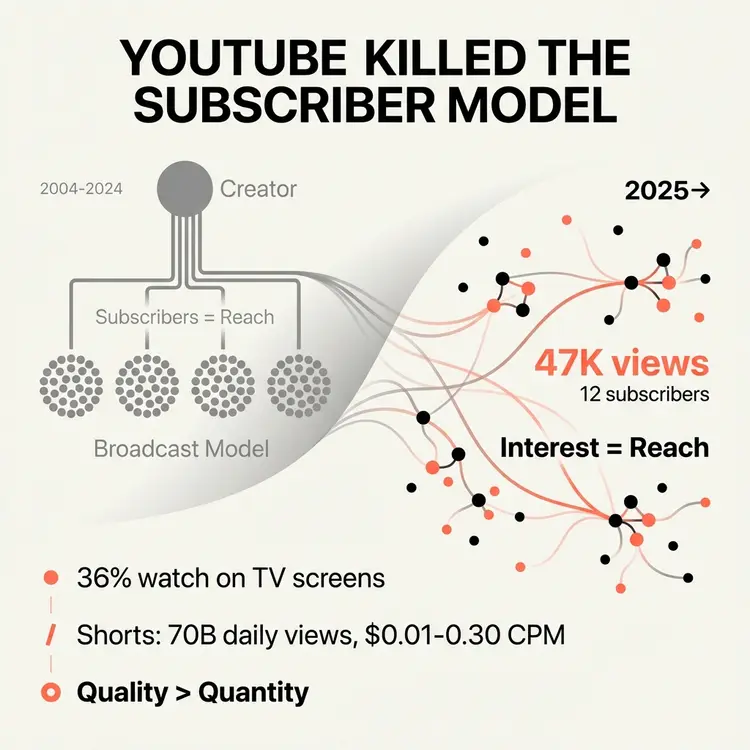
The platform’s 20th anniversary report reveals something I’ve been tracking for months but couldn’t fully articulate until now. YouTube shifted from a subscriber-broadcast model to an interest-based discovery system. The algorithm doesn’t push content to audiences anymore. Viewers control what gets recommended to them through their watch history and engagement patterns.
This isn’t a minor adjustment to how content gets distributed. This is a structural recalibration that eliminates the artificial barrier between new creators and established channels.
The Subscriber Count Myth Just Collapsed
Small channels have a real shot at wide reach now. The algorithm cares more about viewer response than subscriber counts or upload history. If a video hooks the right audience, it gets recommended regardless of who made it.
I tested this with a client last quarter. We launched a new channel with zero subscribers. Within three weeks, one video hit 47,000 views. The channel had 12 subscribers at the time.
That doesn’t happen in a subscriber-dependent system.
YouTube’s Director of Growth confirmed this through built-in viewer surveys that collect feedback on how people feel about what they watched. The platform optimizes for satisfaction over watch time. This means quality of engagement beats quantity of followers.
The implication for mid-growth companies is significant:
- You can rebuild reach quickly if you lose platform access.
- Your audience isn’t trapped behind a subscriber wall anymore.
- Content quality and viewer response determine distribution, not historical follower count.
TV Screens Now Dominate YouTube Consumption
YouTube amassed 45.1 billion viewer hours between January and June 2025. TV screens accounted for 36% of total viewer hours—16.3 billion hours. That’s more than mobile devices at 29% or 13.2 billion hours.
People over 50 represent about 36% of all time spent watching YouTube on TV screens, more than the combined 28% for teenagers and adults 18–34.
I didn’t expect that demographic split.
This shift to TV-based consumption changes content strategy fundamentally. Viewers watch YouTube on TV while cooking dinner, working from home, or doing household tasks. They want longer-form content suitable for multitasking, not just quick hits between meetings.
Your content now needs to:
- Function as background-capable media.
- Remain engaging enough to hold attention when viewers look up.
- Be structured for longer sessions rather than 30–60 second bursts.
That’s a different production requirement than optimizing for mobile-first consumption.
The Shorts Monetization Gap Reveals Platform Economics
YouTube Shorts now averages over 70 billion daily views globally. The format exploded in growth, but monetization tells a different story.
-
- Typical Shorts ad rates: roughly $0.01–$0.30 per 1,000 views in many niches.
-
- Long-form with multiple ad breaks: often $5–$25+ per 1,000 views in premium markets.
A viral Short commonly delivers only a small number of new subscribers relative to views, and the majority of those views come from non‑subscribers. Channels that combine Shorts with long-form content tend to grow significantly faster, but it’s the long-form content that keeps viewers on the channel and watching more videos.
In client accounts, the pattern is consistent:
- Shorts drive discovery.
- Long-form drives revenue and relationship.
The recommendation system often tests new Shorts with a small audience first; if performance is strong, the video gets shown to wider audiences over time, which means Shorts can take off weeks or months after posting.
This creates a clear strategic split:
- Use Shorts for audience acquisition and brand awareness.
- Use long-form for monetization and relationship depth.
Trying to force Shorts into a primary revenue role creates frustration because the platform economics don’t support it at scale.
Most Creators Still Earn Under $15,000 Annually
The creator economy has been estimated at around $250 billion in recent years, yet more than half of individual creators report earning under $15,000 a year, while only a small single‑digit percentage clear $100,000+ annually.
Top earners typically maintain multiple revenue streams—often around three on average—compared to roughly two for lower‑earning creators. Their income mix tends to include:
- Brand sponsorships.
- Digital products.
- Affiliate and ad revenue.
- Services.
- Paid subscriptions.
The pattern is clear: diversification determines financial viability.
Audience ownership is even more revealing. A majority of professional creators report owning their audience directly via email, and those with strong email lists are several times more likely to earn over $30,000 per year.
Across client engagements, the same dynamics show up:
- Platform reach fluctuates.
- Email lists remain relatively stable.
- Direct communication channels create resilience against distribution volatility.
Professional Infrastructure Becomes Mandatory
Among top‑earning creators, a large majority work on their creator business as their primary job, and most collaborate with at least one other person, compared to much lower figures among the general creator population.
As YouTube becomes more financially viable, amateur creators face pressure to professionalize. Content is increasingly viewed as infrastructure requiring dedicated resources.
After watching dozens of mid‑growth companies attempt to “wing it” with spare time and enthusiasm, one conclusion holds:
- The production quality threshold keeps rising.
- The consistency requirement keeps intensifying.
- The strategic complexity keeps expanding.
You need dedicated capacity to maintain competitive positioning. That doesn’t mean a full production team on day one, but it does mean treating content as core business infrastructure rather than marketing decoration.
Budget accordingly. Staff accordingly. Measure accordingly.
Early Monetization Signals Long-Term Success
Survey data on creators shows that nearly half of top earners made their first dollar within the first few months of starting, versus a smaller fraction among the broader creator pool.
This supports a simple principle: test small before you invest big.
- Start with one revenue stream and prove it works.
- Get your first paying customer.
- Optimize that conversion path.
- Only then add a second revenue stream.
Many creators spread effort across several income sources that each generate tiny amounts instead of focusing long enough on a single, higher‑leverage stream.
Platform Selection Determines Commercial Viability
Different platforms monetize attention in radically different ways. For example, creator surveys and platform reports suggest that LinkedIn and certain podcast ecosystems produce a higher proportion of creators earning $30,000+ compared with short‑form‑only platforms, especially in B2B and finance niches.
When asked for their primary platform, respondents often report a split along these lines:
- Podcasts as a primary platform for a significant minority.
- YouTube for another large segment.
- Newsletters, live streaming, and short‑form platforms making up the remainder.
Podcasters and B2B‑focused creators tend to outperform short‑form‑only creators in average income, largely because their audiences have budgets and buying authority.
The takeaway: platform economics matter more than pure content quality.
- If you sell to enterprise buyers, LinkedIn often beats consumer‑focused platforms regardless of follower count.
- If you need deep relationship development, podcasts and long‑form often beat Shorts regardless of production budget.
Companies that chase reach on platforms where their ideal customers lack purchasing power often build large but low‑value audiences.
Choose platforms where your audience has both attention and transaction capability.
What This Means For Your Content Strategy
YouTube’s transformation from subscriber‑dependent distribution to interest‑based discovery creates three immediate opportunities for mid‑growth companies.
- Enter without existing audience infrastructure.
The algorithm evaluates content performance independently of channel history. This lowers the barrier to building new distribution channels when you need to diversify platform risk. - Optimize for satisfaction, not vanity metrics.
Viewer response and satisfaction signals determine reach more than subscriber counts or raw view totals. This shifts focus from audience size to audience quality, which aligns better with B2B and high‑ticket models. Over 40 years, I have stepped in to clean up after dozens of agency nightmares. Big checks written, 12-month contracts signed, and almost nothing to show for it except fancy slide decks and excuses.
But I’ve also worked with smart CEOs who never get burned. Before they sign a contract with any marketing partner, they always ask three simple questions:
- “Can you show me a client in my exact industry whose revenue actually grew?” (Not just someone whose “clicks” went up.)
- “Who is specifically doing the work on my account every day?” (Make sure the senior team pitching you isn’t handing your account off to an intern.)
- “What happens if this program misses its targets in the first 90 days?” (Listen carefully to see if they take accountability or immediately make excuses.)
Bad agencies will fumble these questions every single time. Good partners will answer them with total confidence. Ask them before you sign on the dotted line.
If this has made you curious, why not take the next step and book a free 15 minute discovery session by clicking on https://www.leadbuildermarketing.com/meetnow. I’ll see you next time. Don’t forget to like and subscribe.
 Business owners hire web designers to make their site look pretty. Web designers win awards for sleek layouts, cool animations, and unique fonts.
The problem? A beautiful website and a sales-ready website are often two completely different things.
A pretty website focuses on artistic feel. A sales-ready website focuses on clarity and conversion. Here is what a high-converting site actually includes:
- Clear, simple headlines that explain your offer in 3 seconds flat.
- Direct call-to-action buttons that stand out visually on every page.
- Social proof (testimonials, case studies, client logos) placed right next to key action areas.
- Fast loading speed with zero annoying pop-ups or clunky animations that slow down the user.
- Frictionless forms that only ask for essential contact info.
Your website shouldn’t belong in an art gallery. It should belong on your sales team’s roster as their hardest-working rep.
If this has made you curious, why not take the next step and book a free 15 minute discovery session by clicking on https://www.leadbuildermarketing.com/meetnow. I’ll see you next time. Don’t forget to like and subscribe.
 For the last six months, my team and I have been running real-world tests across our client base to see what actually drives visibility in AI search engines. We tried blog posts, press releases, social pushes, and structural site updates.
Out of everything we tested, one single tactic moved the needle more than all the others combined: Structured Authorship Signals.
When we attached real, verified subject-matter experts to a company’s content—linking their articles to personal profiles, industry databases, and external interviews—the AI tools took notice fast.
AI search models don’t just care what is written; they care who wrote it. They want to verify that the person behind the advice has real-world authority. When we built that clear authorship trail, our clients started appearing in AI search queries within 90 days.
If you want to be visible in the age of AI, stop publishing generic, anonymous articles. Put your real experts front and center.
If this has made you curious, why not take the next step and book a free 15 minute discovery session by clicking on https://www.leadbuildermarketing.com/meetnow. I’ll see you next time. Don’t forget to like and subscribe.
 Most business owners think AI tools search the web just like Google used to. They assume that if they buy enough SEO keywords, ChatGPT will magically start recommending them.
That isn’t how it works. Google looks for keywords; AI models look for patterns.
When an AI tool answers a prompt, it pulls from thousands of sources across the web to see what people say about your brand. It looks at your website, your news features, your podcasts, your social profiles, and third-party review sites.
If your brand message is inconsistent across those platforms, the AI gets confused and skips you entirely. But if you have a clear, consistent “semantic signature”—meaning you use the exact same industry terms, authority signals, and expert content everywhere—the AI views you as a trusted source.
AI visibility isn’t about gaming an algorithm. It’s about building a consistent pattern of real expertise across the entire web.
If this has made you curious, why not take the next step and book a free 15 minute discovery session by clicking on https://www.leadbuildermarketing.com/meetnow. I’ll see you next time. Don’t forget to like and subscribe.
 A few months ago, we decided to run an experiment for one of our commercial construction clients. We opened four major AI tools—ChatGPT, Perplexity, Claude, and Gemini—and asked them to recommend the top commercial builders in our client’s region.
The results were brutal. Their chief competitor showed up in four out of four AI searches. Our client showed up zero times.
This client has 30 years of experience, a fantastic reputation, and hundreds of completed projects. Yet to the new world of AI search tools, they were completely invisible.
Why? Because their competitor had structured their website data, guest articles, and press releases in a way that AI tools could easily read and verify. Our client had relied entirely on traditional word-of-mouth.
Your buyers are no longer just using Google—they are asking AI tools for recommendations. If your online footprint isn’t set up for AI tools to understand, you are slowly disappearing from your market’s shortlist.
If this has made you curious, why not take the next step and book a free 15 minute discovery session by clicking on https://www.leadbuildermarketing.com/meetnow. I’ll see you next time. Don’t forget to like and subscribe.
 Companies spend endless hours arguing over what counts as a “Marketing Qualified Lead” (MQL). They make complex rules, point charts, and scoring systems.
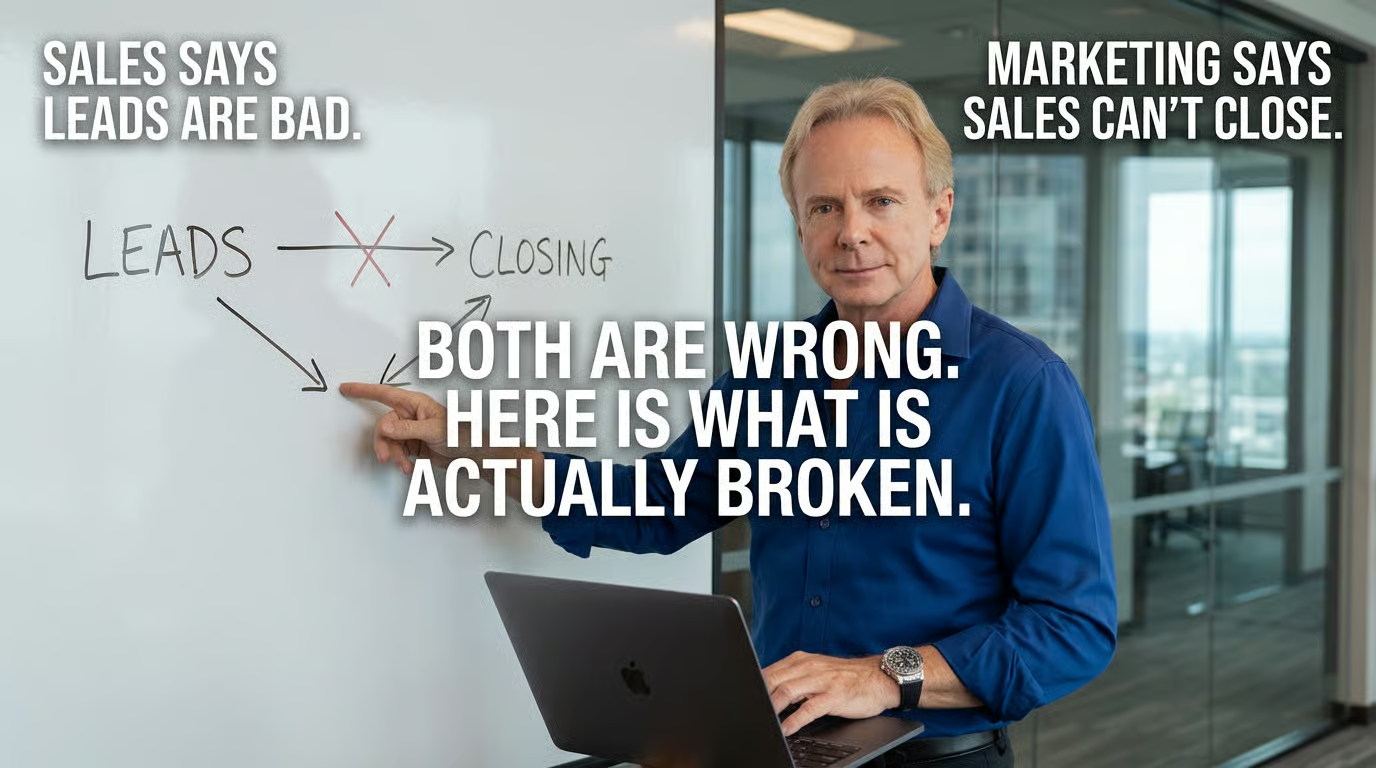
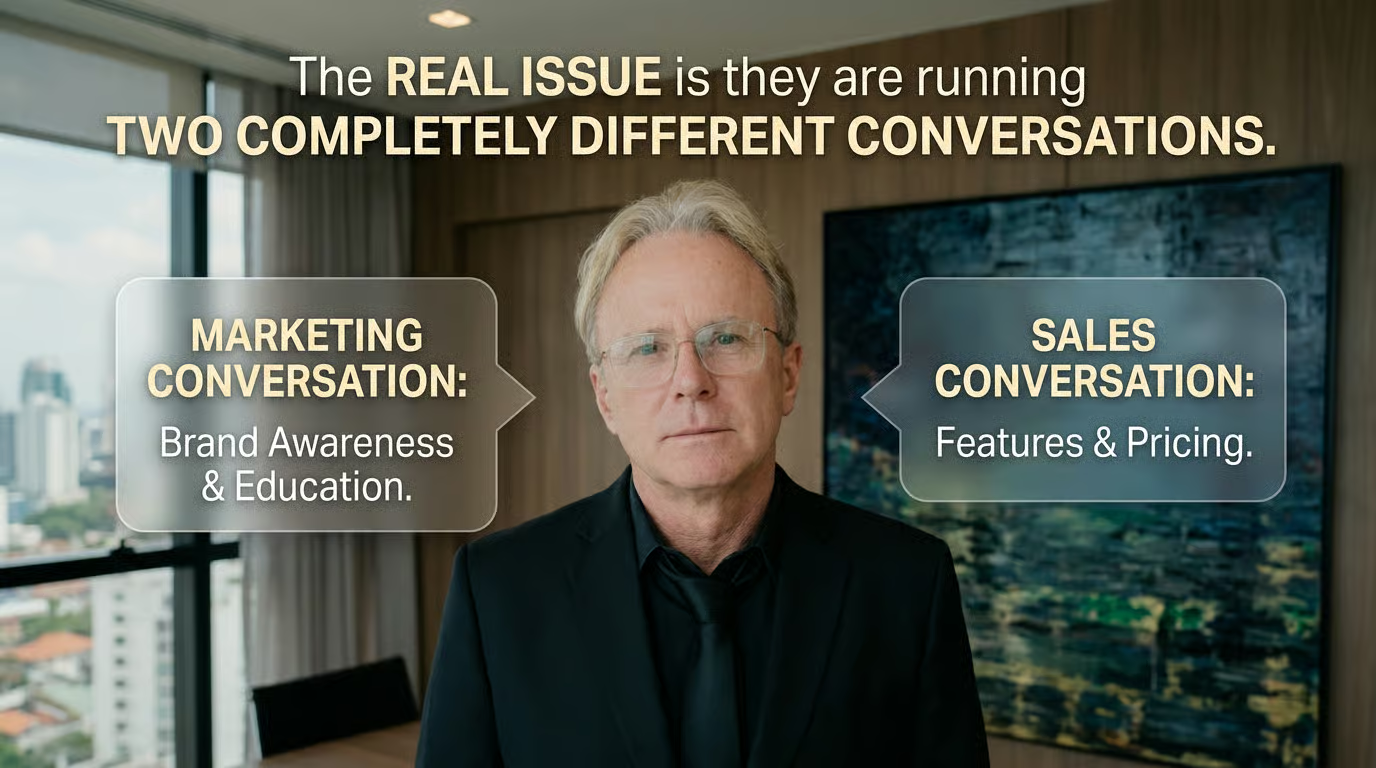
All of that debate is just a symptom. The real issue is much simpler: marketing and sales are running two completely different conversations with the exact same customer.
Marketing posts content about high-level trends and industry strategy. Then, when the prospect books a call, the sales team immediately launches into a aggressive pitch about feature lists, technical specs, and pricing discounts.
The buyer feels like they got hit with a bait-and-switch.
Your marketing copy and your sales presentation must tell the same story. When your ad message, website copy, and sales deck use the exact same language to address the buyer’s pain, the sales process becomes natural and fast.
If this has made you curious, why not take the next step and book a free 15 minute discovery session by clicking on https://www.leadbuildermarketing.com/meetnow. I’ll see you next time. Don’t forget to like and subscribe.
Before I touch a marketing budget, I ask five operational questions.
That usually changes the whole plan.
When a CEO asks me to “fix marketing,” the request usually sounds like an advertising problem: the website needs work, the campaigns aren’t converting, the social content isn’t landing. But in practice, the real issue is often somewhere else entirely — in sales speed, onboarding, retention, or customer service.
That’s why I start with operations.
I ask five questions:
- How long does it take your sales team to contact a new lead?
- What is your churn rate over the last 12 months?
- How many steps does it take to fully onboard a new client?
- What is the #1 complaint your account team hears most often?
- How consistently do your reps follow up when a lead goes quiet?
Those questions matter because marketing does not work in isolation. If lead response is slow, follow-up is inconsistent, onboarding is confusing, or customers are leaving too quickly, then the problem is not just demand generation — it’s the system around demand.
For example, Harvard Business Review found that companies that tried to contact a lead within an hour were nearly 7 times more likely to qualify that lead than those that waited longer. In other words, a strong ad campaign can still underperform if the sales team is too slow to respond.
The same pattern shows up in follow-up. InsideSales research reported that 7 or more follow-up attempts generated 15% more connections than fewer attempts. So if leads are going quiet after the first touch, the issue may not be marketing quality at all — it may be persistence.
Onboarding creates the same kind of drag. McKinsey has shown that customer journeys can lose satisfaction even when individual touchpoints seem fine, simply because the overall process is too long or too fragmented. If a new customer has to take nine calls over three months just to get activated, the marketing team may be blamed for “bad leads” when the real leak is operational friction after the sale.
Complaint handling matters too. Research on customer retention shows that complaints are often tied to a higher chance of churn, and recovery efforts do not always fully erase the damage. If account managers keep hearing the same complaint over and over — delayed service, unclear expectations, poor communication — that is not just a support issue. It is a growth issue.
That is why I say operational friction makes marketing weaker than it should be. Fix the response time. Simplify onboarding. Tighten follow-up. Reduce the biggest recurring complaint. Improve retention. Then marketing starts working much harder without increasing spend.
If you want more proof, here are a few useful references:
- Harvard Business Review on lead response time
- InsideSales/XANT research on follow-up attempts
- McKinsey research on customer journeys and onboarding
- Journal of Marketing research on complaints and churn
- Salesforce guidance on sales cadences and feedback handling
A better marketing budget often starts with a better operating system.
If this has made you curious, the next step is simple: book a free 15-minute discovery session at https://www.leadbuildermarketing.com/meetnow.
I’ll see you next time. Don’t forget to like and subscribe.

The advent of generative AI has made it easy to create content for websites, but creating good content is another matter. Webmasters and self-described SEO experts have unleashed a flood of what’s basically website spam, using AI to churn out mountains of quick, machine-written pages in the hopes that some of them might rank well. It’s a lot like how email spam works: If they put enough junk out there, occasionally, one of their messages will convince someone that there really is a Nigerian prince looking to give them a million dollars.
But just because so many people are using AI to create lousy content doesn’t mean that there aren’t good ways to use AI for your website. In fact, even Google says that “our focus [is] on the quality of content, rather than how content is produced”: If you can use AI to help you create content that’s high-quality and useful to readers, it’s totally fine to do so. The key is to think of AI not as a replacement for human effort and expertise but as an assistant that can help you spot opportunities to improve your content and create that content more efficiently.
Useful AI Tools for Content Analysis
Anyone can create an AI-powered tool that claims to be useful for SEO, especially now that ChatGPT Plus lets you make a custom GPT with very little effort. But if you want useful results, you’ll need to stick with AI tools made by trustworthy sources with known expertise.
Custom GPTs
Here are a few GPTs made so far by highly regarded figures in SEO:
- GSC Keyword Ranking Changes Scatter Plot by Marie Haynes: Export a CSV from Google Search Console showing your keyword rankings over a period of time overlapping the date of a Google update. Then, upload the file to the GPT and it will make a scatter plot to visualize changes in keyword rankings over time, which can show how much the site’s rankings were affected by the update. Depending on what kind of Google update it was, you’ll have an idea of what you should work on to improve your content. (Haynes also has a “Which Pages Impacted?” GPT that can show which pages you should start with.)
- SEO: Search Query Analyzer by Ann Smarty: Give this GPT a keyword phrase and it will go look at the SERP for you, then summarize the types of pages ranking for that phrase and the likely search intent. It also provides suggestions for what should be on your page based on this information.
- Content Helpfulness and Quality SEO Analyzer by Aleyda Solis: Give it the URL of one of your pages and a keyword phrase and it will analyze the page content using Google content quality guidelines. If you provide the URLs of competing pages, the GPT can also compare their content.
RivalFlow
There’s also a really interesting tool out there that can do a competitor content analysis on a larger scale. It’s called RivalFlow, and it was built by SpyFu, meaning that it can draw on all of that tool’s data to inform its output. Features include:
- Content Gap Analysis: Plug in your domain and it helps you find competing sites that outrank you, then compares your content and theirs to determine how yours falls short. RivalFlow identifies questions that the competitor answers more thoroughly than you as well as questions that they answer but you don’t, showing you opportunities to expand and improve on your content.
- AI Content Generation: Once RivalFlow determines what you need to add to your page, it will generate content for you to meet that need, which you can hand off to a human editor as a starting point for their work.
The first part alone has the potential to be a huge time-saver. We should be doing this sort of analysis anyway, but doing it manually on your entire website can be incredibly time-consuming, especially when you think about how many pages you have on your site and how many competitors’ pages you’d need to look at to gather all of this information. RivalFlow automates this process with AI, making it a potential game-changer.
Using AI Tools Responsibly
The most important thing to know about using any sort of generative AI tool, be it ChatGPT or another product, is that you shouldn’t use text that AI writes without having a human edit it. It’s entirely possible that the AI output will be inaccurate, irrelevant to your intended topic, or just boring and uninformative. You can get into all sorts of trouble when you post AI content without editing.
But you can use AI content as a starting point. Look at the text it gives you, then edit, rework, or completely rewrite it to get an informative, engaging piece of text that meets the user intent for your target keywords.
You should also be completely transparent with anyone you’re creating content for about your use of AI. Never try to pass off AI-written content as your own: That’s unethical, and besides, your clients will be able to tell the difference between machine-generated text and content that’s created by a human to be interesting and helpful to the reader.
The post How to Create Good Content With Help From AI appeared first on Internet Marketing Ninjas Blog.

Working in social media marketing can be overwhelming, so you are forced to try to organize and scale tasks as much as you can. Sadly, behind that scaling effort hides another problem: You may ultimately build a routine and do the same thing day after day.
Social media is all about variety though: Tactics change daily, new tools and apps are launched, new opportunities emerge.
Bonus: Join Zest.is!
Zest.is is the community of digital marketers who curate marketing content for you to easily access highest-quality guides on a daily basis.
What makes Zest stand out is that they have multi-step moderation process that ensures the best quality possible. If you are tired of re-purposed marketing advice, Zest is the place to go. You’ll be impressed by the selection there. Every article is a gem there!
Let’s get down to the list now! Here are 15 resources to help you get out of social media marketing routine and try something new:
1. Social Media for Business 101 from our own @IMNinjaSuzy
A good place to start, this article organizes what you may already know listing some essential tips and tools.
2. How Hashtags Work from @seosmarty over at @Moz
It gives a good overlook of how hashtags operate on different social media sites.
3. How to Generate and Close Social Leads On Twitter from @Growmap
A thorough, in-depth look at building leads using Twitter.
4. The Secret Sauce to Shareable Visual Content Your Audience Will Devour from @sociallysorted
Images are key to social media engagement: Bookmark this guide for tips and tools to help you create irresistible images for your social media updates.
5. How to Promote a Blog Post on Social Media from @JimBoykin via #JimAndAnn show
Do you have a piece of content to promote on social media? Here are the actual steps you need to take to share a URL on social media to generate clicks and engagement. This one includes platforms like Drumup and social media promotion with VCB.
6. How to Create the Perfect Social Media Post from @PegFitzpatrick
Everything from wording to character limits and images, this article will help you make your social media stand out.
7. How to Promote Your YouTube Channel Like a Pro from @djthewriter via @sproutsocial
A thorough step-by-step guide into marketing your Youtube channel.
8. How to Do Reddit Marketing without Making Enemies
Easy to follow steps on marketing your content on Reddit
9.What are digital business cards and how they work
A very important concept in our cross-marketing era. Keep an eye on your digital footprint!
10. Practical Tips to Reach More People on Social Media via @pakwired
Finally, a quick reminder to keep you out of trouble. Oftentimes, using social media tools may ruin your relationships with your contacts instead of strengthening them, so beware!
Social Media Podcasts
I love podcasts because you can listen to them while on the go: When commuting, traveling, etc. They allow for otherwise thoughtless time to be spent efficiently. Here are free social media marketing podcasts to subscribe to:
1. The Science of Social Media By Buffer
Buffer always has great guests to talk about indepth tactics and useful tools. It’s also pretty active publishing new items a few times a month.
2. The Social Media Examiner Show
Social Media Examiner is one of my favorite social media marketing blogs. Targeting business owners, it’s a great resource with always high-quality tutorials. They put every article on voiceover and turn into a podcast. They also regularly invite experts to discuss new social media trends and events.
3. Social Media Social Hour with Tyler J. Anderson
This podcast is very actionable and tactical. Be ready to implement some tips right after listening! Tyler covers a variety of social media networks including Pinterest, LinkedIn, Google Plus, YouTube, Snapchat, Periscope, and more.
4. The #AskGaryVee Show with Gary Vaynerchuk
Focusing on relationship building, this one will be a great motivation for you to start trying new tactics.
5. The Social Toolkit by Social Fresh
Jason Keath @jasonkeath and Jason Yarborough @yarby interviews social media experts on tools and software. It’s a great resource to discover new tools weekly.
Finally, don’t forget to check out our own #JimAndAnn show on both Youtube and iTunes!
The post 15 Resources to Bring Your Social Media Marketing Strategy to the Next Level appeared first on Internet Marketing Ninjas Blog.
A form fill is not a sales opportunity. It might be a student researching a project, a competitor checking your pricing, or a vendor looking for a partner. If every name that hits your CRM gets treated like a hot prospect, your sales team burns time, marketing celebrates fake pipeline, and leadership gets a forecast built on sand. Learning how to qualify B2B leads fixes that disconnect.
The goal is not to make your lead count look impressive. The goal is to identify organizations with a real problem, a credible path to purchase, and enough urgency to justify a sales conversation. Revenue, not just traffic. Conversations that move forward, not a spreadsheet full of contact records.
How to Qualify B2B Leads Before Sales Wastes Time
Lead qualification is the process of deciding whether a contact and their company deserve sales attention now, later, or not at all. That decision should not rely on instinct alone. Your best salespeople may have great instincts, but a growth system cannot depend on one person reading every inquiry and guessing who is serious.
A useful qualification process evaluates four things: company fit, buying intent, purchase readiness, and access to the buying process. One strong signal is rarely enough. A director at the perfect company who downloaded one generic guide six months ago is not necessarily ready to buy. A prospect who requests a consultation but works for a company that is too small, outside your service area, or outside your capabilities may not be worth pursuing either.
The right standard depends on your sales model. A construction company pursuing large commercial projects will qualify leads differently than a healthcare technology provider selling a recurring platform. Deal size, sales cycle length, market concentration, and delivery capacity all matter. But the principle stays the same: define what a good opportunity looks like before you pay to generate more of them.
Start With the Customer Profile That Produces Revenue
Most teams begin with demographics. They ask for job title, company size, industry, and location. Those fields matter, but they are only the starting point. Your best-fit customer profile should be built from closed-won business, not assumptions about who might like your offer.
Look at your best customers from the last 12 to 24 months. Find the patterns behind profitable, retainable accounts. What industries do they serve? How large are their teams or revenues? What business trigger caused them to look for help? Who got involved in the decision? How long did the buying process take? Which services or products did they purchase first, and what made them expand?
Then look at the deals you wish you had never chased. Maybe they had tiny budgets, unrealistic timelines, unclear authority, or a need that did not match your expertise. Those are not just bad luck stories. They are qualification criteria.
For example, a DFW-based B2B services firm may determine that its most valuable prospects have 25 to 500 employees, a complex sale, an outdated website or fragmented campaign presence, and leadership pressure to generate pipeline. A local startup seeking a $500 website may still be a lead, but it should not receive the same sales response as a marketing director planning a six-figure growth initiative.
Separate Fit From Intent
Fit answers, “Could we help this company?” Intent answers, “Are they trying to solve this problem?” Too many lead scoring models blend these together and create confusion.
A prospect can be an excellent fit but show low intent. Think of a VP at a target account who subscribes to your newsletter. That person belongs in a smart nurture program, not an immediate sales queue. On the other hand, someone can show intense intent but be a poor fit. They may repeatedly visit your pricing page and request a call, but their budget, geography, or use case may make a successful engagement unlikely.
Fit signals usually include firmographic facts: industry, location, company size, annual revenue, technology stack, and business model. Intent signals come from behavior and context: visiting solution pages, watching a case-study video, returning to your site multiple times, requesting a proposal, asking a detailed question, or engaging with content tied to a specific business problem.
Behavior should carry more weight when it indicates a clear commercial action. A social like is light interest. A visit to a services page is stronger. A form submission that says, “We need a new site before our Q3 product launch and need lead tracking connected to our CRM,” is a signal your sales team can act on.
Let’s be real: 10,000 video views do not equal 10,000 leads. But a video that explains a costly business problem, proves your expertise, and drives the right viewer to book a conversation can be a powerful qualification tool. The content is not the finish line. It is part of the conversion path.
Use Questions That Reveal Buying Readiness
Your forms and discovery process should ask enough to route leads intelligently without turning every inquiry into a tax return. Long forms can reduce conversion rates, especially early in the buying journey. Short forms can leave sales blind. The answer is progressive qualification.
At the first conversion point, capture the basics: name, work email, company, role, and the reason for reaching out. Add one question that reveals the nature of the need, such as the service they need, their primary goal, or their approximate timeline.
Once a prospect requests a meeting or replies to follow-up, go deeper. Ask what prompted the search, what happens if the issue is not addressed, who else is involved in the decision, what timeline they are working against, and whether a budget range exists. You do not need to interrogate every lead. You need enough information to determine whether there is a real business case.
The strongest qualification questions expose consequences. “What are you hoping to improve?” is useful. “What is this problem costing your team today?” is better. A prospect that can describe missed opportunities, a stalled sales process, low-quality inquiries, recruiting challenges, or a looming launch date is usually further along than one asking only for general information.
Build a Scoring Model Sales Will Trust
Lead scoring fails when marketing builds it in isolation and hands sales a mysterious number. A score should be explainable. If a prospect has 72 points, your team should know why: target industry, decision-maker role, service-page visits, a webinar attendance, and a stated three-month timeline.
Start simple. Assign positive points for high-value fit and intent signals, then use negative scoring to protect your team from obvious dead ends. A personal email address, a company below your minimum engagement threshold, an unsupported region, or a career-related inquiry may lower a score or route the lead elsewhere.
A basic model can classify contacts into three groups:
- Marketing-qualified leads match enough of your ideal profile and have shown meaningful interest. They should receive focused nurturing or initial outreach.
- Sales-qualified leads have a defined need, credible fit, and signs of active buying. They deserve fast, personal follow-up.
- Disqualified or nurture leads are not a current fit, lack sufficient readiness, or need education before a sales call makes sense.
Do not overengineer the score on day one. Start with the criteria your sales team already uses when they say, “This one is worth calling.” Review the outcomes monthly. If high-scoring leads rarely become opportunities, your rules are wrong. If sales keeps finding winners among low-scoring leads, your model is missing a signal.
Make Speed and Routing Part of Qualification
A qualified lead can go cold while your team debates ownership. Routing rules matter as much as scoring rules. Define who receives what, when they receive it, and what happens if they do not respond.
High-intent inquiries should go directly to the right sales owner with the context captured on the form and the behavior that triggered the alert. A generic “new lead” notification is weak. A useful handoff tells the rep that a COO from a 200-person manufacturer requested a website and video strategy consultation after reviewing two case studies and visiting your pricing page twice.
Set a response-time standard. For high-value inbound leads, minutes matter more than most teams admit. That does not mean a rushed pitch. It means a timely, informed response that acknowledges the prospect’s stated problem and offers a relevant next step.
For lower-intent leads, automation can do useful work. Send relevant proof, answer common objections, and invite the prospect to take the next meaningful action. But do not hide behind automation forever. If a lead begins showing stronger intent, the system should escalate them to a human.
Hold Marketing and Sales Accountable to the Same Definition
Marketing should not be judged only on cost per lead. Sales should not be allowed to dismiss every inbound contact as “bad” without evidence. Both teams need shared definitions and a feedback loop tied to revenue outcomes.
Track the movement from inquiry to qualified lead, qualified lead to meeting, meeting to opportunity, opportunity to close, and close to retained revenue. Review by source, campaign, industry, offer, and sales owner. This is where the truth shows up. A channel with a high cost per lead may generate the best customers. A cheap campaign may produce lots of names and no pipeline.
That visibility also improves creative decisions. If a certain case-study video consistently attracts qualified manufacturing prospects, make more content around that pain point. If a downloadable guide brings in researchers but no buyers, change the offer, add better screening, or use it strictly for nurture. A pretty campaign is useless if it does not make you money.
The best lead qualification system is not the one with the fanciest dashboard. It is the one your team uses every day to protect sales capacity and create more real opportunities. Start with the customers you want more of, build rules around observable signals, and keep refining the process based on closed revenue. That is how pipeline stops being a vanity metric and starts becoming a business asset.

A prospect lands on your website, checks your LinkedIn page, and sees generic stock photos next to claims about precision, expertise, and results. The message breaks before they read the second sentence. Commercial photography is not decoration for your marketing. It is visual evidence that your company is real, capable, credible, and worth contacting.
Let’s be real: polished images that never support a sales conversation are just expensive wallpaper. The right photo strategy gives your sales team stronger proof, makes campaigns feel more credible, helps recruiters attract better candidates, and gives decision-makers fewer reasons to hesitate.
Why Commercial Photography Is a Revenue Asset
Marketing teams often treat photography as the final item on a launch checklist. The website is designed, the campaign is planned, and someone realizes they need a few images to fill blank spaces. That approach usually produces a scattered gallery of headshots, office photos, and posed handshakes with no clear business job.
A better approach starts with the conversion path. What must a prospective customer believe before they request a consultation, schedule a demo, visit a location, or call your team? For a construction firm, that may mean seeing project scale, site safety, skilled crews, and completed work. For a healthcare organization, it may mean seeing a calm patient experience, modern equipment, and compassionate professionals. For a B2B services company, it may mean seeing the people, process, environment, and proof behind the promise.
Images can answer those questions faster than a paragraph of brand copy. They make abstract claims tangible. They also give buyers visual context, which matters when the purchase carries risk, complexity, or a long approval cycle.
That is why commercial photography belongs inside a broader marketing system. A photo used on a homepage has a different job than one used in a recruiting campaign, a paid social ad, a case study, or a sales presentation. The subject may be the same, but the crop, composition, message, and call to action should support the channel where it appears.
Stop Buying Photos Without a Business Use Case
The most common failure is not bad photography. It is photography with no distribution plan.
A company invests in a production day, receives a folder of attractive images, posts three on social media, and lets the rest sit in cloud storage. Meanwhile, the website continues using stock imagery, sales decks feel generic, job postings lack personality, and the next campaign needs new creative from scratch. That is waste, even when the photos look great.
Before a camera arrives, define where the assets will work hardest. A focused production plan may support your website refresh, paid campaigns, organic social, proposal templates, recruitment materials, executive thought leadership, email nurture, trade show displays, and customer stories. When those needs are mapped early, the crew can capture intentional variations instead of hoping one image works everywhere.
This does not mean every shoot requires a massive production. It depends on your goals. A leadership team that needs updated brand imagery may need a streamlined studio session. A manufacturer launching a new service line may need on-site environmental portraits, operations coverage, product details, and a library of landscape and vertical campaign assets. The scope should match the commercial opportunity, not a one-size-fits-all package.
What High-Performing Brand Images Actually Show
Strong visual content gives prospects evidence they can understand immediately. It does not hide the work behind vague lifestyle photos or overproduced scenes that look nothing like your business.
For most organizations, an effective image library includes four distinct categories:
- People: Executives, subject-matter experts, frontline staff, and teams doing meaningful work. Buyers want to know who will be accountable.
- Process: Planning, consulting, fabrication, treatment, training, inspections, collaboration, and other moments that show how the work gets done.
- Place and scale: Facilities, job sites, vehicles, equipment, technology, classrooms, clinics, and environments that establish operational credibility.
- Proof: Finished projects, products in use, customer interactions, certifications, safety practices, and visible outcomes that support your claims.
The balance changes by industry. A law firm may prioritize attorney portraits, client-ready meeting spaces, and editorial imagery that supports practice-area pages. A public-safety organization may need training scenarios, technology, community engagement, and command-level leadership. A college may need a deep library across campuses, programs, faculty, student life, and workforce outcomes.
The point is not to manufacture a version of your organization that does not exist. It is to show the strongest, clearest version of the real thing. Authenticity is commercially useful because it reduces the gap between a prospect’s expectations and the experience your team delivers.
Photography Direction Matters as Much as Camera Quality
A high-end camera does not create a useful marketing asset on its own. The work happens in the direction: deciding what story each image needs to tell, arranging the frame to create room for web copy or ad text, guiding people who are not professional models, and capturing enough options to fit multiple formats.
This is especially true in B2B. Your best experts may be uncomfortable on camera, your operations may move quickly, and access to a job site or facility may be limited. An experienced production team plans around those constraints. They build an efficient shot sequence, coordinate with stakeholders, protect safety requirements, and get the footage and photography needed without derailing the workday.
There is also a real trade-off between highly staged imagery and candid documentation. Staged images provide control over lighting, wardrobe, brand consistency, and composition. Candid images often feel more immediate and believable. Most companies need both. Use controlled portraits and hero images where brand presentation matters most, then pair them with active, in-context images that prove your team does the work it says it does.
Build the Shoot Around Your Marketing Calendar
A production day should not be an isolated creative event. It should serve the next six to twelve months of marketing activity.
Start with the business priorities already on the calendar: a website launch, a new market entry, a hiring push, a seasonal campaign, an industry event, or a major service rollout. Then identify the audiences that matter most. A photo that helps a procurement leader assess credibility may not be the same image that convinces a job candidate to apply.
From there, create a shot plan tied to real pages, campaigns, and sales materials. If a website has six priority service pages, capture subject matter that belongs on those pages. If paid social campaigns need vertical creative, plan for vertical compositions. If your team uses presentations to open enterprise conversations, photograph assets with the framing and detail level those slides require.
This is where an integrated partner has an advantage. Lead Builder Marketing can align photography with website strategy, campaign creative, social content, video production, and conversion goals, rather than treating each channel as a separate vendor problem. One coordinated production can create a practical content library that keeps working long after shoot day.
Measure More Than Likes
Photography does influence perception, but perception alone is not the finish line. The question is whether stronger visuals help move people toward a meaningful action.
Track the pages and campaigns where new assets are used. Watch engagement with key landing pages, form submissions, consultation requests, recruiting applications, proposal response, email clicks, and sales feedback. A single photo rarely deserves full credit for a closed deal, but it can strengthen the trust signals that make the next step feel safer.
Qualitative feedback matters too. Ask sales teams which images help them explain complex work. Ask recruiters whether candidates arrive with a clearer view of the culture. Ask clients whether your marketing now reflects the quality of the experience they receive. Those answers can reveal whether your visual library is doing real commercial work or simply making feeds look nicer.
A pretty image has a short shelf life when it is disconnected from strategy. An image built around credibility, audience needs, and distribution can support revenue conversations for years. Before you schedule your next shoot, identify the decision you need your audience to make – then photograph the proof that helps them make it.

Your website gets traffic but not enough qualified inquiries. Sales says marketing is sending weak leads. Your social channels look active, yet nobody can point to revenue. Meanwhile, a full-time senior marketing hire feels expensive, slow, and risky. That is the gap a fractional cmo dallas engagement is meant to solve.
But let’s be real: a fractional CMO is not a magic title you rent to make marketing problems disappear. The right leader creates focus, builds a revenue plan, and makes every marketing dollar accountable. The wrong one adds another layer of meetings, reports on activity, and leaves your internal team with a prettier version of the same problem.
What a Fractional CMO Actually Does
A fractional chief marketing officer is a senior marketing leader who works with your business on a part-time, contract, or retained basis. They bring executive-level strategy without the cost or commitment of a full-time CMO. For Dallas-Fort Worth companies in growth mode, that can be a smart middle ground between asking an overloaded marketing manager to lead strategy and making a six-figure executive hire before the business is ready.
Their job should start with commercial goals, not channel preferences. If your company needs more enterprise sales conversations, better recruitment results, stronger market positioning, or a more predictable pipeline, the fractional CMO builds the marketing plan around that outcome.
That usually includes clarifying your ideal customer profile, sharpening your message, identifying the stages between first touch and sales opportunity, setting channel priorities, and establishing the metrics that actually matter. It also means making hard calls. A campaign may need to be cut. A website may need to be rebuilt. A social calendar may need to stop consuming time because it is generating applause instead of demand.
A good fractional CMO does not simply say, “You should do more video” or “You need SEO.” They explain what those investments must accomplish, who owns execution, how performance will be measured, and what happens if the numbers do not move.
Why Dallas Businesses Bring in Fractional Leadership
DFW has no shortage of capable businesses with fragmented marketing. A construction firm may have excellent project photography but no case-study system that helps estimators win larger bids. A healthcare organization may invest heavily in awareness but struggle to convert patient inquiries or recruit difficult-to-find talent. A B2B technology company may have an experienced sales team, a decent website, and no reliable path for turning expertise into qualified opportunities.
These are not always creative problems. They are operating problems.
Dallas companies often reach this point after growth outpaces their marketing structure. The founder has been the brand voice. Sales has driven referrals. A coordinator posts content, an agency runs ads, and a web vendor handles updates. Everyone is busy, but nobody owns the full path from positioning to pipeline.
A fractional CMO can create that ownership without forcing a business to build an entire in-house department overnight. They can give leadership a clear answer to questions such as: Which audiences are worth pursuing? What should sales receive from marketing? Which offers should be promoted? Where is the conversion path breaking? What should we stop funding?
The value is especially strong when a company has execution resources but lacks senior direction. If you already have a marketing director, designer, sales leader, or outside partners, a fractional leader can align the work around one commercial plan instead of replacing everyone.
When a Fractional CMO Dallas Engagement Makes Sense
The best time to hire a fractional CMO is not when you want “more marketing.” It is when you need better marketing decisions.
You may be a fit if your leadership team has ambitious revenue goals but no documented go-to-market plan. You may be a fit if sales cycles are long, multiple stakeholders influence buying decisions, and your current messaging does not address their concerns. You may also be a fit if your company is entering a new market, launching a service line, preparing for investment, recovering from a stalled pipeline, or trying to bring scattered vendors under one strategy.
There is a practical test: can someone in your organization clearly connect your current marketing activity to a business result? Not impressions. Not followers. Not a report showing website sessions. Can they show how marketing is creating qualified conversations, opportunities, revenue, recruitment outcomes, or retention?
If the answer is no, the problem may not be effort. It may be leadership and structure.
That said, a fractional CMO is not the right first move for every business. If you have no budget to execute a plan, no one available to respond to leads, or no willingness to change weak positioning, strategic guidance alone will not fix the issue. Strategy without implementation becomes an expensive slide deck.
What the First 90 Days Should Produce
A serious engagement should create visible operating clarity early. The first month should focus on discovery: revenue goals, sales data, customer interviews, existing marketing performance, competitors, customer journey gaps, and internal capabilities. This is where a strong CMO separates assumptions from evidence.
By the second month, the business should have a prioritized marketing roadmap. That roadmap should define target segments, core message architecture, offers, channel roles, campaign themes, lead handling expectations, budget priorities, and a measurement framework. It should be clear enough that leadership can see what gets done first, what waits, and why.
The third month is where the plan becomes active. That may involve a conversion-focused website update, a paid media test, a sales enablement package, thought-leadership content, a recruitment campaign, or a video system built to answer buyer questions before a sales call. The specific mix depends on the business. The requirement is the same: each asset needs a job.
For example, a polished brand video is not automatically useful. If it never reaches the right audience, offers no next step, and does not support a campaign, it is just expensive decoration. The same is true of a beautiful website that makes visitors hunt for proof, pricing context, service detail, or a reason to contact you.
At Lead Builder Marketing, that principle guides the work: websites, video, social content, and campaigns are built as conversion tools, not as trophies for a portfolio.
Strategy Is Only Valuable If Execution Holds Up
A fractional CMO should be able to lead the plan, but you need to understand who will make it real. Some fractional leaders manage internal teams. Some coordinate a collection of specialized vendors. Others work with an integrated agency that can handle strategy, web development, SEO, paid campaigns, creative, and production under one operating rhythm.
Neither model is automatically better. A consultant-led approach can work well when you have a capable internal team and trusted partners. An integrated model can move faster when your marketing is fragmented and you need strategy tied directly to production and distribution.
Video is a good example. For DFW organizations with complex services, high-consideration purchases, or recruiting needs, video can explain credibility faster than a wall of copy. Customer stories, leadership perspectives, project walk-throughs, training content, and recruiting pieces can all support revenue or hiring. But production should not end when the cameras stop. The plan needs distribution across the website, sales outreach, campaigns, social channels, presentations, and follow-up sequences.
Ask who owns that step. Passive video does not create pipeline.
How to Evaluate a Fractional CMO
Look past personality and credentials. Ask how they define success in your business, what they would examine first, and how they will work with sales. Ask for examples of the decisions they have made when budgets were limited or performance was weak. Senior leadership is partly about choosing what not to do.
You should also ask how often they will be involved. A monthly advisory call may be enough for a mature company with a strong team. It is rarely enough for a business rebuilding its marketing engine. Clarify whether they will attend leadership meetings, review campaign performance, guide vendors, support sales alignment, and help manage execution.
Most importantly, ask what the scorecard looks like. The answer should include leading indicators such as qualified form submissions, booked meetings, cost per qualified lead, conversion rates, and sales acceptance. It should also connect those indicators to lagging outcomes such as pipeline value, closed revenue, customer acquisition cost, and retention where applicable.
A fractional CMO should not promise instant revenue. Long sales cycles, weak follow-up, pricing issues, and market conditions all affect results. They should, however, make the path to improvement measurable and easier to manage.
The right partner gives your leadership team more than marketing activity. They give you a sharper view of where growth is getting stuck, what deserves investment, and what needs to change before another quarter slips by.
- Build compounding content assets, not disposable posts.
YouTube videos can keep generating views months after publication. Your output becomes an asset base, not just a stream of quickly‑expiring content.Over 40 years, I have stepped in to clean up after dozens of agency nightmares. Big checks written, 12-month contracts signed, and almost nothing to show for it except fancy slide decks and excuses.But I’ve also worked with smart CEOs who never get burned. Before they sign a contract with any marketing partner, they always ask three simple questions:
- “Can you show me a client in my exact industry whose revenue actually grew?” (Not just someone whose “clicks” went up.)
- “Who is specifically doing the work on my account every day?” (Make sure the senior team pitching you isn’t handing your account off to an intern.)
- “What happens if this program misses its targets in the first 90 days?” (Listen carefully to see if they take accountability or immediately make excuses.)
Bad agencies will fumble these questions every single time. Good partners will answer them with total confidence. Ask them before you sign on the dotted line.
If this has made you curious, why not take the next step and book a free 15 minute discovery session by clicking on https://www.leadbuildermarketing.com/meetnow. I’ll see you next time. Don’t forget to like and subscribe.
Business owners hire web designers to make their site look pretty. Web designers win awards for sleek layouts, cool animations, and unique fonts.The problem? A beautiful website and a sales-ready website are often two completely different things.
A pretty website focuses on artistic feel. A sales-ready website focuses on clarity and conversion. Here is what a high-converting site actually includes:
- Clear, simple headlines that explain your offer in 3 seconds flat.
- Direct call-to-action buttons that stand out visually on every page.
- Social proof (testimonials, case studies, client logos) placed right next to key action areas.
- Fast loading speed with zero annoying pop-ups or clunky animations that slow down the user.
- Frictionless forms that only ask for essential contact info.
Your website shouldn’t belong in an art gallery. It should belong on your sales team’s roster as their hardest-working rep.
If this has made you curious, why not take the next step and book a free 15 minute discovery session by clicking on https://www.leadbuildermarketing.com/meetnow. I’ll see you next time. Don’t forget to like and subscribe.
For the last six months, my team and I have been running real-world tests across our client base to see what actually drives visibility in AI search engines. We tried blog posts, press releases, social pushes, and structural site updates.Out of everything we tested, one single tactic moved the needle more than all the others combined: Structured Authorship Signals.
When we attached real, verified subject-matter experts to a company’s content—linking their articles to personal profiles, industry databases, and external interviews—the AI tools took notice fast.
AI search models don’t just care what is written; they care who wrote it. They want to verify that the person behind the advice has real-world authority. When we built that clear authorship trail, our clients started appearing in AI search queries within 90 days.
If you want to be visible in the age of AI, stop publishing generic, anonymous articles. Put your real experts front and center.
If this has made you curious, why not take the next step and book a free 15 minute discovery session by clicking on https://www.leadbuildermarketing.com/meetnow. I’ll see you next time. Don’t forget to like and subscribe.
Most business owners think AI tools search the web just like Google used to. They assume that if they buy enough SEO keywords, ChatGPT will magically start recommending them.That isn’t how it works. Google looks for keywords; AI models look for patterns.
When an AI tool answers a prompt, it pulls from thousands of sources across the web to see what people say about your brand. It looks at your website, your news features, your podcasts, your social profiles, and third-party review sites.
If your brand message is inconsistent across those platforms, the AI gets confused and skips you entirely. But if you have a clear, consistent “semantic signature”—meaning you use the exact same industry terms, authority signals, and expert content everywhere—the AI views you as a trusted source.
AI visibility isn’t about gaming an algorithm. It’s about building a consistent pattern of real expertise across the entire web.
If this has made you curious, why not take the next step and book a free 15 minute discovery session by clicking on https://www.leadbuildermarketing.com/meetnow. I’ll see you next time. Don’t forget to like and subscribe.
A few months ago, we decided to run an experiment for one of our commercial construction clients. We opened four major AI tools—ChatGPT, Perplexity, Claude, and Gemini—and asked them to recommend the top commercial builders in our client’s region.The results were brutal. Their chief competitor showed up in four out of four AI searches. Our client showed up zero times.
This client has 30 years of experience, a fantastic reputation, and hundreds of completed projects. Yet to the new world of AI search tools, they were completely invisible.
Why? Because their competitor had structured their website data, guest articles, and press releases in a way that AI tools could easily read and verify. Our client had relied entirely on traditional word-of-mouth.
Your buyers are no longer just using Google—they are asking AI tools for recommendations. If your online footprint isn’t set up for AI tools to understand, you are slowly disappearing from your market’s shortlist.
If this has made you curious, why not take the next step and book a free 15 minute discovery session by clicking on https://www.leadbuildermarketing.com/meetnow. I’ll see you next time. Don’t forget to like and subscribe.
Companies spend endless hours arguing over what counts as a “Marketing Qualified Lead” (MQL). They make complex rules, point charts, and scoring systems.All of that debate is just a symptom. The real issue is much simpler: marketing and sales are running two completely different conversations with the exact same customer.
Marketing posts content about high-level trends and industry strategy. Then, when the prospect books a call, the sales team immediately launches into a aggressive pitch about feature lists, technical specs, and pricing discounts.
The buyer feels like they got hit with a bait-and-switch.
Your marketing copy and your sales presentation must tell the same story. When your ad message, website copy, and sales deck use the exact same language to address the buyer’s pain, the sales process becomes natural and fast.
If this has made you curious, why not take the next step and book a free 15 minute discovery session by clicking on https://www.leadbuildermarketing.com/meetnow. I’ll see you next time. Don’t forget to like and subscribe.
Before I touch a marketing budget, I ask five operational questions.
That usually changes the whole plan.
When a CEO asks me to “fix marketing,” the request usually sounds like an advertising problem: the website needs work, the campaigns aren’t converting, the social content isn’t landing. But in practice, the real issue is often somewhere else entirely — in sales speed, onboarding, retention, or customer service.
That’s why I start with operations.
I ask five questions:
- How long does it take your sales team to contact a new lead?
- What is your churn rate over the last 12 months?
- How many steps does it take to fully onboard a new client?
- What is the #1 complaint your account team hears most often?
- How consistently do your reps follow up when a lead goes quiet?
Those questions matter because marketing does not work in isolation. If lead response is slow, follow-up is inconsistent, onboarding is confusing, or customers are leaving too quickly, then the problem is not just demand generation — it’s the system around demand.
For example, Harvard Business Review found that companies that tried to contact a lead within an hour were nearly 7 times more likely to qualify that lead than those that waited longer. In other words, a strong ad campaign can still underperform if the sales team is too slow to respond.
The same pattern shows up in follow-up. InsideSales research reported that 7 or more follow-up attempts generated 15% more connections than fewer attempts. So if leads are going quiet after the first touch, the issue may not be marketing quality at all — it may be persistence.
Onboarding creates the same kind of drag. McKinsey has shown that customer journeys can lose satisfaction even when individual touchpoints seem fine, simply because the overall process is too long or too fragmented. If a new customer has to take nine calls over three months just to get activated, the marketing team may be blamed for “bad leads” when the real leak is operational friction after the sale.
Complaint handling matters too. Research on customer retention shows that complaints are often tied to a higher chance of churn, and recovery efforts do not always fully erase the damage. If account managers keep hearing the same complaint over and over — delayed service, unclear expectations, poor communication — that is not just a support issue. It is a growth issue.
That is why I say operational friction makes marketing weaker than it should be. Fix the response time. Simplify onboarding. Tighten follow-up. Reduce the biggest recurring complaint. Improve retention. Then marketing starts working much harder without increasing spend.
If you want more proof, here are a few useful references:
- Harvard Business Review on lead response time
- InsideSales/XANT research on follow-up attempts
- McKinsey research on customer journeys and onboarding
- Journal of Marketing research on complaints and churn
- Salesforce guidance on sales cadences and feedback handling
A better marketing budget often starts with a better operating system.
If this has made you curious, the next step is simple: book a free 15-minute discovery session at https://www.leadbuildermarketing.com/meetnow.
I’ll see you next time. Don’t forget to like and subscribe.
The advent of generative AI has made it easy to create content for websites, but creating good content is another matter. Webmasters and self-described SEO experts have unleashed a flood of what’s basically website spam, using AI to churn out mountains of quick, machine-written pages in the hopes that some of them might rank well. It’s a lot like how email spam works: If they put enough junk out there, occasionally, one of their messages will convince someone that there really is a Nigerian prince looking to give them a million dollars.
But just because so many people are using AI to create lousy content doesn’t mean that there aren’t good ways to use AI for your website. In fact, even Google says that “our focus [is] on the quality of content, rather than how content is produced”: If you can use AI to help you create content that’s high-quality and useful to readers, it’s totally fine to do so. The key is to think of AI not as a replacement for human effort and expertise but as an assistant that can help you spot opportunities to improve your content and create that content more efficiently.
Useful AI Tools for Content Analysis
Anyone can create an AI-powered tool that claims to be useful for SEO, especially now that ChatGPT Plus lets you make a custom GPT with very little effort. But if you want useful results, you’ll need to stick with AI tools made by trustworthy sources with known expertise.
Custom GPTs
Here are a few GPTs made so far by highly regarded figures in SEO:
- GSC Keyword Ranking Changes Scatter Plot by Marie Haynes: Export a CSV from Google Search Console showing your keyword rankings over a period of time overlapping the date of a Google update. Then, upload the file to the GPT and it will make a scatter plot to visualize changes in keyword rankings over time, which can show how much the site’s rankings were affected by the update. Depending on what kind of Google update it was, you’ll have an idea of what you should work on to improve your content. (Haynes also has a “Which Pages Impacted?” GPT that can show which pages you should start with.)
- SEO: Search Query Analyzer by Ann Smarty: Give this GPT a keyword phrase and it will go look at the SERP for you, then summarize the types of pages ranking for that phrase and the likely search intent. It also provides suggestions for what should be on your page based on this information.
- Content Helpfulness and Quality SEO Analyzer by Aleyda Solis: Give it the URL of one of your pages and a keyword phrase and it will analyze the page content using Google content quality guidelines. If you provide the URLs of competing pages, the GPT can also compare their content.
RivalFlow
There’s also a really interesting tool out there that can do a competitor content analysis on a larger scale. It’s called RivalFlow, and it was built by SpyFu, meaning that it can draw on all of that tool’s data to inform its output. Features include:
- Content Gap Analysis: Plug in your domain and it helps you find competing sites that outrank you, then compares your content and theirs to determine how yours falls short. RivalFlow identifies questions that the competitor answers more thoroughly than you as well as questions that they answer but you don’t, showing you opportunities to expand and improve on your content.
- AI Content Generation: Once RivalFlow determines what you need to add to your page, it will generate content for you to meet that need, which you can hand off to a human editor as a starting point for their work.
The first part alone has the potential to be a huge time-saver. We should be doing this sort of analysis anyway, but doing it manually on your entire website can be incredibly time-consuming, especially when you think about how many pages you have on your site and how many competitors’ pages you’d need to look at to gather all of this information. RivalFlow automates this process with AI, making it a potential game-changer.
Using AI Tools Responsibly
The most important thing to know about using any sort of generative AI tool, be it ChatGPT or another product, is that you shouldn’t use text that AI writes without having a human edit it. It’s entirely possible that the AI output will be inaccurate, irrelevant to your intended topic, or just boring and uninformative. You can get into all sorts of trouble when you post AI content without editing.
But you can use AI content as a starting point. Look at the text it gives you, then edit, rework, or completely rewrite it to get an informative, engaging piece of text that meets the user intent for your target keywords.
You should also be completely transparent with anyone you’re creating content for about your use of AI. Never try to pass off AI-written content as your own: That’s unethical, and besides, your clients will be able to tell the difference between machine-generated text and content that’s created by a human to be interesting and helpful to the reader.
The post How to Create Good Content With Help From AI appeared first on Internet Marketing Ninjas Blog.
Working in social media marketing can be overwhelming, so you are forced to try to organize and scale tasks as much as you can. Sadly, behind that scaling effort hides another problem: You may ultimately build a routine and do the same thing day after day.
Social media is all about variety though: Tactics change daily, new tools and apps are launched, new opportunities emerge.
Bonus: Join Zest.is!
Zest.is is the community of digital marketers who curate marketing content for you to easily access highest-quality guides on a daily basis.
What makes Zest stand out is that they have multi-step moderation process that ensures the best quality possible. If you are tired of re-purposed marketing advice, Zest is the place to go. You’ll be impressed by the selection there. Every article is a gem there!
Let’s get down to the list now! Here are 15 resources to help you get out of social media marketing routine and try something new:
1. Social Media for Business 101 from our own @IMNinjaSuzy
A good place to start, this article organizes what you may already know listing some essential tips and tools.
2. How Hashtags Work from @seosmarty over at @Moz
It gives a good overlook of how hashtags operate on different social media sites.
3. How to Generate and Close Social Leads On Twitter from @Growmap
A thorough, in-depth look at building leads using Twitter.
4. The Secret Sauce to Shareable Visual Content Your Audience Will Devour from @sociallysorted
Images are key to social media engagement: Bookmark this guide for tips and tools to help you create irresistible images for your social media updates.
5. How to Promote a Blog Post on Social Media from @JimBoykin via #JimAndAnn show
Do you have a piece of content to promote on social media? Here are the actual steps you need to take to share a URL on social media to generate clicks and engagement. This one includes platforms like Drumup and social media promotion with VCB.
6. How to Create the Perfect Social Media Post from @PegFitzpatrick
Everything from wording to character limits and images, this article will help you make your social media stand out.
7. How to Promote Your YouTube Channel Like a Pro from @djthewriter via @sproutsocial
A thorough step-by-step guide into marketing your Youtube channel.
8. How to Do Reddit Marketing without Making Enemies
Easy to follow steps on marketing your content on Reddit
9.What are digital business cards and how they work
A very important concept in our cross-marketing era. Keep an eye on your digital footprint!
10. Practical Tips to Reach More People on Social Media via @pakwired
Finally, a quick reminder to keep you out of trouble. Oftentimes, using social media tools may ruin your relationships with your contacts instead of strengthening them, so beware!
Social Media Podcasts
I love podcasts because you can listen to them while on the go: When commuting, traveling, etc. They allow for otherwise thoughtless time to be spent efficiently. Here are free social media marketing podcasts to subscribe to:
1. The Science of Social Media By Buffer
Buffer always has great guests to talk about indepth tactics and useful tools. It’s also pretty active publishing new items a few times a month.
2. The Social Media Examiner Show
Social Media Examiner is one of my favorite social media marketing blogs. Targeting business owners, it’s a great resource with always high-quality tutorials. They put every article on voiceover and turn into a podcast. They also regularly invite experts to discuss new social media trends and events.
3. Social Media Social Hour with Tyler J. Anderson
This podcast is very actionable and tactical. Be ready to implement some tips right after listening! Tyler covers a variety of social media networks including Pinterest, LinkedIn, Google Plus, YouTube, Snapchat, Periscope, and more.
4. The #AskGaryVee Show with Gary Vaynerchuk
Focusing on relationship building, this one will be a great motivation for you to start trying new tactics.
5. The Social Toolkit by Social Fresh
Jason Keath @jasonkeath and Jason Yarborough @yarby interviews social media experts on tools and software. It’s a great resource to discover new tools weekly.
Finally, don’t forget to check out our own #JimAndAnn show on both Youtube and iTunes!
The post 15 Resources to Bring Your Social Media Marketing Strategy to the Next Level appeared first on Internet Marketing Ninjas Blog.
A form fill is not a sales opportunity. It might be a student researching a project, a competitor checking your pricing, or a vendor looking for a partner. If every name that hits your CRM gets treated like a hot prospect, your sales team burns time, marketing celebrates fake pipeline, and leadership gets a forecast built on sand. Learning how to qualify B2B leads fixes that disconnect.
The goal is not to make your lead count look impressive. The goal is to identify organizations with a real problem, a credible path to purchase, and enough urgency to justify a sales conversation. Revenue, not just traffic. Conversations that move forward, not a spreadsheet full of contact records.
How to Qualify B2B Leads Before Sales Wastes Time
Lead qualification is the process of deciding whether a contact and their company deserve sales attention now, later, or not at all. That decision should not rely on instinct alone. Your best salespeople may have great instincts, but a growth system cannot depend on one person reading every inquiry and guessing who is serious.
A useful qualification process evaluates four things: company fit, buying intent, purchase readiness, and access to the buying process. One strong signal is rarely enough. A director at the perfect company who downloaded one generic guide six months ago is not necessarily ready to buy. A prospect who requests a consultation but works for a company that is too small, outside your service area, or outside your capabilities may not be worth pursuing either.
The right standard depends on your sales model. A construction company pursuing large commercial projects will qualify leads differently than a healthcare technology provider selling a recurring platform. Deal size, sales cycle length, market concentration, and delivery capacity all matter. But the principle stays the same: define what a good opportunity looks like before you pay to generate more of them.
Start With the Customer Profile That Produces Revenue
Most teams begin with demographics. They ask for job title, company size, industry, and location. Those fields matter, but they are only the starting point. Your best-fit customer profile should be built from closed-won business, not assumptions about who might like your offer.
Look at your best customers from the last 12 to 24 months. Find the patterns behind profitable, retainable accounts. What industries do they serve? How large are their teams or revenues? What business trigger caused them to look for help? Who got involved in the decision? How long did the buying process take? Which services or products did they purchase first, and what made them expand?
Then look at the deals you wish you had never chased. Maybe they had tiny budgets, unrealistic timelines, unclear authority, or a need that did not match your expertise. Those are not just bad luck stories. They are qualification criteria.
For example, a DFW-based B2B services firm may determine that its most valuable prospects have 25 to 500 employees, a complex sale, an outdated website or fragmented campaign presence, and leadership pressure to generate pipeline. A local startup seeking a $500 website may still be a lead, but it should not receive the same sales response as a marketing director planning a six-figure growth initiative.
Separate Fit From Intent
Fit answers, “Could we help this company?” Intent answers, “Are they trying to solve this problem?” Too many lead scoring models blend these together and create confusion.
A prospect can be an excellent fit but show low intent. Think of a VP at a target account who subscribes to your newsletter. That person belongs in a smart nurture program, not an immediate sales queue. On the other hand, someone can show intense intent but be a poor fit. They may repeatedly visit your pricing page and request a call, but their budget, geography, or use case may make a successful engagement unlikely.
Fit signals usually include firmographic facts: industry, location, company size, annual revenue, technology stack, and business model. Intent signals come from behavior and context: visiting solution pages, watching a case-study video, returning to your site multiple times, requesting a proposal, asking a detailed question, or engaging with content tied to a specific business problem.
Behavior should carry more weight when it indicates a clear commercial action. A social like is light interest. A visit to a services page is stronger. A form submission that says, “We need a new site before our Q3 product launch and need lead tracking connected to our CRM,” is a signal your sales team can act on.
Let’s be real: 10,000 video views do not equal 10,000 leads. But a video that explains a costly business problem, proves your expertise, and drives the right viewer to book a conversation can be a powerful qualification tool. The content is not the finish line. It is part of the conversion path.
Use Questions That Reveal Buying Readiness
Your forms and discovery process should ask enough to route leads intelligently without turning every inquiry into a tax return. Long forms can reduce conversion rates, especially early in the buying journey. Short forms can leave sales blind. The answer is progressive qualification.
At the first conversion point, capture the basics: name, work email, company, role, and the reason for reaching out. Add one question that reveals the nature of the need, such as the service they need, their primary goal, or their approximate timeline.
Once a prospect requests a meeting or replies to follow-up, go deeper. Ask what prompted the search, what happens if the issue is not addressed, who else is involved in the decision, what timeline they are working against, and whether a budget range exists. You do not need to interrogate every lead. You need enough information to determine whether there is a real business case.
The strongest qualification questions expose consequences. “What are you hoping to improve?” is useful. “What is this problem costing your team today?” is better. A prospect that can describe missed opportunities, a stalled sales process, low-quality inquiries, recruiting challenges, or a looming launch date is usually further along than one asking only for general information.
Build a Scoring Model Sales Will Trust
Lead scoring fails when marketing builds it in isolation and hands sales a mysterious number. A score should be explainable. If a prospect has 72 points, your team should know why: target industry, decision-maker role, service-page visits, a webinar attendance, and a stated three-month timeline.
Start simple. Assign positive points for high-value fit and intent signals, then use negative scoring to protect your team from obvious dead ends. A personal email address, a company below your minimum engagement threshold, an unsupported region, or a career-related inquiry may lower a score or route the lead elsewhere.
A basic model can classify contacts into three groups:
- Marketing-qualified leads match enough of your ideal profile and have shown meaningful interest. They should receive focused nurturing or initial outreach.
- Sales-qualified leads have a defined need, credible fit, and signs of active buying. They deserve fast, personal follow-up.
- Disqualified or nurture leads are not a current fit, lack sufficient readiness, or need education before a sales call makes sense.
Do not overengineer the score on day one. Start with the criteria your sales team already uses when they say, “This one is worth calling.” Review the outcomes monthly. If high-scoring leads rarely become opportunities, your rules are wrong. If sales keeps finding winners among low-scoring leads, your model is missing a signal.
Make Speed and Routing Part of Qualification
A qualified lead can go cold while your team debates ownership. Routing rules matter as much as scoring rules. Define who receives what, when they receive it, and what happens if they do not respond.
High-intent inquiries should go directly to the right sales owner with the context captured on the form and the behavior that triggered the alert. A generic “new lead” notification is weak. A useful handoff tells the rep that a COO from a 200-person manufacturer requested a website and video strategy consultation after reviewing two case studies and visiting your pricing page twice.
Set a response-time standard. For high-value inbound leads, minutes matter more than most teams admit. That does not mean a rushed pitch. It means a timely, informed response that acknowledges the prospect’s stated problem and offers a relevant next step.
For lower-intent leads, automation can do useful work. Send relevant proof, answer common objections, and invite the prospect to take the next meaningful action. But do not hide behind automation forever. If a lead begins showing stronger intent, the system should escalate them to a human.
Hold Marketing and Sales Accountable to the Same Definition
Marketing should not be judged only on cost per lead. Sales should not be allowed to dismiss every inbound contact as “bad” without evidence. Both teams need shared definitions and a feedback loop tied to revenue outcomes.
Track the movement from inquiry to qualified lead, qualified lead to meeting, meeting to opportunity, opportunity to close, and close to retained revenue. Review by source, campaign, industry, offer, and sales owner. This is where the truth shows up. A channel with a high cost per lead may generate the best customers. A cheap campaign may produce lots of names and no pipeline.
That visibility also improves creative decisions. If a certain case-study video consistently attracts qualified manufacturing prospects, make more content around that pain point. If a downloadable guide brings in researchers but no buyers, change the offer, add better screening, or use it strictly for nurture. A pretty campaign is useless if it does not make you money.
The best lead qualification system is not the one with the fanciest dashboard. It is the one your team uses every day to protect sales capacity and create more real opportunities. Start with the customers you want more of, build rules around observable signals, and keep refining the process based on closed revenue. That is how pipeline stops being a vanity metric and starts becoming a business asset.
A prospect lands on your website, checks your LinkedIn page, and sees generic stock photos next to claims about precision, expertise, and results. The message breaks before they read the second sentence. Commercial photography is not decoration for your marketing. It is visual evidence that your company is real, capable, credible, and worth contacting.
Let’s be real: polished images that never support a sales conversation are just expensive wallpaper. The right photo strategy gives your sales team stronger proof, makes campaigns feel more credible, helps recruiters attract better candidates, and gives decision-makers fewer reasons to hesitate.
Why Commercial Photography Is a Revenue Asset
Marketing teams often treat photography as the final item on a launch checklist. The website is designed, the campaign is planned, and someone realizes they need a few images to fill blank spaces. That approach usually produces a scattered gallery of headshots, office photos, and posed handshakes with no clear business job.
A better approach starts with the conversion path. What must a prospective customer believe before they request a consultation, schedule a demo, visit a location, or call your team? For a construction firm, that may mean seeing project scale, site safety, skilled crews, and completed work. For a healthcare organization, it may mean seeing a calm patient experience, modern equipment, and compassionate professionals. For a B2B services company, it may mean seeing the people, process, environment, and proof behind the promise.
Images can answer those questions faster than a paragraph of brand copy. They make abstract claims tangible. They also give buyers visual context, which matters when the purchase carries risk, complexity, or a long approval cycle.
That is why commercial photography belongs inside a broader marketing system. A photo used on a homepage has a different job than one used in a recruiting campaign, a paid social ad, a case study, or a sales presentation. The subject may be the same, but the crop, composition, message, and call to action should support the channel where it appears.
Stop Buying Photos Without a Business Use Case
The most common failure is not bad photography. It is photography with no distribution plan.
A company invests in a production day, receives a folder of attractive images, posts three on social media, and lets the rest sit in cloud storage. Meanwhile, the website continues using stock imagery, sales decks feel generic, job postings lack personality, and the next campaign needs new creative from scratch. That is waste, even when the photos look great.
Before a camera arrives, define where the assets will work hardest. A focused production plan may support your website refresh, paid campaigns, organic social, proposal templates, recruitment materials, executive thought leadership, email nurture, trade show displays, and customer stories. When those needs are mapped early, the crew can capture intentional variations instead of hoping one image works everywhere.
This does not mean every shoot requires a massive production. It depends on your goals. A leadership team that needs updated brand imagery may need a streamlined studio session. A manufacturer launching a new service line may need on-site environmental portraits, operations coverage, product details, and a library of landscape and vertical campaign assets. The scope should match the commercial opportunity, not a one-size-fits-all package.
What High-Performing Brand Images Actually Show
Strong visual content gives prospects evidence they can understand immediately. It does not hide the work behind vague lifestyle photos or overproduced scenes that look nothing like your business.
For most organizations, an effective image library includes four distinct categories:
- People: Executives, subject-matter experts, frontline staff, and teams doing meaningful work. Buyers want to know who will be accountable.
- Process: Planning, consulting, fabrication, treatment, training, inspections, collaboration, and other moments that show how the work gets done.
- Place and scale: Facilities, job sites, vehicles, equipment, technology, classrooms, clinics, and environments that establish operational credibility.
- Proof: Finished projects, products in use, customer interactions, certifications, safety practices, and visible outcomes that support your claims.
The balance changes by industry. A law firm may prioritize attorney portraits, client-ready meeting spaces, and editorial imagery that supports practice-area pages. A public-safety organization may need training scenarios, technology, community engagement, and command-level leadership. A college may need a deep library across campuses, programs, faculty, student life, and workforce outcomes.
The point is not to manufacture a version of your organization that does not exist. It is to show the strongest, clearest version of the real thing. Authenticity is commercially useful because it reduces the gap between a prospect’s expectations and the experience your team delivers.
Photography Direction Matters as Much as Camera Quality
A high-end camera does not create a useful marketing asset on its own. The work happens in the direction: deciding what story each image needs to tell, arranging the frame to create room for web copy or ad text, guiding people who are not professional models, and capturing enough options to fit multiple formats.
This is especially true in B2B. Your best experts may be uncomfortable on camera, your operations may move quickly, and access to a job site or facility may be limited. An experienced production team plans around those constraints. They build an efficient shot sequence, coordinate with stakeholders, protect safety requirements, and get the footage and photography needed without derailing the workday.
There is also a real trade-off between highly staged imagery and candid documentation. Staged images provide control over lighting, wardrobe, brand consistency, and composition. Candid images often feel more immediate and believable. Most companies need both. Use controlled portraits and hero images where brand presentation matters most, then pair them with active, in-context images that prove your team does the work it says it does.
Build the Shoot Around Your Marketing Calendar
A production day should not be an isolated creative event. It should serve the next six to twelve months of marketing activity.
Start with the business priorities already on the calendar: a website launch, a new market entry, a hiring push, a seasonal campaign, an industry event, or a major service rollout. Then identify the audiences that matter most. A photo that helps a procurement leader assess credibility may not be the same image that convinces a job candidate to apply.
From there, create a shot plan tied to real pages, campaigns, and sales materials. If a website has six priority service pages, capture subject matter that belongs on those pages. If paid social campaigns need vertical creative, plan for vertical compositions. If your team uses presentations to open enterprise conversations, photograph assets with the framing and detail level those slides require.
This is where an integrated partner has an advantage. Lead Builder Marketing can align photography with website strategy, campaign creative, social content, video production, and conversion goals, rather than treating each channel as a separate vendor problem. One coordinated production can create a practical content library that keeps working long after shoot day.
Measure More Than Likes
Photography does influence perception, but perception alone is not the finish line. The question is whether stronger visuals help move people toward a meaningful action.
Track the pages and campaigns where new assets are used. Watch engagement with key landing pages, form submissions, consultation requests, recruiting applications, proposal response, email clicks, and sales feedback. A single photo rarely deserves full credit for a closed deal, but it can strengthen the trust signals that make the next step feel safer.
Qualitative feedback matters too. Ask sales teams which images help them explain complex work. Ask recruiters whether candidates arrive with a clearer view of the culture. Ask clients whether your marketing now reflects the quality of the experience they receive. Those answers can reveal whether your visual library is doing real commercial work or simply making feeds look nicer.
A pretty image has a short shelf life when it is disconnected from strategy. An image built around credibility, audience needs, and distribution can support revenue conversations for years. Before you schedule your next shoot, identify the decision you need your audience to make – then photograph the proof that helps them make it.
Your website gets traffic but not enough qualified inquiries. Sales says marketing is sending weak leads. Your social channels look active, yet nobody can point to revenue. Meanwhile, a full-time senior marketing hire feels expensive, slow, and risky. That is the gap a fractional cmo dallas engagement is meant to solve.
But let’s be real: a fractional CMO is not a magic title you rent to make marketing problems disappear. The right leader creates focus, builds a revenue plan, and makes every marketing dollar accountable. The wrong one adds another layer of meetings, reports on activity, and leaves your internal team with a prettier version of the same problem.
What a Fractional CMO Actually Does
A fractional chief marketing officer is a senior marketing leader who works with your business on a part-time, contract, or retained basis. They bring executive-level strategy without the cost or commitment of a full-time CMO. For Dallas-Fort Worth companies in growth mode, that can be a smart middle ground between asking an overloaded marketing manager to lead strategy and making a six-figure executive hire before the business is ready.
Their job should start with commercial goals, not channel preferences. If your company needs more enterprise sales conversations, better recruitment results, stronger market positioning, or a more predictable pipeline, the fractional CMO builds the marketing plan around that outcome.
That usually includes clarifying your ideal customer profile, sharpening your message, identifying the stages between first touch and sales opportunity, setting channel priorities, and establishing the metrics that actually matter. It also means making hard calls. A campaign may need to be cut. A website may need to be rebuilt. A social calendar may need to stop consuming time because it is generating applause instead of demand.
A good fractional CMO does not simply say, “You should do more video” or “You need SEO.” They explain what those investments must accomplish, who owns execution, how performance will be measured, and what happens if the numbers do not move.
Why Dallas Businesses Bring in Fractional Leadership
DFW has no shortage of capable businesses with fragmented marketing. A construction firm may have excellent project photography but no case-study system that helps estimators win larger bids. A healthcare organization may invest heavily in awareness but struggle to convert patient inquiries or recruit difficult-to-find talent. A B2B technology company may have an experienced sales team, a decent website, and no reliable path for turning expertise into qualified opportunities.
These are not always creative problems. They are operating problems.
Dallas companies often reach this point after growth outpaces their marketing structure. The founder has been the brand voice. Sales has driven referrals. A coordinator posts content, an agency runs ads, and a web vendor handles updates. Everyone is busy, but nobody owns the full path from positioning to pipeline.
A fractional CMO can create that ownership without forcing a business to build an entire in-house department overnight. They can give leadership a clear answer to questions such as: Which audiences are worth pursuing? What should sales receive from marketing? Which offers should be promoted? Where is the conversion path breaking? What should we stop funding?
The value is especially strong when a company has execution resources but lacks senior direction. If you already have a marketing director, designer, sales leader, or outside partners, a fractional leader can align the work around one commercial plan instead of replacing everyone.
When a Fractional CMO Dallas Engagement Makes Sense
The best time to hire a fractional CMO is not when you want “more marketing.” It is when you need better marketing decisions.
You may be a fit if your leadership team has ambitious revenue goals but no documented go-to-market plan. You may be a fit if sales cycles are long, multiple stakeholders influence buying decisions, and your current messaging does not address their concerns. You may also be a fit if your company is entering a new market, launching a service line, preparing for investment, recovering from a stalled pipeline, or trying to bring scattered vendors under one strategy.
There is a practical test: can someone in your organization clearly connect your current marketing activity to a business result? Not impressions. Not followers. Not a report showing website sessions. Can they show how marketing is creating qualified conversations, opportunities, revenue, recruitment outcomes, or retention?
If the answer is no, the problem may not be effort. It may be leadership and structure.
That said, a fractional CMO is not the right first move for every business. If you have no budget to execute a plan, no one available to respond to leads, or no willingness to change weak positioning, strategic guidance alone will not fix the issue. Strategy without implementation becomes an expensive slide deck.
What the First 90 Days Should Produce
A serious engagement should create visible operating clarity early. The first month should focus on discovery: revenue goals, sales data, customer interviews, existing marketing performance, competitors, customer journey gaps, and internal capabilities. This is where a strong CMO separates assumptions from evidence.
By the second month, the business should have a prioritized marketing roadmap. That roadmap should define target segments, core message architecture, offers, channel roles, campaign themes, lead handling expectations, budget priorities, and a measurement framework. It should be clear enough that leadership can see what gets done first, what waits, and why.
The third month is where the plan becomes active. That may involve a conversion-focused website update, a paid media test, a sales enablement package, thought-leadership content, a recruitment campaign, or a video system built to answer buyer questions before a sales call. The specific mix depends on the business. The requirement is the same: each asset needs a job.
For example, a polished brand video is not automatically useful. If it never reaches the right audience, offers no next step, and does not support a campaign, it is just expensive decoration. The same is true of a beautiful website that makes visitors hunt for proof, pricing context, service detail, or a reason to contact you.
At Lead Builder Marketing, that principle guides the work: websites, video, social content, and campaigns are built as conversion tools, not as trophies for a portfolio.
Strategy Is Only Valuable If Execution Holds Up
A fractional CMO should be able to lead the plan, but you need to understand who will make it real. Some fractional leaders manage internal teams. Some coordinate a collection of specialized vendors. Others work with an integrated agency that can handle strategy, web development, SEO, paid campaigns, creative, and production under one operating rhythm.
Neither model is automatically better. A consultant-led approach can work well when you have a capable internal team and trusted partners. An integrated model can move faster when your marketing is fragmented and you need strategy tied directly to production and distribution.
Video is a good example. For DFW organizations with complex services, high-consideration purchases, or recruiting needs, video can explain credibility faster than a wall of copy. Customer stories, leadership perspectives, project walk-throughs, training content, and recruiting pieces can all support revenue or hiring. But production should not end when the cameras stop. The plan needs distribution across the website, sales outreach, campaigns, social channels, presentations, and follow-up sequences.
Ask who owns that step. Passive video does not create pipeline.
How to Evaluate a Fractional CMO
Look past personality and credentials. Ask how they define success in your business, what they would examine first, and how they will work with sales. Ask for examples of the decisions they have made when budgets were limited or performance was weak. Senior leadership is partly about choosing what not to do.
You should also ask how often they will be involved. A monthly advisory call may be enough for a mature company with a strong team. It is rarely enough for a business rebuilding its marketing engine. Clarify whether they will attend leadership meetings, review campaign performance, guide vendors, support sales alignment, and help manage execution.
Most importantly, ask what the scorecard looks like. The answer should include leading indicators such as qualified form submissions, booked meetings, cost per qualified lead, conversion rates, and sales acceptance. It should also connect those indicators to lagging outcomes such as pipeline value, closed revenue, customer acquisition cost, and retention where applicable.
A fractional CMO should not promise instant revenue. Long sales cycles, weak follow-up, pricing issues, and market conditions all affect results. They should, however, make the path to improvement measurable and easier to manage.
The right partner gives your leadership team more than marketing activity. They give you a sharper view of where growth is getting stuck, what deserves investment, and what needs to change before another quarter slips by.

The shift to TV‑based consumption, the Shorts monetization gap, and the professionalization pressure all point to the same pattern: YouTube has evolved into infrastructure for building sustainable media businesses, not just a platform for viral‑content gambling.
If you’re still treating YouTube as a marketing channel for short‑term campaign distribution, you’re missing the structural opportunity. The platform now functions as a digital headquarters where:
- Content compounds over time.
- Audiences discover you through interest alignment rather than follower relationships.
- Monetization comes from integrated revenue streams, not ad revenue alone.
That’s not a trend. That’s a fundamental recalibration of how content creates commercial value.
Call to Action: Turn This Strategy Into a System
If you’re a business owner or marketing leader who wants to turn YouTube from a guessing game into a predictable growth engine, you don’t have to figure this all out alone.
Book a strategy session with our team and we’ll help you:
- Audit your current content and channel positioning.
- Design an interest‑based content plan that works with YouTube’s modern algorithm.
- Build a barbell strategy that uses Shorts for discovery and long‑form for revenue.
- Identify the right platforms and revenue streams for your specific business model.
Click here to schedule your session now and start turning your content into a compounding, monetizable asset instead of disposable posts.
Keywords
Keywords found in this article:
- YouTube algorithm
- interest-based discovery
- subscriber model
- viewer satisfaction
- viewer surveys
- engagement signals
- watch history
- recommendation system
- subscriber myth
- small channels
- mid-growth companies
- TV-based consumption
- connected TV
- viewer hours
- long-form content
- background-capable media
- YouTube Shorts
- short-form video
- Shorts monetization
- CPM
- long-form monetization
- discovery vs revenue
- creator economy
- creator income
- multiple revenue streams
- brand sponsorships
- digital products
- affiliate revenue
- ad revenue
- services
- paid subscriptions
- audience ownership
- email list
- liquid content capital
- professional infrastructure
- content consistency
- production quality
- early monetization
- revenue validation
- platform selection
- LinkedIn creators
- podcasts
- short-form creators
- platform economics
- B2B content
- enterprise buyers
- content strategy
- compounding content assets
- digital headquarters
- integrated revenue streams