Most businesses publish content and hope something sticks. A blog post here, a social media carousel there, maybe even a webinar nobody attends. The problem isn’t effort. The problem is that content marketing for lead generation requires a system, not a scattershot approach. Without a clear strategy connecting each piece of content to an actual conversion path, you’re just adding noise to the internet.
Here’s what we’ve learned across 850+ projects at Lead Builder Marketing: content that generates leads looks fundamentally different from content that generates applause. Likes and shares feel good, but they don’t fill your pipeline. The businesses we work with, service companies, B2B teams, growing brands in DFW and beyond, come to us because they’re tired of marketing that can’t prove its worth. They want content tied directly to revenue.
This guide breaks down exactly how to build a content marketing strategy that attracts the right prospects and moves them toward a buying decision. We’ll cover the formats that actually convert, from video and blog content to lead magnets and webinars, along with the distribution tactics and measurement frameworks that separate real lead generation from wishful thinking. Whether you’re starting from scratch or trying to fix a strategy that’s underperforming despite consistent output, you’ll walk away with a concrete plan you can act on this quarter.
What content marketing for lead generation means
Content marketing is the practice of creating and distributing valuable, relevant content to attract a specific audience. When you add "for lead generation" to that definition, the goal sharpens considerably. You’re not just building awareness or earning goodwill. You’re creating content with a deliberate conversion path attached to every piece, one that ends with a prospect sharing their contact information or taking a concrete step toward becoming a customer.
Content marketing for lead generation treats every blog post, video, or webinar as a step in a sales conversation, not just a broadcast.
What counts as a lead
A lead is any person who has shown enough interest in your business to exchange something of value, usually their contact information, for something you offer. That exchange is the moment content marketing crosses from brand building into pipeline building. Until that exchange happens, you have an audience member, not a prospect. Your content strategy needs to create the conditions for that exchange repeatedly and at scale.
There’s an important distinction between a marketing-qualified lead (MQL) and a sales-qualified lead (SQL). An MQL has engaged with your content and fits your target profile but hasn’t signaled purchase intent yet. An SQL has taken a more direct action, like requesting a demo, booking a call, or asking for pricing. Good content marketing moves people from one stage to the other without requiring your sales team to do all the heavy lifting.
How content marketing differs from traditional advertising
Traditional advertising puts your message in front of people whether they asked for it or not. Content marketing for lead generation works the opposite way. You create content that people actively seek out because it answers a question they already have or helps them make a decision they’re already considering. By the time a prospect finds you through content, they’ve already self-selected as relevant to your business.
This pull-based model has a compounding effect that paid ads simply don’t. A well-optimized blog post or video keeps attracting qualified visitors for months or years after you publish it. A paid ad stops the moment you stop funding it. Leads you generate through content cost less over time because the content asset keeps earning long after the initial production cost is paid back.
What makes content "lead generation content" specifically
Not all content is built to generate leads. A viral social post might get thousands of views and produce zero pipeline. Lead generation content is specifically designed with a next step in mind. That next step might be downloading a guide, signing up for a webinar, scheduling a consultation, or subscribing to a newsletter. Every piece of content you create should have a clear, low-friction conversion action attached to it that matches where the reader is in their buying journey.
That doesn’t mean every piece needs to feel like a hard sell. In fact, the best lead generation content rarely feels like marketing at all. It feels like genuinely useful information. But underneath that useful information sits a structured system that captures interest, builds trust, and routes the right people toward a conversation with your team at the right moment.
Why content marketing works for lead generation
Content marketing works because it meets people at the exact moment they’re already searching for answers. When someone types a question into Google that your business can answer, your content becomes the first touchpoint in a relationship that can lead directly to a sale. Paid advertising interrupts people mid-scroll. Content earns their attention voluntarily, which means the leads you generate through content already have a reason to trust you before you ever speak to them directly.
It builds trust before the sales conversation starts
Trust is the single biggest barrier to converting a stranger into a customer. People don’t hand over their contact information or budget to companies they’ve never encountered. Content marketing for lead generation shortens the trust-building timeline by giving prospects a chance to experience your expertise before any money changes hands. A well-written guide or an in-depth video demonstrates real competence in a way that a sales pitch simply cannot replicate.
The leads who arrive through content have already decided you know what you’re talking about, which makes every subsequent conversation shorter and easier to close.
When you consistently publish content that helps your target audience solve real problems, you stop being a vendor in their mind and start being a trusted resource. That shift in perception is what separates businesses with strong conversion rates from those that rely entirely on cold outreach to fill their pipeline.
It creates durable lead generation assets
A single piece of well-optimized content can pull in qualified leads for years after you publish it. That’s fundamentally different from how paid advertising works. When you stop paying for an ad, the lead flow stops immediately. When you invest in a blog post, a video, or a detailed how-to guide, the asset keeps working independently of your ongoing budget.
This durability matters especially for service businesses and B2B companies where the sales cycle stretches over weeks or months. A prospect might read your article today, bookmark it, and return three months later when their budget opens up, ready to buy. Your content kept the relationship alive without any manual effort from your team. Over time, a library of strong content assets compounds into a pipeline that becomes less dependent on paid channels and more self-sustaining quarter over quarter.
How the lead generation content funnel works
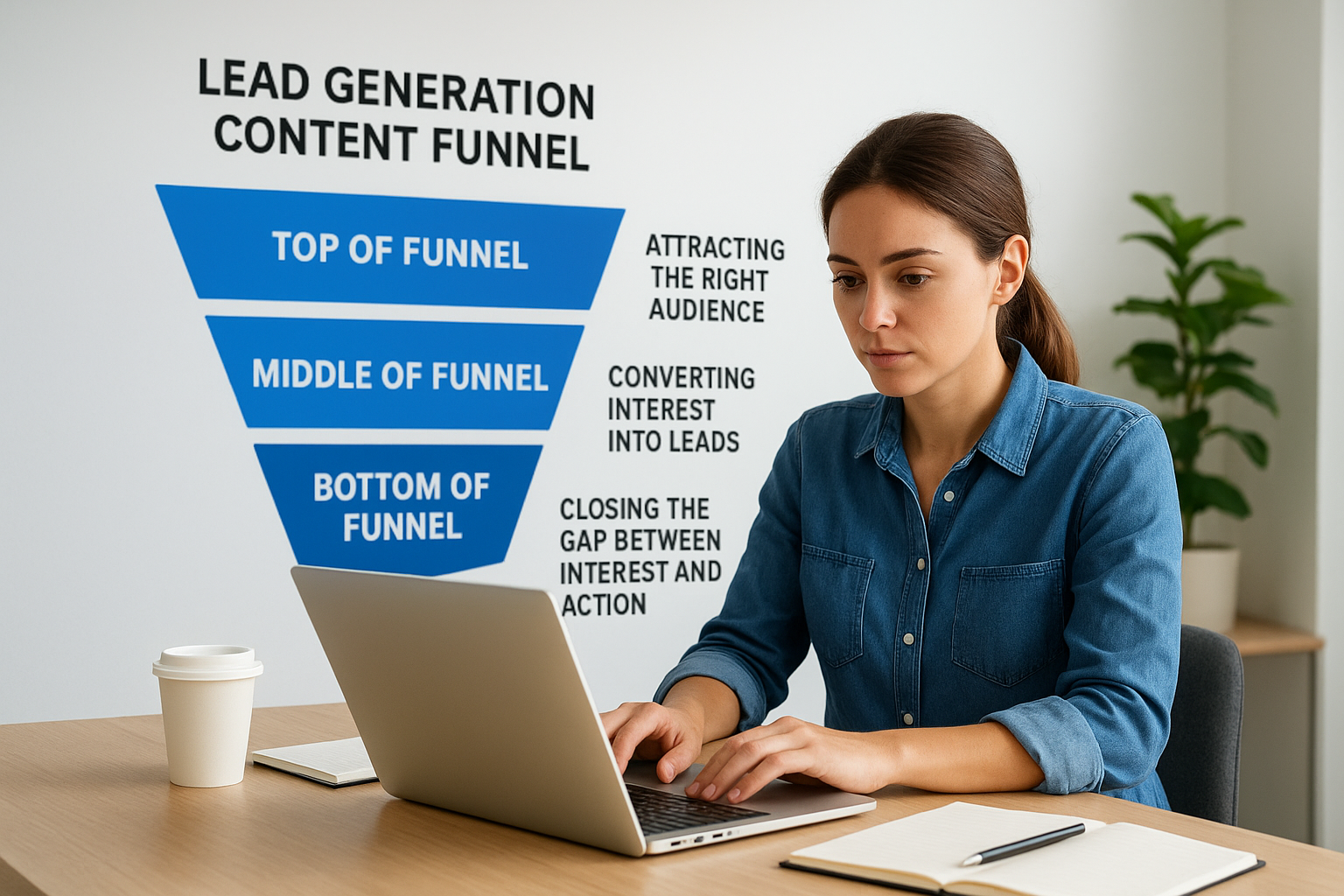
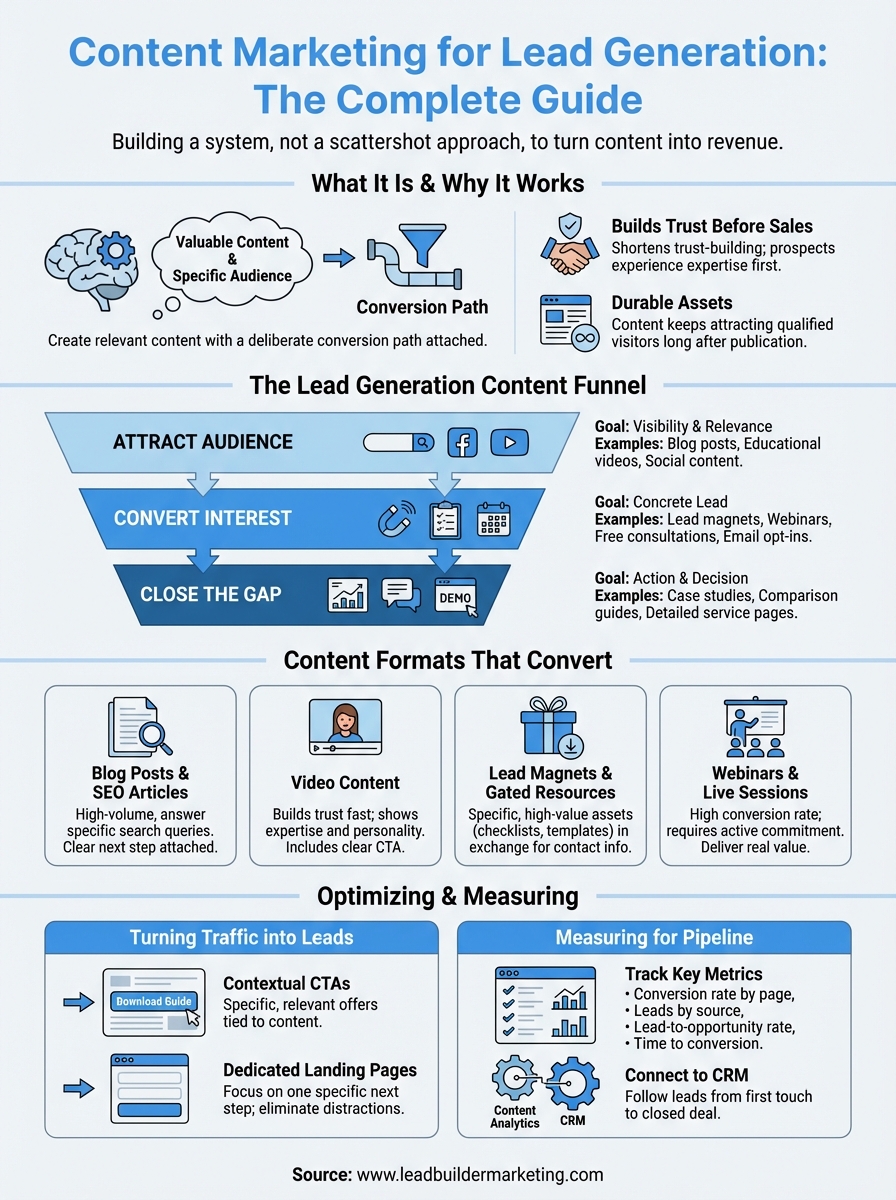
Most people think of content as a single touchpoint. In reality, content marketing for lead generation works across three distinct stages, each one designed to meet a prospect at a different point in their decision-making process. Understanding which stage your content belongs to changes how you write it, what action you attach to it, and how you measure whether it’s working.
Top of funnel: attracting the right audience
Top-of-funnel content targets people who have a problem or question but aren’t yet looking for a specific solution. Blog posts that answer common search queries, educational videos, and social content all fit here. The goal is visibility and relevance, not a sales pitch. Your job at this stage is to show up when someone types their frustration into a search bar and give them something genuinely useful in return.
The top of the funnel isn’t where you close deals. It’s where you earn the right to keep the conversation going.
Middle of funnel: converting interest into leads
Once someone knows your brand exists and trusts that you understand your subject, the middle of the funnel turns that awareness into a concrete lead. This is where lead magnets, webinars, free consultations, and email opt-ins live. You’re asking for contact information in exchange for something that delivers immediate, specific value, like a checklist, a video series, or access to a live training session. The exchange has to feel fair, which means the offer needs to solve a real, specific problem your audience already knows they have.
The quality of your middle-of-funnel content determines whether your pipeline fills with qualified prospects or random contacts who never convert. A strong offer attracts people who are genuinely considering a solution like yours. A weak or generic offer attracts everyone and converts no one.
Bottom of funnel: closing the gap between interest and action
Bottom-of-funnel content speaks directly to people who are close to making a decision. Case studies, comparison guides, detailed service pages, and testimonial videos all belong here. These pieces address the specific objections and questions a prospect has right before they commit. At this stage, your content should make the next step obvious and low-risk, whether that’s booking a call, requesting a proposal, or watching a demo. Every word should reduce friction, not add to it.
How to choose topics that attract qualified leads
Topic selection is where most content strategies quietly fail. Businesses pick subjects that feel interesting, chase trending headlines, or copy whatever competitors are writing about, and then wonder why their content brings in traffic that never converts. The right topic for content marketing for lead generation isn’t the one with the highest search volume. It’s the one your ideal buyer is actively searching for right before they’re ready to spend money.
Start with the questions your buyers already ask
Your sales team is sitting on the most valuable topic research available to you. Every question a prospect asks during a discovery call, every objection that comes up before a contract is signed, and every hesitation that slows down a deal is a content topic waiting to be written. These questions represent real, active demand from people who are already considering a purchase.
The questions that slow down your sales process are exactly the topics your content should answer first.
Start by pulling a list of the ten most common questions your team hears from prospects. Then look at what people type into Google using a tool like Google Search Console if you already have site traffic. You want topics where the searcher’s intent is clearly commercial, meaning they’re looking for a solution, comparing options, or trying to justify a decision, not just satisfying idle curiosity.
- "How much does [your service] cost?"
- "What’s the difference between [option A] and [option B]?"
- "How do I know if I need [your service]?"
- "What should I look for in a [provider type]?"
These question-based topics pull in prospects who are already in buying mode, which is exactly the audience you want landing on your site.
Check whether the topic attracts buyers or browsers
Not every topic that draws traffic builds your pipeline. A high-traffic topic aimed at beginners who will never become customers wastes your production time and clutters your analytics. Before you commit to a topic, ask yourself who specifically would search for this and whether that person has a budget problem you can solve.
One reliable test: imagine the person who types that search query. Are they a business owner trying to fix a real operational issue, or are they a student doing research? If you can’t picture a qualified buyer on the other side of that search, move to a different topic. Traffic from the wrong audience has zero conversion value regardless of how well the content performs.
Content formats that generate leads
Not every content format earns its place in a lead generation strategy. Some formats build awareness efficiently. Others convert that awareness into pipeline. The most effective approach to content marketing for lead generation uses a mix of formats that work at different stages of the funnel, each matched to what your buyer needs at that moment.

Blog posts and SEO-optimized articles
Blog posts are your highest-volume top-of-funnel asset when written with search intent in mind. A well-optimized article targeting a specific question your buyer types into Google brings in qualified traffic consistently over time, without ongoing ad spend. The key is writing posts that answer a real question completely, then attaching a clear next step at the end, whether that’s downloading a related resource or booking a consultation.
Treat every blog post as a landing page with a job to do, not just a publishing exercise.
Video content
Video builds trust faster than any other format because it shows your actual expertise and personality rather than just describing them. A short explainer video addressing a specific pain point, a behind-the-scenes look at how you deliver results, or a client testimonial in their own words all create credibility that written content struggles to match. Pair your videos with a clear call to action pointing to a lead capture page, and they become a direct pipeline driver rather than just brand content.
Lead magnets and gated resources
A lead magnet is a specific, high-value resource you offer in exchange for contact information. Checklists, templates, detailed guides, and video training series all work well here. The format matters less than the specificity. A generic "ultimate guide" attracts everyone and converts few. A narrowly focused resource that solves one precise problem your ideal buyer has right now will consistently outperform broader content that tries to appeal to a wide audience.
- Checklists your buyer can use immediately
- Templates that replace work they’d otherwise do manually
- Short video series that walk through a specific process
- Calculators or tools that help them size a decision
Webinars and live sessions
Webinars convert at a higher rate than almost any other content format because attendance requires active commitment. Someone who registers for and shows up to a live event has already demonstrated serious interest in the topic. Use the session to deliver real value, not a thinly veiled pitch, and close with a specific offer that makes the logical next step obvious for attendees who are ready to act.
How to turn traffic into leads on your website
Getting traffic to your site is only half the job. The other half is converting that traffic into actual leads, and most websites fail at this step completely. A well-structured conversion path takes someone who landed on your page with a question and gives them a clear, low-friction reason to stay engaged. Without it, even the strongest content marketing for lead generation strategy bleeds qualified prospects out the back door every single day.

Traffic without a conversion path is just an audience you’ll never speak to again.
Make your calls to action specific and contextual
Generic calls to action like "Contact us" or "Learn more" don’t give visitors a reason to act right now. Specific, contextual CTAs tied to what someone just read perform significantly better because they feel like a direct continuation of the content the visitor just consumed. If someone reads a blog post about video production budgets, the right CTA is an offer to download a production cost breakdown or book a budget consultation, not a vague link to your homepage.
Place your CTA in at least two spots: once mid-article after you’ve established real value, and again at the end after the reader has absorbed the full piece. Test both placement and offer copy regularly. Small wording changes can shift conversion rates meaningfully without requiring any additional traffic to your site.
Use dedicated landing pages for lead capture
Sending traffic to your homepage and hoping visitors find the right path on their own is one of the most expensive habits a business can develop. Dedicated landing pages built around a single offer and a single action convert at dramatically higher rates because they eliminate every possible distraction. Every element on the page, the headline, the supporting copy, the form, and the button, should focus on one specific next step and nothing else.
Your landing page form length matters more than most businesses realize. Asking for too much information up front adds enough friction to lose people who were otherwise ready to convert. Start with name and email only, then gather additional qualifying details once you’ve earned the relationship through follow-up. The goal of that first conversion is to start a conversation, not run a complete qualification interview before you’ve delivered anything of value to the person on the other side of the form.
How to nurture leads with email and video
Capturing a lead is the beginning of a relationship, not the end of the process. Most prospects who give you their contact information are not ready to buy immediately, and if you stop communicating after that first exchange, you lose them to competitors who stay in front of them consistently. Effective content marketing for lead generation includes a deliberate nurture sequence that moves leads from initial interest toward a buying decision using email and video as the primary tools.
Build an email sequence that delivers value first
A nurture email sequence is a series of planned messages sent after someone converts on your site or downloads a lead magnet. The goal isn’t to sell on every email. The goal is to keep delivering useful content that reinforces your expertise and keeps your business relevant in your prospect’s mind while their buying timeline matures.
Your first email sets the tone for the entire relationship, so lead with something immediately useful rather than a pitch.
Each email in your sequence should do one specific job: answer a question, introduce a relevant piece of content, share a client result, or address a common objection. Keep the sequence focused on what you know your target buyer cares about based on the topic that originally brought them to you. A prospect who downloaded a guide about video production costs wants to hear about budgeting, timelines, and ROI, not a general overview of every service you offer. Relevance drives engagement, and engagement drives replies, meetings, and sales.
Use video inside your nurture emails
Plain-text emails get opened, but video thumbnails inside emails get clicked at dramatically higher rates because they stand out visually and promise a richer experience than reading another block of text. Embedding a short video, even just two to three minutes, where you address a specific concern your lead likely has creates a personal connection that written content cannot replicate.
Record short, direct videos that speak to one concern per message: how you handle a specific part of your process, what a typical project outcome looks like, or how to evaluate vendors in your category. These don’t require studio-grade production quality to be effective. What they do require is clarity and a clear next step at the end, pointing your viewer toward booking a call or replying with their biggest question. That single action is what separates nurture content that builds pipeline from content that just fills inboxes.
How to measure and optimize lead gen content
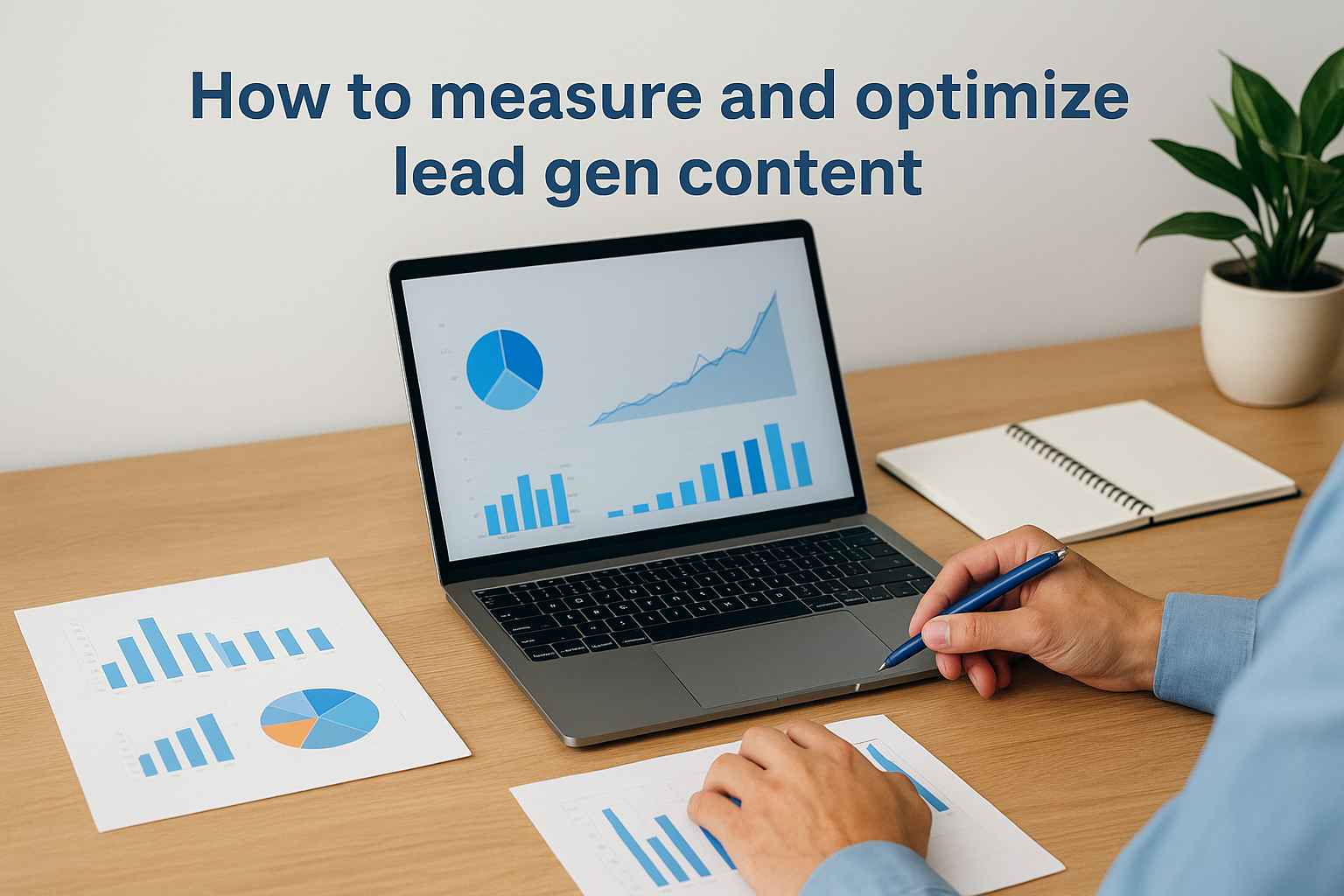
Running content marketing for lead generation without tracking the right numbers is the same as running a sales team without a CRM. You’re doing real work with no way to know what’s actually paying off. Measurement isn’t the final step in your content process. It’s the feedback loop that tells you where to invest more and where to stop wasting time and budget.
Track the metrics that connect content to pipeline
Most content teams default to traffic and page views as their primary success indicators, which tells you almost nothing about whether your content is generating revenue. The metrics that actually matter are the ones that tie directly to lead volume and quality. Focus on these instead:
| Metric | What it tells you |
|---|---|
| Conversion rate by page | Which content pieces are turning visitors into leads |
| Leads by source | Which channels and topics are driving the most qualified contacts |
| Lead-to-opportunity rate | Whether the leads your content generates are actually sales-ready |
| Time to conversion | How long it takes a lead to move from first content touch to a sales conversation |
If a piece of content drives high traffic but zero conversions, it’s an audience asset, not a pipeline asset, and your strategy should treat it differently.
Tracking these numbers requires connecting your content analytics to your CRM so you can follow a lead from the blog post or video that first brought them in all the way through to a closed deal. Without that connection, you’re measuring output instead of outcomes.
Optimize based on what the data actually shows
Once you have the right data, optimization becomes specific instead of speculative. Start with your highest-traffic pages that convert at below-average rates. These are your biggest leverage points because the audience is already there. A stronger CTA, a more relevant lead magnet, or clearer next-step language can lift conversion rates on existing traffic without requiring you to publish anything new.
Run one change at a time on each page so you can isolate what actually moved the needle. Testing headline copy, CTA placement, and offer type separately gives you clean data to act on. Once a page is converting well, document what worked and apply the same principles to new content from the start rather than waiting to fix underperformance after the fact. That’s how a content library compounds into a lead generation engine that gets more efficient over time instead of just larger.
Common mistakes that kill lead generation
Even businesses that invest heavily in content marketing for lead generation end up with a pipeline that doesn’t grow. The reason is rarely a lack of content. It’s almost always a handful of recurring, fixable mistakes that break the conversion path before a lead ever has a chance to form.
Publishing content without a conversion path
The single most common mistake is creating content that educates readers and then lets them leave with no clear next step. Every piece of content you publish needs a specific, relevant offer attached to it that gives the reader a reason to exchange their contact information for something of greater value. Without that offer, even your best-performing traffic just bounces.
Content without a conversion path is brand building with none of the pipeline benefit.
You don’t need a hard sell on every page. What you do need is a clear, contextual CTA that feels like a natural continuation of what the reader just consumed. A blog post about video production ROI should end with an offer tied to measuring production results, not a generic contact link that gives your visitor no reason to act right now.
Targeting search volume instead of buyer intent
Chasing high-volume keywords that attract beginners, students, or casual researchers might grow your traffic numbers, but it won’t grow your pipeline. When your content topics don’t match the questions your actual buyers ask before making a purchase decision, the leads your strategy produces either never convert or take years to get anywhere near a sale.
Focus instead on topics where the searcher’s intent is clearly commercial. Questions about pricing, comparisons between options, and "how do I know if I need this" searches come from people who are already close to buying. Those topics may attract less traffic than broad educational posts, but the traffic they bring converts at a fraction of the effort and a much higher rate.
Letting leads go cold after the first conversion
Capturing a lead and then failing to follow up consistently is one of the most expensive habits in content marketing. Most prospects aren’t ready to buy immediately, and a gap in your nurture sequence is all it takes for a competitor who communicates more regularly to close a deal you generated. Build a structured follow-up sequence before you launch any lead magnet or gated resource, so every new contact enters a path that keeps your business relevant until their buying timeline catches up.
Next steps
You now have a complete picture of how content marketing for lead generation works, from choosing topics that attract buyers to measuring which content pieces are actually driving pipeline. The system only produces results when you put it into motion. Start by identifying the three most common questions your prospects ask before they buy, then build one piece of content around each question with a specific conversion offer attached.
From there, set up a simple email nurture sequence and connect your content analytics to your CRM so you can track leads from first touch to closed deal. That connection is what separates a content strategy that grows your business from one that just fills your publishing calendar. If you want experienced help building this kind of system from the ground up, talk to the team at Lead Builder Marketing and find out what a results-driven content strategy looks like in practice.