Print-on-demand looks like a design business. It is a search business with a design step attached.
The reasoning is simple. Every seller on the platform prints on the same blanks, through the same fulfillment, at the same quality, delivered on the same terms. Product differentiation is close to zero.
What remains is whether a customer typing something into a search bar is shown your design or somebody else’s, and that outcome is decided by a text field capped at fifty characters.
Fifty. Not five hundred.
TL;DR
- A Merch listing gets a 50-character title. That is the entire primary ranking surface, and it is a fraction of what a standard Amazon product listing works with.
- Royalties typically run 20% to 30%, so price is a ranking decision as much as a margin one.
- Artwork must be at least 300 dpi. Most upload rejections are resolution or intellectual property, not taste.
- Trademark clearance takes minutes and is free. Skipping it is the single fastest route to losing the account.
In short; nobody loses on Merch because their design was mediocre. They lose because fifty characters were spent badly.
Chapters
What the platform actually is

Amazon Merch on Demand is Amazon’s print-on-demand program, rebranded from Merch by Amazon in 2022. A seller uploads artwork, sets a price, and Amazon handles printing, fulfillment, customer service and returns. No inventory is purchased. No unit is produced until one is sold.
That structure removes the two costs that normally gate a physical product business, which is why the program attracts an enormous volume of applicants and why acceptance is not automatic. It also means the seller controls almost nothing that normally constitutes a product decision. Material, print process, sizing, shipping speed and returns policy are all fixed.
What the seller controls is the artwork and the metadata. Of those two, only one is a ranking input.
The metadata surface, and how small it is
Compare the fields available on a Merch listing against a standard Amazon product listing and the constraint becomes obvious.
| Field | Merch on Demand | Standard Amazon listing |
|---|---|---|
| Title | 50 characters | Typically 150 to 200 characters |
| Bullet points | 2, up to 50 characters each | 5, several hundred characters each |
| Backend search terms | Not seller-controlled | 249 bytes |
| Product description | Brief, secondary weight | Long form, supports A+ content |
| Variations | Fixed by product type | Seller-defined |
| Images | Design mockups only | Multiple seller-supplied images |
Read the first column as a total. A Merch seller has roughly 150 characters of text across the entire listing, and half of that sits in bullets that carry less weight than the title. A standard listing has several thousand characters plus a backend field the customer never sees.
This is not a smaller version of the same problem. It is a different problem. On a standard listing, a seller can afford to include synonyms, use cases, materials, dimensions and audience descriptors. On Merch, including a single unnecessary word measurably costs discoverability, because that word occupies space no other term can use.
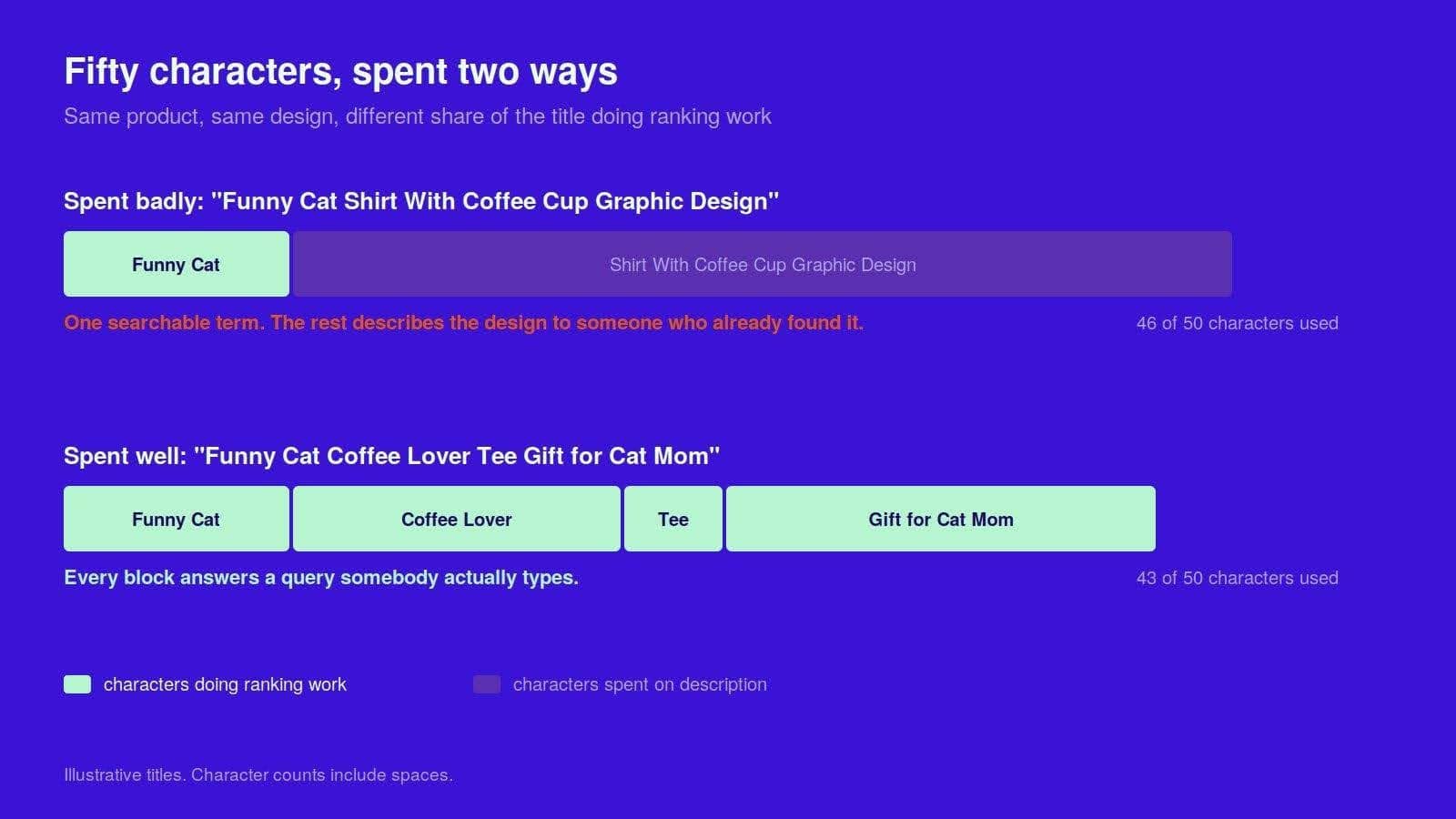
The instinct most new sellers bring is to write a title that describes the design. “Funny Cat Shirt With Coffee Cup Graphic Design” spends forty-six characters saying almost nothing a search engine can act on. It contains one term with meaningful search intent. The rest is description for a human who has already found the product, which is the one audience that does not need convincing.
Marketplace search is not web search, and the difference is structural

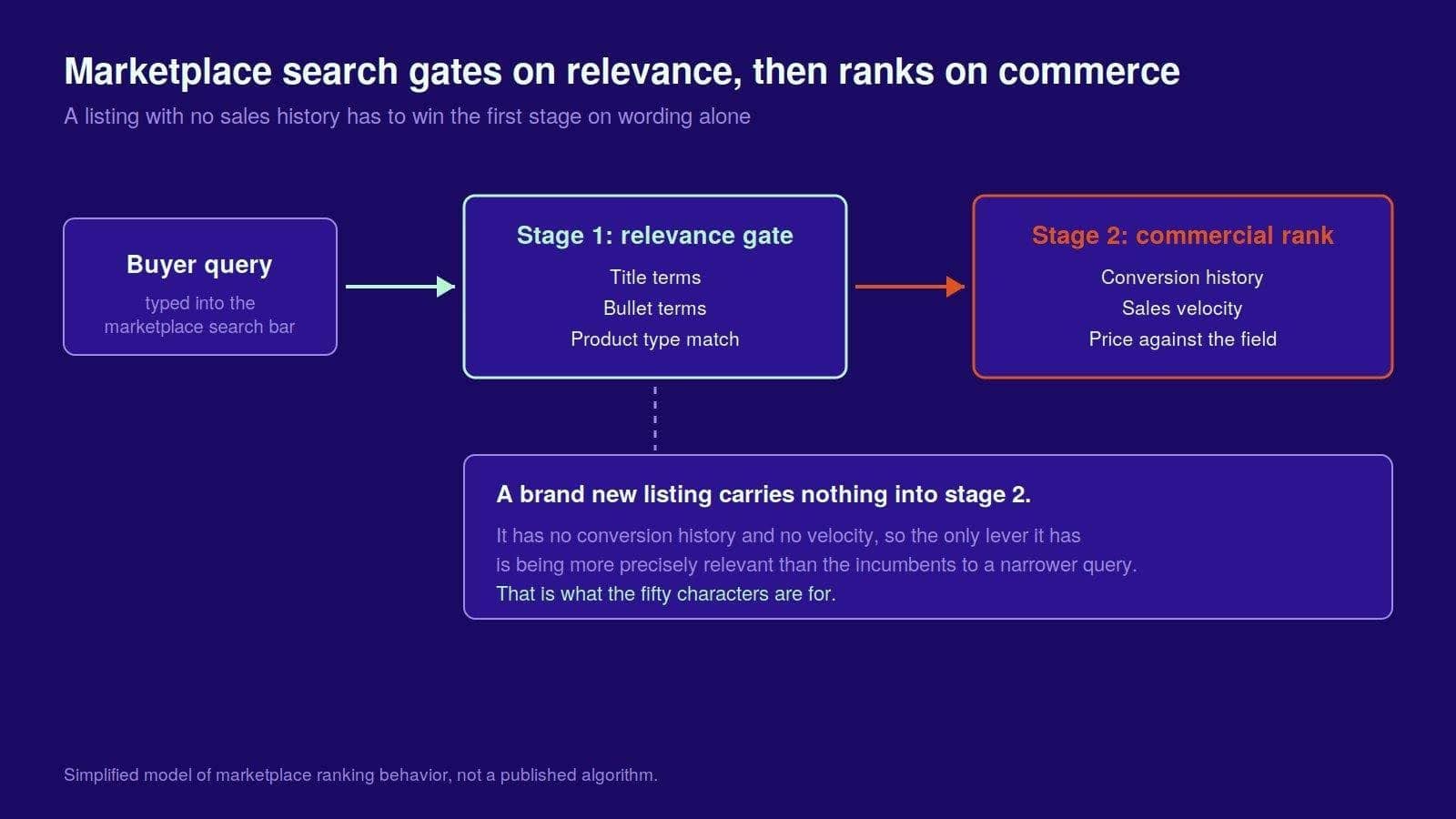
Search inside a marketplace behaves like a recommendation system with a text input, not like a general web index. Relevance is a gate rather than a ranking. Once a listing clears the relevance threshold for a query, position is decided largely by commercial signals: conversion history, sales velocity, price competitiveness, and how the listing performs against others already holding the slot.
This has an uncomfortable implication for new listings. A design with no sales history has no commercial signal, so it competes on relevance alone, against listings that have both. The only lever available in that state is being more precisely relevant than the incumbents to a narrower query.
That dynamic is not unique to Amazon, and it is why the cold start usually gets broken from outside the search box. An audience brought in from elsewhere, whether a mailing list, an existing following, or a deliberate effort to promote Amazon products on social media, supplies the early conversions that on-platform search will not hand a listing with no record.
That is a way around the problem rather than a solution to it, because the listing still has to clear the relevance gate first. Marketplace search rewards specificity at launch and volume afterwards, and a listing that tries to compete broadly on day one competes with nothing.
For Merch specifically, this means the fifty characters should be spent on a query a real person types and a small number of listings currently answer well. Not the broadest term. The narrowest one with genuine volume behind it.
Royalties make price a ranking input
Royalty rates on Merch typically run 20% to 30%, varying by product type and price tier. The seller sets the list price; Amazon deducts its costs; the remainder is the royalty.
This creates a coupling that does not exist in most retail. Raising the price raises the royalty per unit, and it also raises the price the customer compares against every other design answering the same query. Since price competitiveness feeds ranking, a price increase that improves per-unit economics can reduce placement, which reduces units, which can reduce total royalty despite each sale earning more.
Sellers who treat pricing as a pure margin exercise get caught by this repeatedly. The correct framing is that price is one of the very few ranking inputs a Merch seller controls directly, and it should be set with placement in mind rather than optimized in isolation.
The practical approach is to establish the price band that the listings already ranking for the target query occupy, and to make a deliberate decision about where inside that band to sit. Sitting above it requires the design to carry the difference. That is achievable, but it is a decision rather than an accident.
There is a second-order effect worth naming, and it is the reason sequencing matters more here than in most retail. Sales history is a listing-level asset, not an account-level one. A seller with one strong performer and nine dormant designs does not get to lend the performer’s signal to the other nine. Each listing starts from zero and has to clear the relevance gate on its own.
That inverts the usual creative instinct. The temptation is to lead with the design the seller is proudest of, on the reasoning that the best work deserves the first slot. The better move is to lead with the design that answers the narrowest query with genuine volume behind it, because a listing that converts early is the only thing that stops competing on relevance alone. The proudest design can wait until there is something for it to rank against.
Order of upload is therefore a commercial decision. Most sellers treat it as a matter of what was finished first.
The two rejection causes worth taking seriously
Upload rejections cluster around two things, and neither of them is aesthetic judgment.
Resolution. Artwork must be at least 300 dpi, supplied as PNG or JPEG. Files exported at screen resolution look identical on a monitor and fail immediately on upload. This one is trivially avoidable and still accounts for a large share of first-attempt failures.
Intellectual property. This is the serious one, because the consequence is not a rejected upload. It is account termination.
Trademark clearance is free and takes minutes. The USPTO’s trademark search system lets anyone check whether a phrase is already registered, and the office’s own guidance is explicit that the point of searching is to confirm a mark is available for the specific goods or services in question. A phrase can be freely usable on one product class and registered on another, which is exactly the trap apparel sellers fall into, because apparel is one of the most heavily registered classes there is.
Common phrases are not safe by virtue of being common. Short, obvious slogans get registered constantly, and a design carrying one on a t-shirt is being used in precisely the class where the registration bites.
Copyright is the separate question, and it is worth understanding that it operates differently. The US Copyright Office explains that protection exists automatically once an original work is fixed in a tangible medium, with no registration required. Two consequences follow. Somebody else’s artwork is protected the moment they made it, whether or not they filed anything. And a seller’s own original designs are protected the moment they are created, though registration is what makes enforcement practical.
The same page notes that copyright protects expression and never ideas, procedures, methods or concepts. A design concept cannot be owned. A specific rendering of it can.
What a fifty-character title should contain
Working backwards from all of the above produces a fairly rigid brief.
The title needs the product noun, because queries include it and a listing that omits it fails the relevance gate for a large share of searches. It needs the primary descriptor, meaning the term the target buyer actually types. It needs the audience or occasion qualifier, if and only if one exists that people search for. And it needs nothing else.
Words that do not earn their space: “shirt” repeated when the product type already establishes it, “design”, “graphic”, “gift” used generically, adjectives that describe quality rather than subject, and any brand or franchise term, which is the trademark problem wearing a marketing costume.
A useful test before committing a title. Read it back and ask, for each word, what query that word wins. If the honest answer for a word is that nobody types it, the word is decoration and the space is better spent. Fifty characters allows roughly six to eight words of English. Losing one to decoration costs somewhere between twelve and sixteen percent of the entire ranking surface, which is a sentence worth rereading before uploading anything.
The bullets deserve the same audit. Two fields of fifty characters each is not room for benefit-led copy, and treating it as such wastes both. Use them for the qualifiers that would not fit in the title, which usually means occasion, recipient or a secondary phrasing of the subject that a different group of buyers types.
The two bullets, at up to fifty characters each, are secondary but not decorative. They are the right home for the terms that would not fit in the title and for the occasion framing that turns a browser into a buyer.
The honest summary is that this is a constrained optimization problem, not a creative one. The creative work happens in the artwork. The commercial work happens in a text field shorter than this sentence.
Is the program worth it
For a designer with an existing audience and a body of original work, the economics are reasonable, because the fixed costs are genuinely zero and the fulfillment burden is genuinely absent.
For anyone approaching it as passive income built on generic designs and volume uploads, the answer has been no for several years. The relevance gate is unforgiving to listings with no commercial signal, and the trademark exposure on generic phrasing is real and permanent.
The sellers who do well treat each listing as a search asset with a design attached, rather than a design with a title attached. That inversion is the whole discipline.
Questions people ask about Merch on Demand
What does it cost to start?
Nothing. There is no listing fee, no inventory purchase and no minimum order. The cost is the design work and the acceptance wait, since the program is application-gated rather than open.
How are royalties actually calculated?
Amazon deducts its production, fulfillment and marketplace costs from the list price, and what remains is the royalty, typically landing in the 20% to 30% range depending on product type and price point. The seller sets the list price, which is why price and placement have to be decided together.
Can the same design be sold on other print-on-demand platforms?
Generally yes, since the seller retains rights to their own original artwork. The constraint worth checking is exclusivity language in any agreement already signed elsewhere, and the practical constraint is that listing the same design in several places splits its sales history rather than combining it.