The Partnership ModelThat’s Replacing Traditional Agency Relationships
I’ve watched the agency-client relationship crack apart over the past decade. The model that worked for years—hire specialists, coordinate deliverables, manage vendors—is collapsing under its own weight.
The fragmentation isn’t just inefficient anymore. It’s become economically unsustainable.
What I’m seeing emerge in its place isn’t a minor adjustment to how agencies and clients work together. It’s a fundamental restructuring of the partnership model itself, driven by coordination costs that now exceed the value individual specialists deliver.
Here’s where I think we’re headed in the next three to five years.
The Fragmented Model Is Dying From Coordination Loss
The traditional approach—strategic consultant over here, creative agency over there, media buyer somewhere else, content producer in another building—made sense when each specialist operated in a distinct domain with clear handoff points.
That world doesn’t exist anymore.
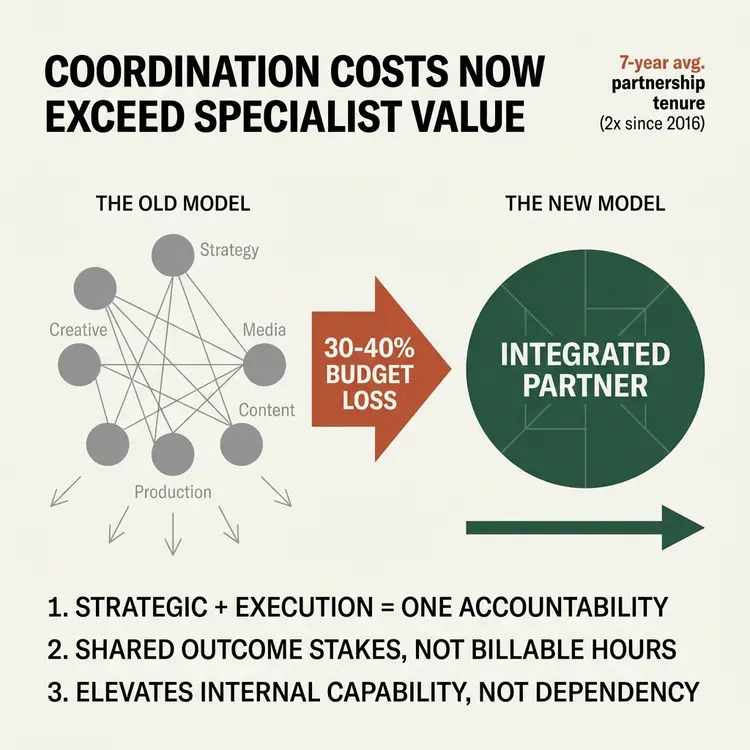
What I’m observing across mid-tier businesses is this: the cost of coordinating multiple vendors now consumes more resources than the specialized expertise delivers in return. Internal teams report spending 30% more time on coordination than execution when working with fragmented service providers.
The math doesn’t work. Research shows that fragmented brand and marketing efforts waste 30-40% of marketing budgets while simultaneously eroding the premium positioning that drives profitability.
You’re not just paying for the specialist work. You’re paying for the gaps between specialists.
Every handoff point introduces friction. Strategic intent gets diluted in translation. Creative concepts lose coherence across execution channels. Timeline delays compound as dependencies multiply. Quality degrades when no single entity owns the complete outcome.
The hidden cost structure looks like this:
- Time spent briefing multiple vendors on the same strategic context
- Energy lost managing conflicting recommendations from specialists who don’t coordinate
- Revenue opportunity missed while waiting for sequential handoffs to complete
- Brand coherence eroded when execution happens in isolated silos
- Internal team capacity consumed by vendor management instead of market-facing work
I used to think the solution was better project management. Tighter processes. Clearer communication protocols.
I was wrong.
The problem isn’t coordination quality. It’s that coordination itself has become the bottleneck. You can’t process-engineer your way out of structural dysfunction.
What’s Replacing It: Integrated Partnership With Outcome Stakes
The model emerging to replace fragmented specialist networks operates on a different premise entirely.
Instead of hiring vendors to deliver discrete outputs, mid-tier businesses are moving toward integrated partners who own continuity from strategic conception through commercial conversion.
This isn’t about finding a bigger agency. It’s about finding a different relationship structure.
The shift I’m tracking has three defining characteristics:
First, strategic and execution functions collapse into a single accountability point.
The artificial separation between “thinkers” and “doers” disappears. Your strategic partner is also your execution partner. The entity that designs the approach also builds it, ships it, and measures whether it worked.
This eliminates the value leakage that happens every time strategic intent passes through a handoff point to reach execution.
Second, the partnership operates on shared outcome stakes rather than billable hours.
Compensation models that reward time spent or activities completed create incentive misalignment. Your vendor profits from complexity and duration. You profit from compression and velocity.
The emerging model ties partnership value to commercial outcomes. When your revenue increases, your partner’s value increases. When market perception shifts, both entities benefit. The stake in results creates alignment that billing hours can never produce.
Third, the partner elevates internal team capability rather than creating dependency.
Traditional vendor relationships often produce learned helplessness in client teams. The more you outsource, the less capable your internal operators become.
The integrated partnership model works in reverse. Your external partner should increase the performance ceiling of your internal team, not replace it. The relationship should build confidence and capability that persists after the engagement ends.
Data supports this directional shift. Average client-agency relationship tenure now stands at approximately seven years—more than double the 3.2-year average from 2016.
That doubling signals something fundamental. Clients aren’t cycling through vendors anymore. They’re finding partners and staying.
Why Mid-Tier Businesses Will Lead This Transition
The integrated partnership model isn’t equally accessible across all business scales.
Enterprise organizations have structural barriers. Multiple decision nodes, procurement processes, departmental silos, and vendor management systems all create friction that prevents deep partnership integration. The larger the organization, the harder it becomes to collapse strategic and execution functions into unified accountability.
Survival-stage businesses have different constraints. When you’re still validating product-market fit or managing cash flow volatility, you can’t absorb the integrated transformation required for this partnership model to function.
Mid-tier businesses occupy the optimal zone.
You’ve achieved initial market validation. Revenue is established. The team has capacity. But you’re hitting a ceiling where incremental improvements don’t produce breakthrough results anymore.
This is where integrated partnership delivers asymmetric value.
You have sufficient structural stability to absorb systematic transformation without operational collapse. Authority and accountability converge in single decision nodes, which eliminates the coordination loss that plagues enterprise implementations. You can move fast enough to capitalize on integrated execution velocity.
The economic case becomes compelling when you examine the alternative. Brands looking for more centralization (53%), flexibility (45%) and simplified services (37%) from their agencies aren’t asking for incremental vendor improvements.
They’re describing a different relationship structure entirely.
And for the 40% of clients who mandate agency reviews, those reviews carry a substantial financial burden—averaging $408,500 per pitch. Mid-tier businesses can’t afford that churn. The integrated partnership model eliminates it by creating switching costs beyond contractual obligations.
The Mechanics of How This Actually Works
Describing the destination is easier than mapping the path to get there.
Here’s what the transition from fragmented vendors to integrated partnership actually looks like in practice.
You start by identifying where coordination loss is costing you the most.
Map your current vendor ecosystem. Track how much time your team spends managing handoffs, reconciling conflicting recommendations, or waiting for sequential dependencies to clear. Quantify the revenue opportunity cost of delayed execution.
The goal isn’t to find inefficient vendors. It’s to locate structural friction points where the coordination itself consumes more value than the specialist work delivers.
Next, you collapse the highest-friction functions into a single integrated partner.
This doesn’t mean firing all specialists simultaneously. It means identifying which functions require continuity from conception through execution, then finding a partner who can own that complete chain.
For most mid-tier businesses, this starts with the strategic-to-execution gap in communication architecture. The entity that designs your positioning should also produce your content, manage your distribution channels, and measure commercial impact.
When one partner owns that complete cycle, coordination loss disappears.
Then you restructure the engagement model around outcome accountability.
Move away from scope-of-work contracts that enumerate deliverables and billable hours. Move toward outcome-based agreements that tie partnership value to commercial results.
What does success look like in revenue terms? In market perception shift? In competitive positioning change? Define those outcomes, then structure compensation to reward achievement rather than activity.
This creates natural alignment. Your partner profits when you profit. The incentive to compress timelines, eliminate waste, and focus on high-leverage activities becomes automatic.
Finally, you use the partnership to elevate internal team capability.
The integrated partner shouldn’t become a permanent crutch. The relationship should transfer knowledge, build confidence, and raise the performance ceiling of your internal operators.
This happens through embedded collaboration rather than arms-length vendor management. Your team works alongside the partner, observing methodology, understanding decision frameworks, and internalizing the patterns that produce results.
Over time, your internal capability increases. The partnership evolves from execution support to strategic guidance. Eventually, your team operates at a higher level than would have been possible through traditional vendor relationships.
The Barriers You’ll Face Making This Shift
Transitioning from fragmented vendors to integrated partnership isn’t technically complex, but it requires dismantling assumptions that feel foundational.
The first barrier is psychological comfort with specialist depth.
Hiring the “best” specialist in each domain feels safer than trusting a single partner to handle multiple functions. The specialist has credentials, case studies, and focused expertise. The integrated partner looks like a generalist by comparison.
This perception misses the actual value equation. Specialist depth doesn’t matter if coordination loss prevents that depth from reaching execution. Integration capability—the ability to maintain continuity across functions—becomes more valuable than isolated expertise.
The second barrier is existing vendor relationships and sunk costs.
You’ve invested time building relationships with current vendors. They understand your business. Switching feels disruptive and risky.
But relationship tenure with underperforming vendors isn’t an asset. It’s an anchor. The question isn’t whether your current vendors are competent. It’s whether the fragmented model itself can deliver the outcomes you need.
Most often, it can’t.
The third barrier is internal process and approval structures built around vendor management.
Your procurement system, budgeting process, and approval workflows assume you’re managing multiple specialists. Collapsing those functions into a single integrated partner requires restructuring how decisions get made and how success gets measured.
This organizational friction often prevents adoption even when the economic case is clear.
The fourth barrier is difficulty finding partners who actually operate this way.
Most agencies claim integration but deliver fragmentation with better branding. They talk about partnership but operate on billable hours. They promise strategic continuity but hand off execution to disconnected teams.
Finding a partner who genuinely owns the complete chain from conception through conversion requires evaluation criteria different from traditional vendor selection. You’re not comparing specialist credentials anymore. You’re assessing integration capability, outcome accountability, and cultural fit for embedded collaboration.
What This Means for How You Evaluate Partners
The criteria that worked for selecting specialist vendors don’t translate to evaluating integrated partners.
Portfolio quality becomes less relevant than process transparency. You need to understand how the partner moves from strategic conception to executed output. Can they articulate the methodology? Do they own the complete production chain or subcontract critical functions?
Specialist credentials matter less than demonstrated pattern recognition across complete cycles. Has this partner guided businesses through the full transformation from positioning clarity to market perception shift to revenue impact? Can they show longitudinal results, not just isolated campaign wins?
Pitch performance becomes less important than cultural compatibility for embedded work. You’re not buying a presentation. You’re entering a relationship where your team collaborates daily with their team. Do working styles align? Do communication patterns match? Can both teams operate with the transparency required for genuine integration?
The evaluation questions shift:
- Who actually performs the work? (Not which team is assigned, but which specific humans will touch your project)
- What gets subcontracted and what stays internal? (Integration breaks down at outsourcing boundaries)
- How do you measure success beyond deliverable completion? (Outcome accountability requires outcome metrics)
- What happens when strategic direction needs to change mid-execution? (Integrated partners adapt; vendors renegotiate scope)
- How does this partnership make our internal team stronger? (Capability transfer should be explicit, not accidental)
These questions reveal whether you’re talking to an integrated partner or a specialist vendor with partnership language.
The Timeline for This Transition
I don’t think this shift happens overnight. The fragmented specialist model has decades of institutional momentum behind it.
But the economic pressure is building faster than most people recognize.
Over the next 18 months, I expect to see continued volatility in traditional agency-client relationships. The data showing 40% of clients switching agencies in the next six months reflects underlying dissatisfaction with fragmented models that can’t deliver integrated outcomes.
In the 2-3 year window, mid-tier businesses that adopt integrated partnership models early will establish competitive advantages that become difficult for competitors to replicate. The performance gap between fragmented and integrated approaches will widen as coordination costs continue increasing.
By year five, I think integrated partnership becomes table stakes for mid-tier businesses operating in communication-dependent markets. The fragmented specialist model will still exist, but it will serve different contexts—enterprise organizations with structural barriers to integration, or project-specific needs that don’t require strategic continuity.
The businesses that move first get the advantage of partner selection before demand exceeds supply. The businesses that wait face the risk of falling behind competitors who’ve already eliminated coordination loss from their operating model.
Why This Matters Now
The shift from fragmented vendors to integrated partnerships isn’t a trend to watch. It’s a structural transition already in motion.
The economic forces driving this change—coordination costs exceeding specialist value, timeline compression through technology, outcome accountability replacing activity measurement—aren’t reversing. They’re accelerating.
For mid-tier businesses, the choice isn’t whether to make this transition. It’s whether to lead it or follow it.
The businesses that recognize coordination loss as their primary constraint can restructure partnerships before competitive pressure forces the change. You get to choose your integrated partner strategically rather than reactively.
The businesses that maintain fragmented vendor models will hit a performance ceiling where incremental improvements can’t overcome structural dysfunction. Eventually, the coordination cost becomes unsustainable and forces a crisis-driven transition.
I’ve seen both paths. The strategic transition produces better outcomes with less disruption.
The integrated partnership model isn’t perfect. It requires cultural compatibility that’s harder to find than specialist credentials. It demands outcome accountability that feels riskier than deliverable-based contracts. It needs organizational willingness to restructure processes built around vendor management.
But for mid-tier businesses where communication architecture directly influences commercial conversion, the fragmented alternative no longer works.
The coordination loss has become too expensive. The value leakage at handoff points has become too severe. The performance ceiling imposed by structural fragmentation has become too limiting.
The question isn’t whether integrated partnership is the right model. It’s whether your business is ready to adopt it before your competitors do.