The Lead Generation Advice Industry Has an Execution Problem
I’ve spent two decades watching the gap between what people say works in lead generation and what actually produces revenue. The distance between those two points keeps growing.
Here’s what I’ve observed: the people creating most of the lead generation frameworks you’re following have never had to hit a quota under their own name. They’ve never felt the pressure of a pipeline that needs to convert by Friday or the business doesn’t make payroll. They’ve never had to look a client in the eye and explain why the strategy they sold didn’t produce the leads they promised.
They build theories. You live with the consequences.
The Credential Gap Nobody Talks About
Walk through any marketing conference. Scan the speaker lineup. Count how many of those experts offering lead generation advice have actually generated leads as their primary revenue responsibility in the last three years.
Not managed a team that does it. Not consulted on it. Actually done it—where their income depended on the conversion rate.
The number is smaller than you think.
I’ve noticed something consistent across consultants who only prescribe recommendations without offering to fulfill the work themselves. It’s a clear signal they may not have the marketing skills or practical experience in the field they’re providing advice for. This isn’t speculation—it’s pattern recognition across hundreds of engagements where I’ve seen the aftermath of theoretical advice meeting operational reality.
The research backs this up. Practical experience, a solid understanding of marketing strategies, and a track record of successful projects outweigh formal education in this field. Yet the industry remains flooded with theorists who’ve never personally hit a quota.
Why Most Lead Generation Strategies Fail at Implementation
Over 60% of marketers report that generating high-quality leads is their biggest challenge. Think about that number. More than half the field struggles with the fundamental task they’re supposed to be experts in.
But here’s the part that reveals the real problem—only around 21% of leads actually convert into sales.
That’s not a lead generation problem. That’s an execution gap so wide you could drive a truck through it.
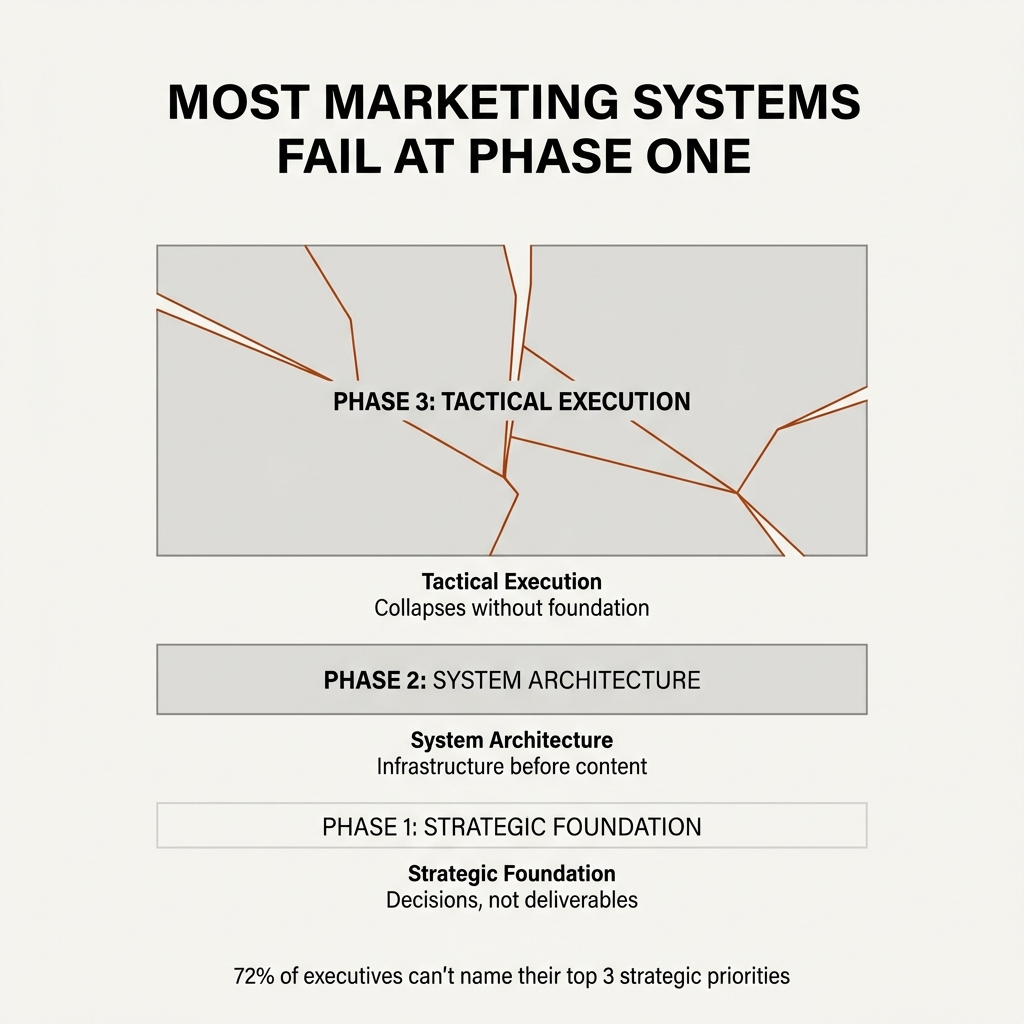
I used to think this was about tactics. Better targeting. Smarter messaging. More sophisticated automation. After watching this pattern repeat across industries and company sizes, I realized the problem sits upstream of all that.
The advice itself is structurally disconnected from the physics of execution.
Academic research confirms what practitioners already know: strategy implementation continues to face high failure rates in practice, and academics still struggle to grasp its persistent complexities. The research calls for insights on the causes of intended-realized strategy gaps—which is academic language for “we know most strategies fail but we don’t really understand why.”
I understand why. Most marketing strategies suffer due to poor implementation, but the people creating those strategies have never had to implement them under real constraints.
The Resource Reality Nobody Mentions
Forty percent of marketers cite lack of resources, improper budgeting, and insufficient staff as the biggest barriers to lead generation. These are the challenges that desk-bound consultants rarely face when crafting their theoretical frameworks.
When you’re building a strategy in a vacuum, you don’t account for the fact that the person executing it is also handling customer service, managing the website, coordinating with sales, and trying to figure out why the CRM keeps breaking.
You create plans that require dedicated teams, specialized tools, and uninterrupted focus.
Then you wonder why implementation fails.
The Measurement Crisis
Here’s a statistic that should concern everyone in this field: around 25% of marketers fail to calculate conversion rates accurately. Nearly half—47%—struggle to measure accurate ROI across multiple channels.
This means the people offering advice may lack the analytical rigor required for real accountability. More importantly, it means the businesses following that advice can’t actually tell what’s working.
I’ve seen this play out dozens of times. A consultant delivers a comprehensive lead generation strategy. The client implements it—or tries to. Three months later, nobody can definitively say whether it worked because the measurement framework either doesn’t exist or doesn’t align with how the business actually operates.
The strategy looks perfect on paper. The execution data tells a different story.
When you can’t measure accurately, you can’t iterate effectively. You’re flying blind, making decisions based on gut feel and hoping the next tactic works better than the last one.
The Sales Handoff Disaster
Even when lead generation works—when you actually get qualified prospects into the pipeline—there’s another execution gap waiting.
According to MarketingSherpa, 79% of leads aren’t nurtured through the sales handoff. Only one in five leads are developed properly when handed off from marketing to sales.
That’s a catastrophic failure at the most critical moment of the entire process.
I’ve watched companies invest tens of thousands of dollars in lead generation campaigns, successfully attract qualified prospects, and then lose them because nobody mapped the handoff process. The marketing team thinks their job ends when they pass the lead to sales. The sales team thinks marketing should have warmed them up more. The lead falls into the gap between those two assumptions.
Fewer than 10% of companies report that they’ve mapped their sales process to their customers’ buying cycles. Think about what that means. Nine out of ten companies are running lead generation strategies without understanding how their prospects actually make decisions.
The theoretical advice doesn’t address this because addressing it requires understanding both the marketing mechanics and the sales reality—and most consultants only live in one of those worlds.
The Quality Problem Nobody Wants to Discuss
Seventeen percent of sales reps saw the lack of high-quality leads as their biggest challenge in 2023. Meanwhile, 34% of sales reps said the main reason leads back out of deals is because they aren’t ready to make a purchase.
Translation: theoretical lead generation strategies are filling pipelines with unqualified prospects rather than revenue-ready opportunities.
This happens when the person designing the strategy optimizes for volume metrics instead of conversion outcomes. It’s easy to generate leads when you don’t have to convert them. It’s easy to recommend aggressive top-of-funnel tactics when you don’t have to explain to sales why half the leads aren’t actually in-market.
The advice focuses on filling the funnel. The execution requires converting the prospect.
Those are two different objectives, requiring two different skill sets, measured by two different metrics. The consultants optimizing for the first metric rarely stick around long enough to face accountability for the second.
Why Cold Tactics Keep Getting Recycled
Traditional methods like impersonal cold calling and generic emails are becoming less effective. Cold calling conversion rates have dropped to just 2%.
Yet consultants continue recycling these tactics in their frameworks.
I’ve watched this pattern repeat for years. A consultant who’s never had to personally execute cold outreach at scale under revenue pressure recommends a cold email campaign. They cite best practices from case studies. They show examples of compelling copy. They build a sequence that looks logical on paper.
Then the client executes it and gets a 0.3% response rate.
The consultant blames the execution. The list wasn’t clean enough. The timing was off. The follow-up wasn’t persistent enough. There’s always a reason why the theory didn’t translate—and that reason is never that the theory itself was disconnected from current market conditions.
When you’re the one sending the emails, you learn quickly what actually gets responses. When you’re the one making the calls, you develop pattern recognition around what opens conversations versus what triggers immediate rejection. That knowledge doesn’t come from studying case studies. It comes from repetition under real consequences.
What Actually Bridges the Gap
I’m not suggesting all strategic advice is worthless or that consultants can’t provide value. I’m observing that there’s a specific type of value that only comes from integrating strategic conception with execution accountability.
When the person designing the strategy also has to deliver the outcome, the strategy changes. It accounts for resource constraints. It builds in measurement from the start. It anticipates handoff friction. It optimizes for conversion, not just volume.
The education system hasn’t caught up to this reality. No matter how advanced or intense your education is, there is no substitute for work experience. There are nuances to working with colleagues and clients you simply can’t learn in a classroom.
I’ve seen this in my own evolution. The strategies I designed in year three of running ApPture were fundamentally different from the ones I design now—not because I learned new tactics, but because I accumulated pattern recognition across hundreds of execution cycles. I learned what breaks under pressure. I learned where coordination costs eat strategy value. I learned which theoretical best practices actually work when you’re the one accountable for the outcome.
That learning doesn’t scale through content. It compounds through repetition.
The Path Forward
If you’re evaluating lead generation advice, ask one question: has this person personally executed what they’re recommending under conditions similar to yours?
Not managed it. Not consulted on it. Executed it—where their revenue depended on the conversion rate.
If the answer is no, the advice might still be valuable as a starting framework. But understand you’re going to encounter execution gaps they didn’t account for because they’ve never had to navigate them.
If you’re creating lead generation strategies—whether for yourself or clients—the most valuable thing you can do is compress the distance between conception and execution. Build strategies you’re willing to implement yourself. Design measurement frameworks you’ll personally use to evaluate success. Map handoff processes you’ll navigate in real time.
The gap between theory and execution isn’t going to close from the theory side.
It closes when the people creating strategies face the same accountability as the people executing them. When strategic advice emerges from execution experience rather than academic frameworks. When the person recommending the tactic has personally tested it under real constraints and can tell you not just what worked, but what broke and why.