Pattern Recognition Beats Marketing Every Time
The problem isn’t the tactics. The problem is that most agencies are selling you a process when what you need is pattern recognition.
At 68, after bringing 7,000 items to market, building 850 websites, and managing over a billion dollars in portfolio, I see the patterns before you see the problem. That’s not arrogance. It’s accumulated data. When you’ve seen the same failure mode play out across construction companies, multifamily housing operations, manufacturing firms, and mental health practices, you stop being surprised by what breaks.
The Committee Problem
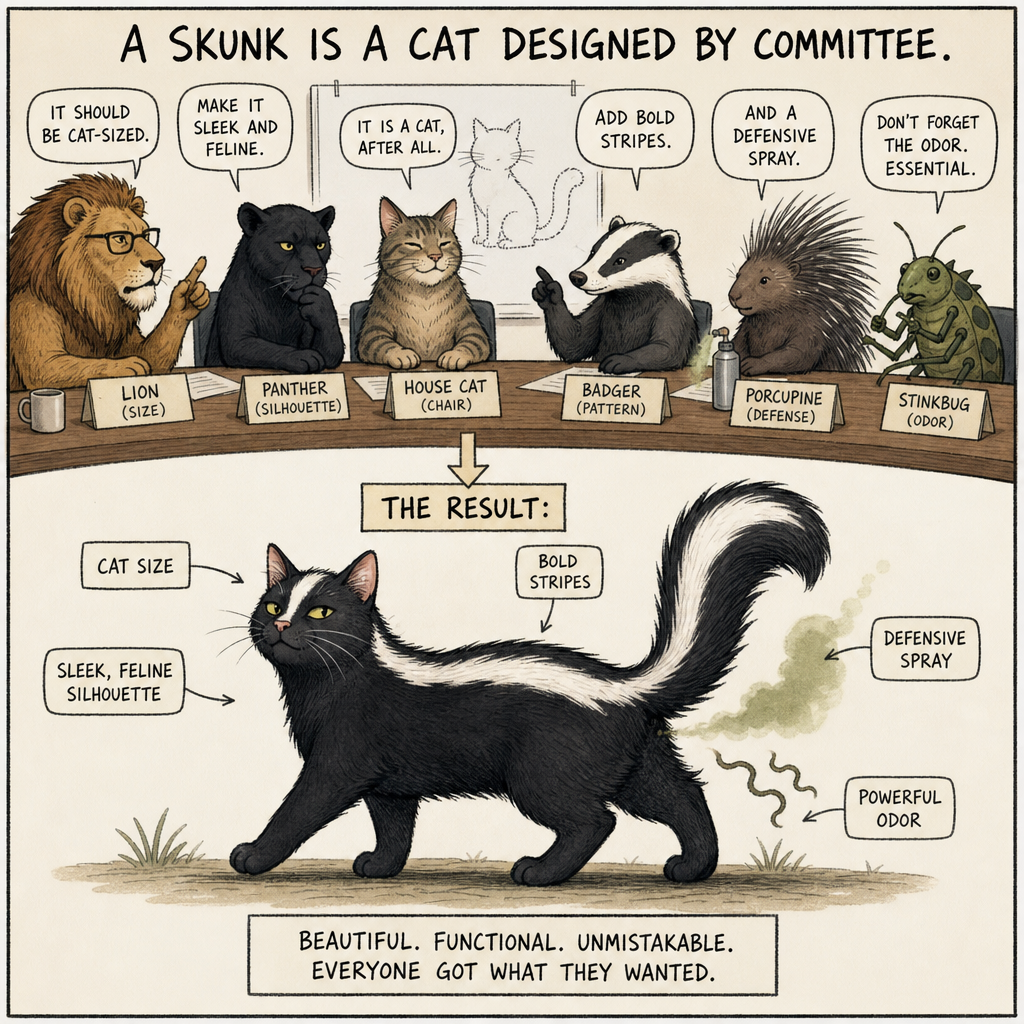
A skunk is a cat designed by committee.
That’s what happens when process replaces judgment. You get something that checks all the boxes but doesn’t work. Most marketing fails because it’s designed by people who never had to live with the consequences of their own recommendations.
I’ve watched this play out hundreds of times. A business owner brings me in after their third failed agency. They’re frustrated, skeptical, and tired of proposals that sound good but deliver nothing. They want a straight answer.
Here’s the straight answer: if your marketing isn’t converting, someone missed the pattern.
What Pattern Recognition Actually Looks Like
When a $4 million construction company comes to me saying their website isn’t generating leads, I don’t start with a redesign proposal. I start with questions about their sales process, their client acquisition timeline, their average deal size, and how they currently close business.
Nine times out of ten, the website isn’t the problem. The problem is they’re trying to use a website to replace the trust-building that happens face-to-face. A webpage won’t do that job, no matter how well it’s designed.
Pattern recognition means I tell you in the first 30 minutes whether your problem is positioning, messaging, delivery infrastructure, or sales enablement. Most agencies spend six weeks doing discovery and charge you $15,000 for a deck that recommends all four.
I’ve already seen your situation. I know what breaks. I know what fixes it.
The Five-Part Framework That Actually Converts
When I work with a client, I operate from a structured framework that eliminates ambiguity and creates accountability. This isn’t theory. It’s the system I’ve used to build partnerships that last decades.
The pitch. I tell you what I see, what’s broken, and what needs to change. No jargon. No weasel words. The pattern I’ve identified and why it matters.
The promise. I tell you what will happen when we fix it. Not “maybe” or “could potentially.” What will happen. I’ve seen this pattern resolve enough times to know the outcome.
The proof. I show you where I’ve done this before. Not case studies designed by a marketing team. Actual client relationships that have lasted 10, 15, 25 years because the work delivered.
Remove the risk. I don’t hide behind contracts built on fear. I operate on trust. If I tell you something will work and it doesn’t, I don’t invoice you for the failure. That’s not how partnerships function.
Ask for the order. I tell you what I need from you to make this work. Resources, access, decision-making authority, timeline. If you can’t provide those things, we’re not a fit. If you can, we move forward.
This framework converts because it eliminates the ambiguity most agencies use to protect themselves from accountability. When you’ve been in business as long as I have, you stop needing escape hatches. You deliver.
Why Experience Compounds Differently Than Talent
A 30-year-old creative director with exceptional talent can produce brilliant work. I’m not dismissing that. But talent doesn’t give you pattern recognition across industries, economic cycles, and technological disruptions.
I’ve been on camera since I was four years old. I’ve managed creative teams, built sales systems, coached founders through imposter syndrome, and helped law enforcement agencies communicate with communities during crises. That breadth creates a different kind of value.
When a client asks me about video production, I’m not thinking about lighting and sound alone. I’m thinking about how they present on camera, whether their message structure will hold attention, how the content fits into their sales process, and what happens when a prospect watches the video at 11 PM on a mobile device.
You don’t learn that in a bootcamp. That’s 64 years of accumulated observation.
The Offshore Problem Nobody Talks About
Three out of ten clients who come to me have been burned by agencies that outsource work overseas. They were told they’d be working with “John,” who turned out to be eight different people with inconsistent skill levels and no continuity.
I’m one person. When you hire me, you get me. My depth, my judgment, my accountability. That’s rare in an industry built on scalable mediocrity.
I don’t say this to disparage offshore talent. I say it because business owners deserve to know who’s doing the work. When someone has been in your industry for decades and sees your problems before you articulate them, that’s worth paying for.
What Happens When You Get This Right
When pattern recognition meets structured execution, something shifts. Clients stop seeing me as a vendor and start seeing me as a partner. They bring me problems that have nothing to do with marketing: leadership challenges, hiring decisions, confidence issues before a big presentation.
That’s not scope creep. That’s what happens when you operate with enough certainty that people want access to how you think.
I’ve had clients stay with me for 25 years. Not because I’m the cheapest option or because I have the flashiest portfolio. Because I show up, I deliver, and I don’t lie about timelines or capabilities.
That creates something most agencies never experience: the extension of trust and the infection of enthusiasm.
When clients see you operate with clarity and deliver on commitments, they want that capacity for themselves. They refer you without hesitation. They involve you in bigger decisions. They become long-term partners instead of transactional buyers.
The Infrastructure I’m Building Next
I’m not winding down. I’m building the capstone.
The next phase is a walk-in video production studio model with broadcast-quality infrastructure. Five cameras, 20 audio channels, 500 meg bandwidth, network-quality live editing. Businesses walk in, grab a mic, go live, and walk out with content that used to require a $50,000 production budget.
This isn’t a dream. It’s a trajectory. I’ve already seen how desktop publishing disrupted print in the 1980s. I’m building the same disruption for video.
Scalable. Franchisable. Repeatable.
That’s what happens when you combine pattern recognition with infrastructure design. You don’t serve clients. You create systems that outlast your direct involvement.
The Offer
If you’ve been frustrated with marketing for years and want a straight answer instead of another proposal, the offer is simple: pattern recognition applied to your specific situation.
I’ll tell you what I see, what needs to change, and what will happen when we fix it. If that resonates, we move forward. If it doesn’t, you’ve lost nothing but a conversation.
I don’t pitch. I diagnose. I don’t collaborate the way most agencies define it. I mentor while executing. And I don’t operate on hope. I operate on 64 years of seeing what works and what doesn’t.
The patterns are visible before you see them. That’s the advantage. That’s what you’re hiring.