17 Actionable Content Marketing Tips
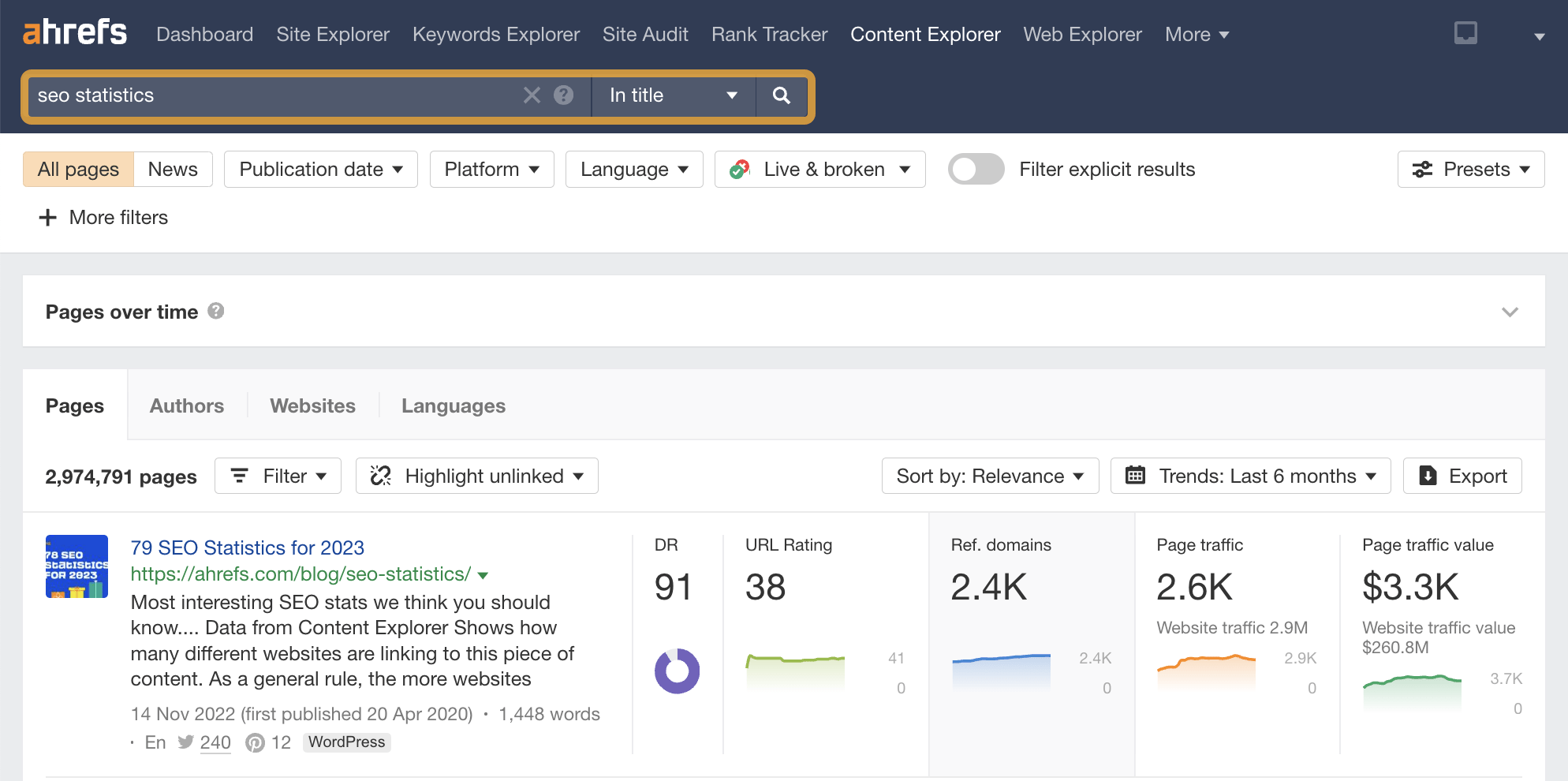
Struggling with your content marketing? Don’t worry. Below is a list of 17 tips that’ll improve your content marketing and help you get more visitors, leads, and sales. 2. Know your audience If you create content for the wrong people, visitors won’t translate into customers or clients. For example, if a conversion rate optimization (CRO) agency writes about CRO, they might attract fellow professionals rather than genuine leads. That’s why it’s important to clearly define your audience. If you already know who you’re targeting, make sure to get it down in writing and share it with your entire team. Otherwise, use the template below to figure it out for your business. Further reading 3. Swipe competitors’ best topics If you know which of your competitors’ articles get the most search traffic, you could replicate their success. Here’s how to find their best topics: Go to Ahrefs’ Site Explorer Enter a competitor’s domain Go to the Top pages report You’ll see their top pages by search traffic and the keyword that sends each page the most traffic. For example, we can see that Beardbrand’s article on beard styles gets an estimated 51K monthly search visits. The keyword sending it the most traffic is “beard styles.” If we owned a competing ecommerce store, we could tackle this topic, too. 4. Prioritize topics with business value Topics have high “business value” if you can naturally mention your product or service in the content. You should prioritize these as they’re most likely to generate sales or leads. For example, here’s how we score topics at Ahrefs: We try to prioritize topics that score 2 and above. Pairing business value with search traffic potential keeps us focused on creating content that actually drives growth. 5. Optimize for search intent Search intent is the why behind a search query.
Personal Brand: What It Really Is & How to Build One
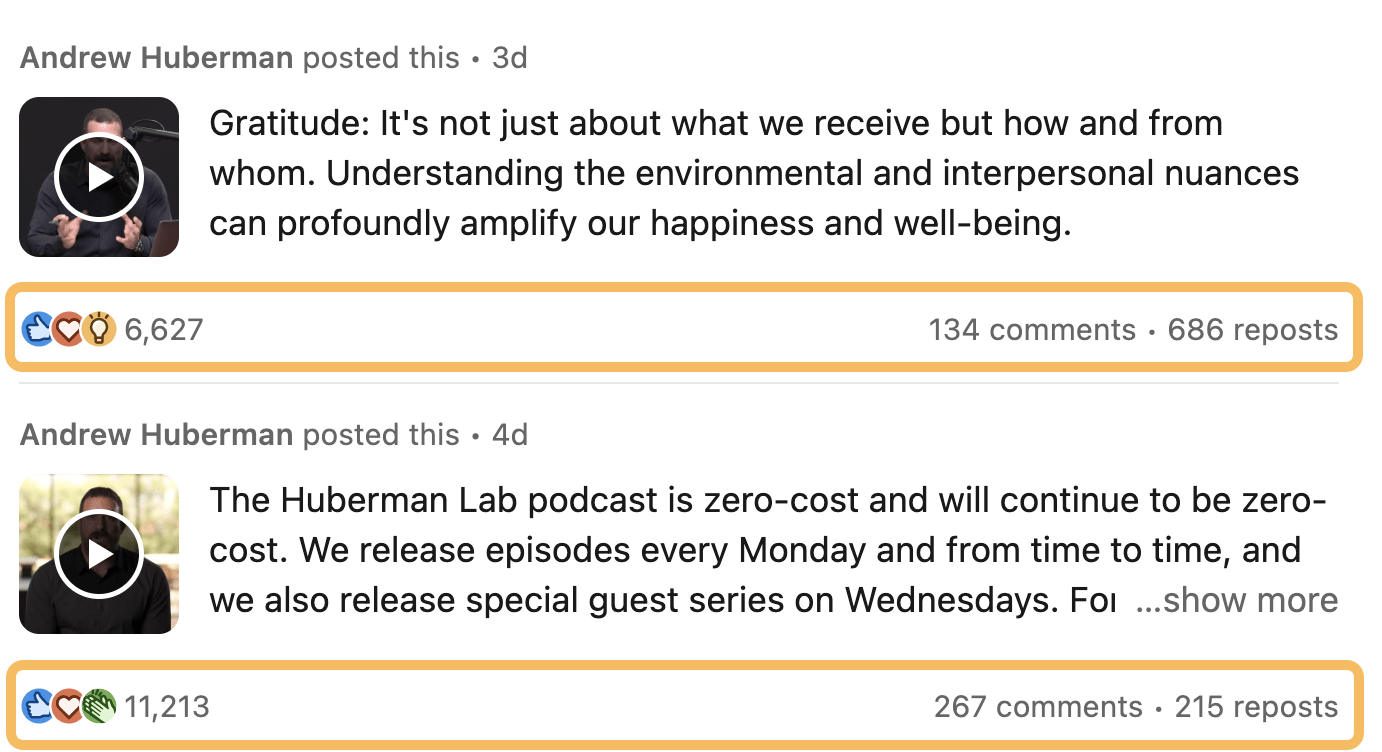
Building a personal brand is undeniably hard work, but it isn’t as tricky as you might think. I spoke with two influencers— Benefits of building a personal brand Wild as it sounds, building a solid personal brand gives you more control over your life. A strong following could: Expand your realm of influence, particularly in your area of expertise (i.e., be viewed as a subject matter expert). Boost your credibility, in turn allowing you to promote your company/product better. Build a loyal following independent of the company you’re working for (or if you own that company, create more positive sentiment towards it). Open doors to job, networking, and investment opportunities. Chiangmai SEO conference founder Matt Diggity shares some excellent points in his Facebook post on the topic, too. How to build a personal brand There’s no linear path to building your personal brand. As a precursor to the below steps, let’s first talk about finding your “voice.” Wes and Matt both emphasize the importance of staying true to yourself. That means not crafting an online persona of who you think you should be. I try to write like how I sound in person. Talking and writing are different media, so you shouldn’t try to match the two in a literal sense, but you want to capture your overall spirit. For example, I have a hint of snark in my writing because that’s how I sound in person. Matt echoes this sentiment: How I talk on the internet is how I talk IRL. If I’m not having a f**king blast on my YouTube videos, I won’t do them. It has to be fun. Keep this idea in mind as you go through the steps below. Step 1: Position yourself Think of yourself as a product: What are your strengths, obsessions, and areas of expertise? If
SEO Community Spotlight: London
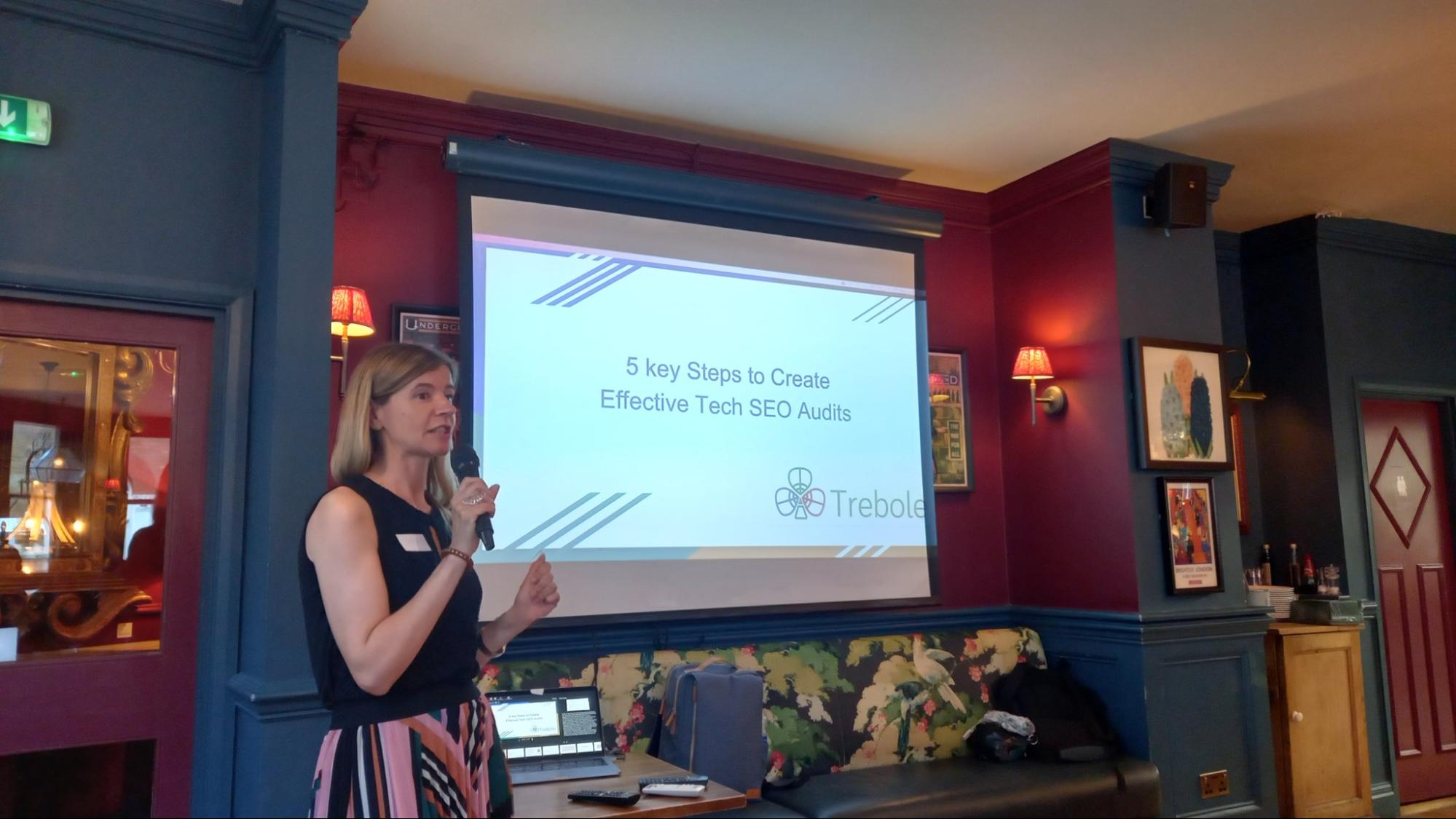
London’s SEO community is a vibrant, thriving one. With so much ground to cover, we did some serious digging to showcase the city’s best SEO speakers, conferences, and meet-ups. SEO conferences in London Search conferences across the UK are aplenty—but you’ll find some solid options within London, too (Not from around here? We rounded up the best SEO conferences from elsewhere.) WTSFest London Women in Tech SEO (WTS) began in 2019 as a support network for women in the technical SEO space and has grown to 6,000 members across Facebook and Slack. Founder Areej AbuAli has since organized three editions of WTSFest—an annual full-day conference whose speakers come from all areas of search. WTS also runs workshops, a mentorship program, and even a podcast and newsletter. LondonSEO XL Conference LondonSEO runs meet-ups, as we mentioned earlier—but their conferences are really a culmination of the Blue Array team’s hard work. (Ahrefs was even a headline sponsor for LondonSEO XL in 2022 and 2023!) For a taste of what to expect, you can access speaker slides and replay videos from this year’s conference here. Speakers included Barry Schwartz, Chima Mmeje, Ahrefs’ own Joshua Hardwick, and many more. MeasureCamp London Conceived in 2012 by Peter O’Neill, MeasureCamp is a (free!) digital analytics conference that now takes place in 24 cities around the world. [embedded content] https://www.youtube.com/watch?v=W4nl8LDH3kI The idea behind the conference was born of casual meet-ups among a group of developers, product managers, and social media users. Peter leveraged the growing network and organized the first MeasureCamp conference in Mozilla’s London office in Sep 2012. At MeasureCamp London 2023, experts from the likes of Meta, Conductrics, and Measurelab discussed everything from full-funnel growth to measuring email performance. SearchLove Conference SearchLove is a marketing conference conceived in 2009 by Distilled founders Will Critchlow and Duncan Morris. The conference today
How to Do a Content Gap Analysis [With Template]
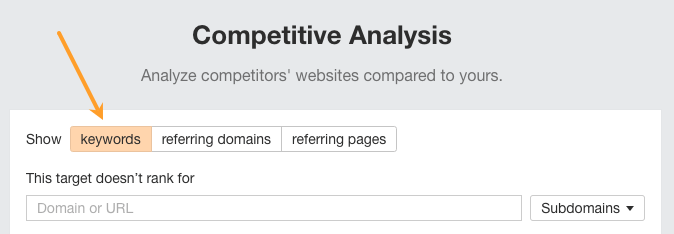
A content gap analysis is the process of finding topics your competitors have covered but you haven’t. It helps you: Get more traffic to existing content Find the best new topics to cover Steal traffic from competitors In this guide, you’ll learn how to use 2. Refine and export the data Take a look at the number of keywords in the content gap report. If there are more than 100,000, you’ll need to refine the list. Otherwise, it’ll probably break the Google Sheets template. To do that, start by excluding mentions of your competitor’s brand name(s) in the keyword filter. Consider misspellings or spaces added and set the filter to pick up “partial matches” to ensure it removes as many mentions as possible. In the same filter, you can also exclude terms related to topics that are irrelevant to your website. If you are checking multiple competitors, it may also be worth adjusting the competitors’ positions to display at least two sites ranking in the top 10. You can also weed out super low-volume keywords by filtering for keywords with a monthly search volume of at least 20. Or, you can use the Keyword Difficulty (KD) filter to reveal low-hanging fruit by setting a maximum KD of 30. Once all your filters are applied, export the data to CSV. 3. Import the data into the template If you haven’t already, make a copy of our content gap analysis template. Then, import the data you downloaded from Ahrefs. To do this, navigate to the “Data” tab and click on cell A1. Then go to File > Import > Upload > Choose your Ahrefs data > Select “Append to current sheet.” You can leave all other options untouched and proceed with importing the data. This may take a few moments depending on how large your keyword list is. Once your

Content Ideation: 8 Ways to Generate Infinite Blog Post Ideas
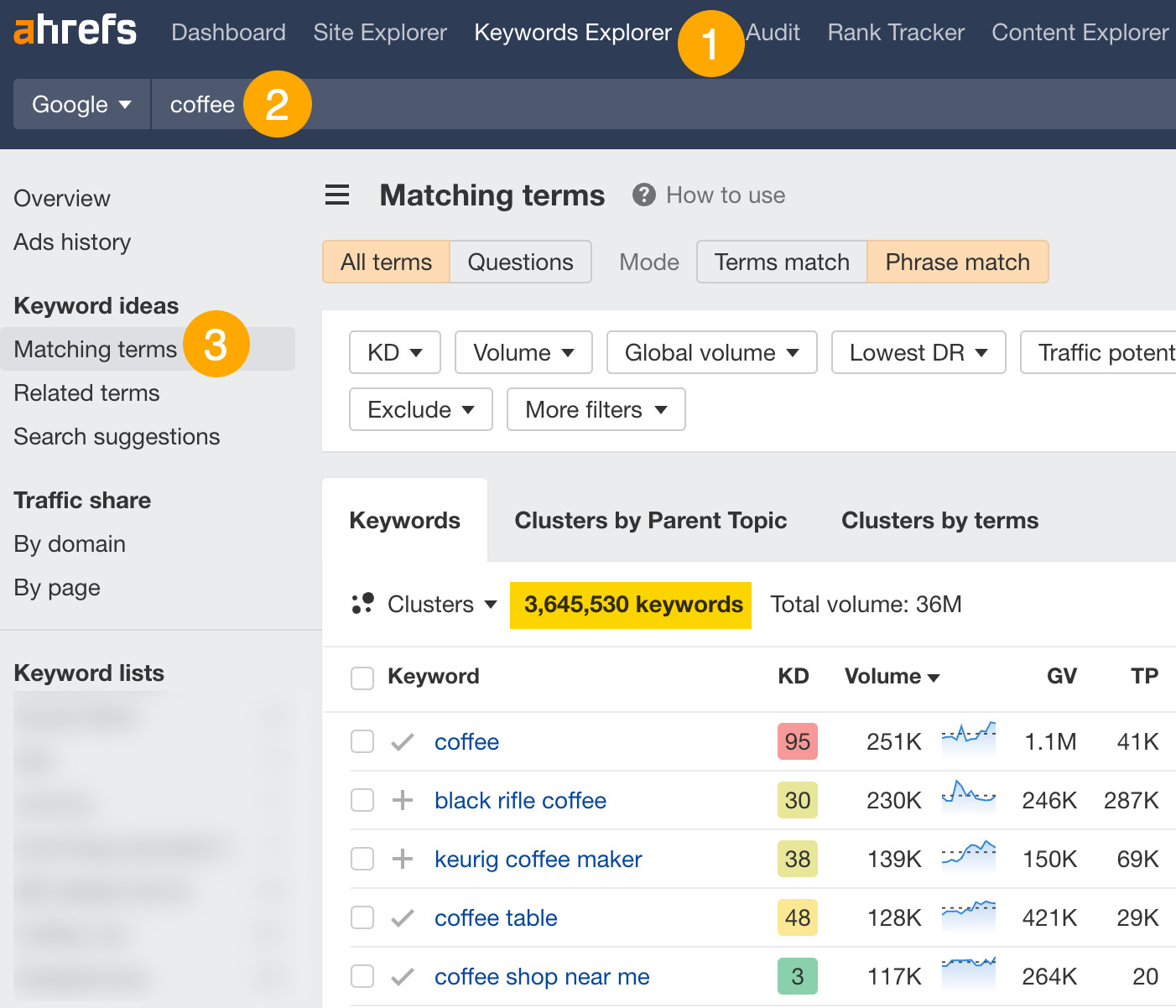
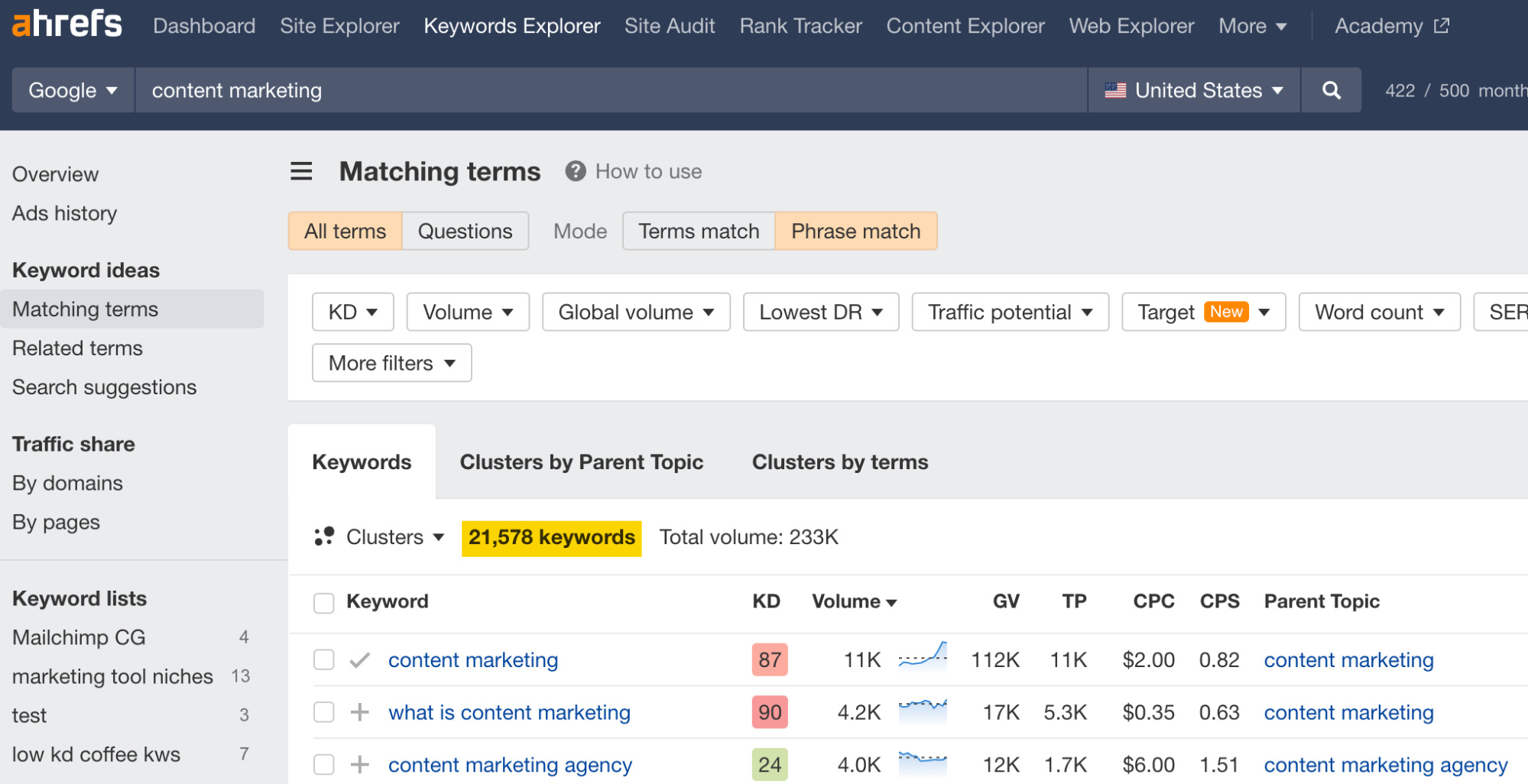
It’s hard to be creative on demand, and harder still to fill a content calendar with high-performing blog post ideas. Content ideation is the process of generating article ideas. A solid ideation process makes it easy to brainstorm dozens of blog post topics, hit a regular publishing cadence, and consistently grow traffic—without unnecessary brain strain. 8 content ideation methods Let’s get specific, and look at eight very different, very useful sources of inspiration for your content marketing. 1. Answer questions The simplest way to generate content ideas is also one of the most useful: provide responses to the questions people ask about your product, your company, and your industry. Prioritize questions that your product can naturally help to answer. For a marketing analytics tool, that might mean answering questions about heat mapping and attribution. For a carpet fitting company, common types of flooring. For Ahrefs, it’s link-building and keyword research. Examples: It’s easy to find questions with significant search volume using Keywords Explorer. Enter your seed keywords (in this case, “carpet” terms), click the Matching terms report, and select the Questions report. You’ll see a list of question keywords that include your seed terms: 2. Address sales objections Content marketing is designed to help sales, and the most immediate way to achieve that goal is to directly address sales objections. Record the problems that prevent people from becoming customers (or ask your sales team), and write responses to their issues. Creating a shared, documented response for the whole company to learn from is a great way to speed up sales deals and persuade would-be customers. Examples: Pipedrive compares its product to close competitor HubSpot. 3. Capture your successes Another way to help sales: tell the world about how awesome your company is. Document your customers’ wins, how they achieved them, and the
Shotgun or Sniper? Choose Your SEO Outreach Tactic
SEO outreach is the practice of contacting website owners and asking them for links back to your website. But what’s the best approach to take? Links are a 1. Shotgun (a.k.a. the “spray and pray” outreach method) As the name suggests, the shotgun approach isn’t the most subtle of strategies. The idea of the shotgun approach is to send an outreach email with zero personalization to many link prospects. It also doesn’t require extra tools—just an email account is good enough to start with. For example, with shotgun, even the name of the person you are emailing won’t be mentioned. How to pitch (and example template) The outreach email using the shotgun approach will look something like this: Let’s face it: it’s not the most engaging outreach template. But for what it lacks in personalization, it makes up for in speed of creation. This type of template is useful for beginners to SEO outreach or if you want to get the message out quickly. Pros It’s fast to send the emails. And it doesn’t require much expertise to get started. Cons It can appear spammy and could be ignored by recipients. For that reason, it could impact your brand’s reputation if you use this method repeatedly with poor audience targeting. 2. Sniper (a more personalized outreach method) The sniper approach takes the opposite approach to shotgun. Rather than spraying the internet with hundreds of emails with minimal personalization, the sniper approach is 100% manual and highly targeted. How to pitch (and example template) With the sniper approach, your outreach email might look like this. As you can see, each email is 100% customized to the person you are targeting. So, with this approach, you’ll need to have a good understanding of your link prospects before you email them. I find the best way to
12 Essential Marketing Analytics Tools for 2024 (Free & Paid)
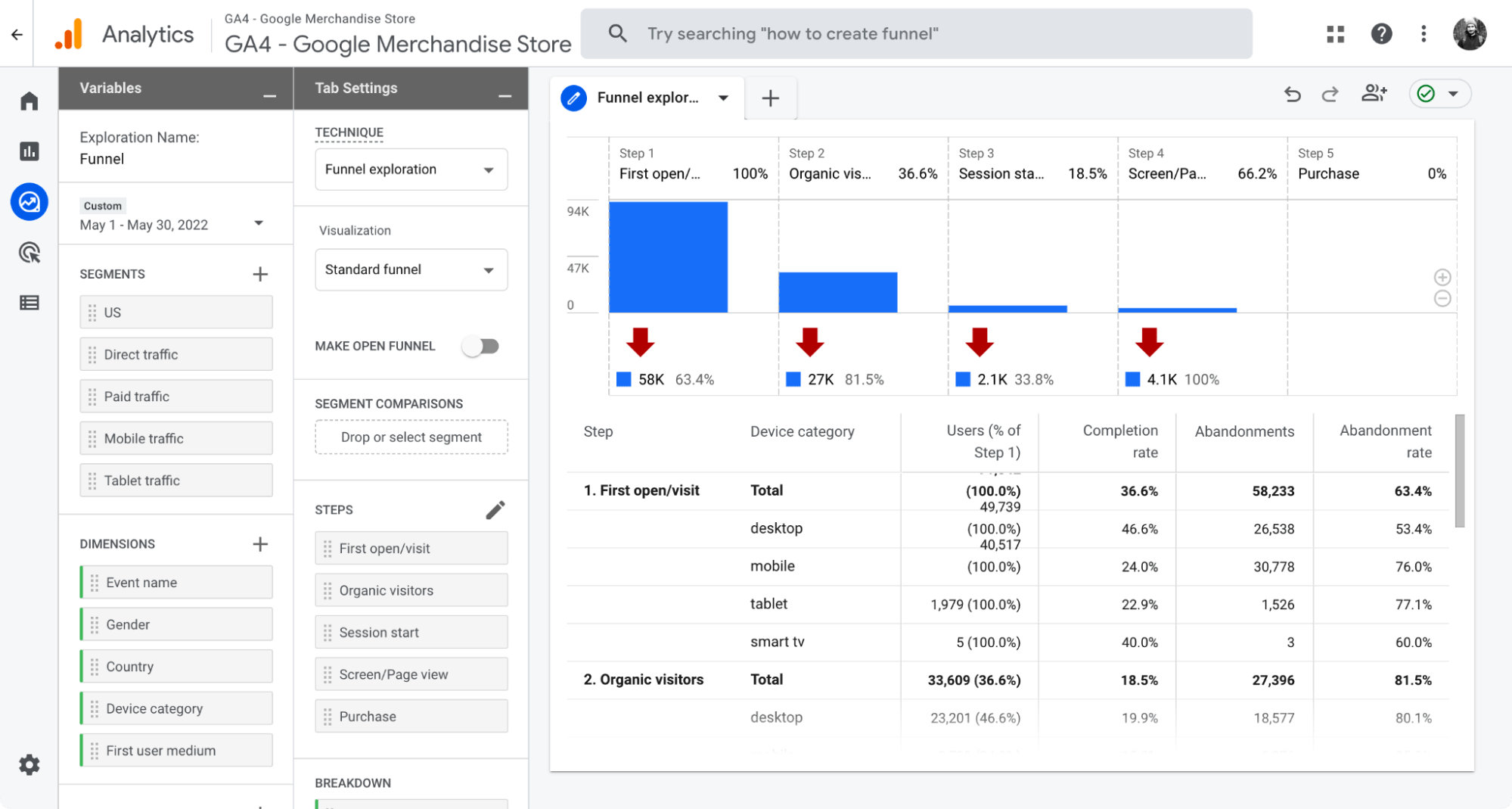
Marketing analytics tools give you access to data you can use to track your performance and find ways to improve. If you’re in digital marketing, chances are you’re going to need more than one analytics tool. In this guide, we’ll go through twelve tools that will help you identify your best-performing tactics, and content, enabling you to do more of what works. Google Analytics 4 (GA4) comes with almost everything you need to see how many people visit your website, where they come from, and what pages they visit. Key use cases Track results of specific campaigns using the UTM tags. Measure conversions on important pages such as form completions or transactions. Use the Explorations tool to uncover trends and patterns in user behavior. Highlighted feature: Explorations The Explorations tool is like your own research lab for web analytics. It allows you to create custom reports that go beyond the information provided by GA4’s standard reports. So if there’s a question bugging you and standard reports don’t cut it, you will likely find your answer in Explorations. You can then share your reports with other people or export them. Here’s an example of a funnel report. Google has revamped funnels in its GA4. It tracks everything as events now, so most of the time, you won’t need to create custom events to create funnels. What’s more, you can create open funnels (the user can enter at any point) and closed funnels (the user can only enter in the first step). Closed funnels are the default option, but you can change it to track non-linear user paths. Pricing Free. There’s also a premium, paid version as part of the Google Marketing Platform (basically, a solution for enterprises). Further reading Ahrefs is an all-in-one SEO toolset. It’s the kind of tool you absolutely need if you want
Content Optimization: The Complete Guide
Content optimization is the process of improving aspects of content to increase its reach or make it more engaging. It involves such techniques as aligning content with search intent, adding missing subtopics, and showing how your product/service can solve users’ problems. In this guide, you’ll learn how to optimize content for SEO, conversions, and social shares. But first, let’s make sure we’re on the same page… . Enter your page URL. Hit Search. You’ll see the number of referring domains on the Overview report. You can then plug your target keyword into Keywords Explorer and check the KD score to see if you have anywhere near the estimated number of referring domains needed to rank in the top 10: If this number is way higher than the number of referring domains to your page, that may be what’s holding you back. Further reading 7. Make sure you’re eligible for rich snippets Rich snippets are search results that highlight structured data embedded on web pages. Here’s an example: Rich snippets likely won’t make your page rank higher, but highlighting key information on your page will make it more eye-catching — and this can result in more clicks. Just compare these two results — which one would you rather click? To be eligible for featured snippets, you need to apply a simple code called schema markup. There are basically two ways of doing this: Use your CMS or a plugin (like Yoast or All in One Schema). Just fill out some information, and it’ll add the code for you. Use a schema markup generator. There are plenty of these around (e.g., Merkle’s Schema Generator). The benefit here is that you can probably better customize your schema than in the first option. The downside is that you have to add the code yourself. Finally, make sure to use a
How to Build (And Structure) an SEO Team
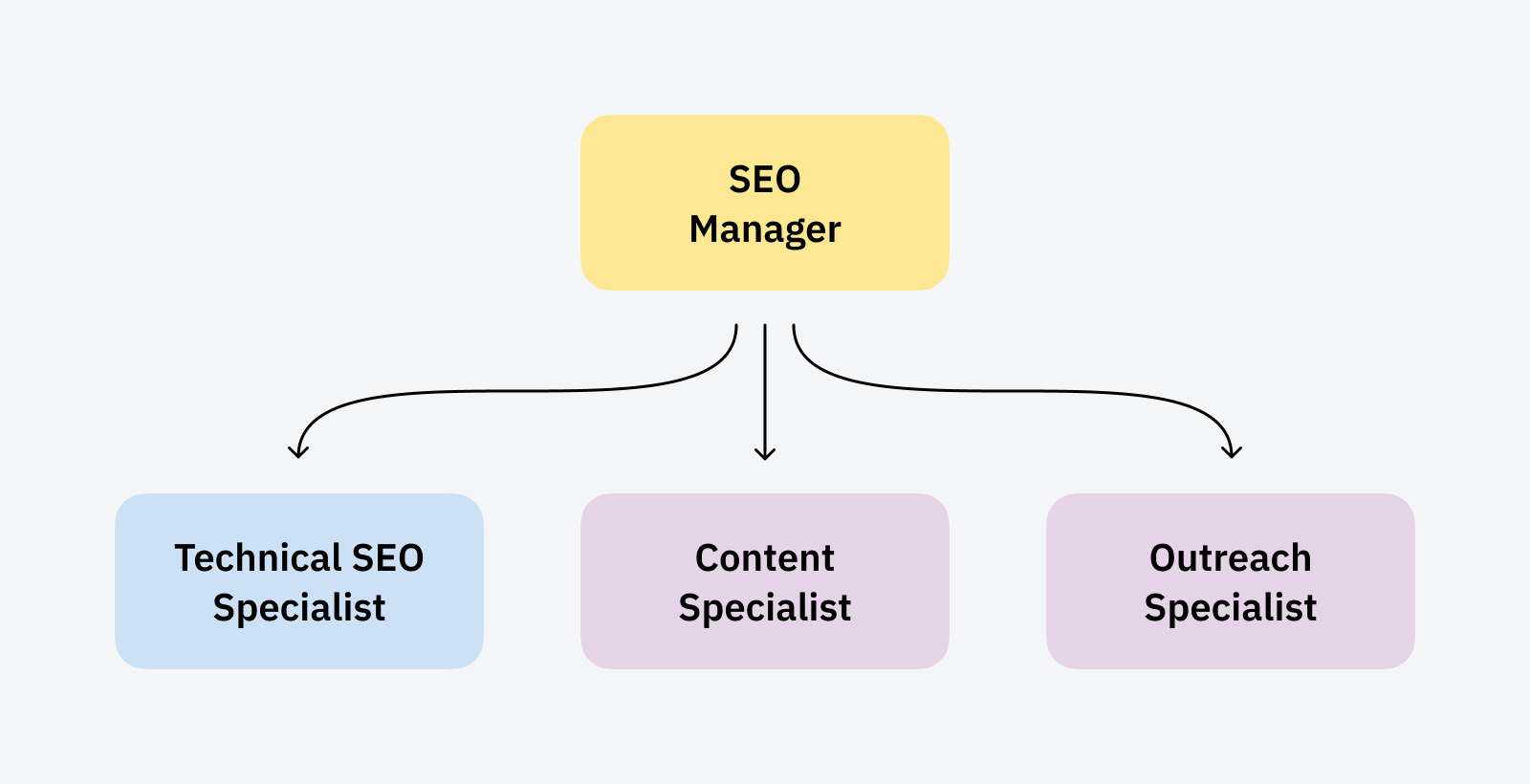
SEO is a difficult task to do on your own. So having a team can make ranking on Google much easier. But how do you build an SEO team? Is it worth the investment? Where do you find the people you need? Today, we answer all these questions and more. How to build an SEO team Building an SEO team falls into three steps: Determining your goals and hiring needs Finding your talent Setting up your task management software to manage it all 1. Determine your goals and hiring needs The size of your team depends on what you’re trying to do and how much money you have. The first thing you should do before hiring anyone is to figure out your competitive landscape. You can do this using Ahrefs’ Keywords Explorer and Content Gap tool. You’re trying to figure out three things: What kinds of keywords am I going after? How competitive are these keywords? What roles do I need to fill the most? For instance, if you currently have a lot of content but it’s not ranking, you’ll need to allocate more budget to link building, especially if you’re targeting highly competitive keywords. But if you don’t have much content yet, your focus should be more on building a content team. There are two quick ways you can use Ahrefs to determine your team’s needs: 1. Use the SERP overview in Keywords Explorer to determine if you need links The SERP overview allows you to see what pages are ranking for a given keyword and how many links those pages have. You can also see each page URL’s Domain Rating (DR) score. Using this tool, you can determine if your pages need more links in order to beat the competition. For example, if we take a look at the keyword “seo tools,” we can see that Ahrefs is
The Official Ahrefs Tutorial: How to Use Ahrefs to Improve SEO
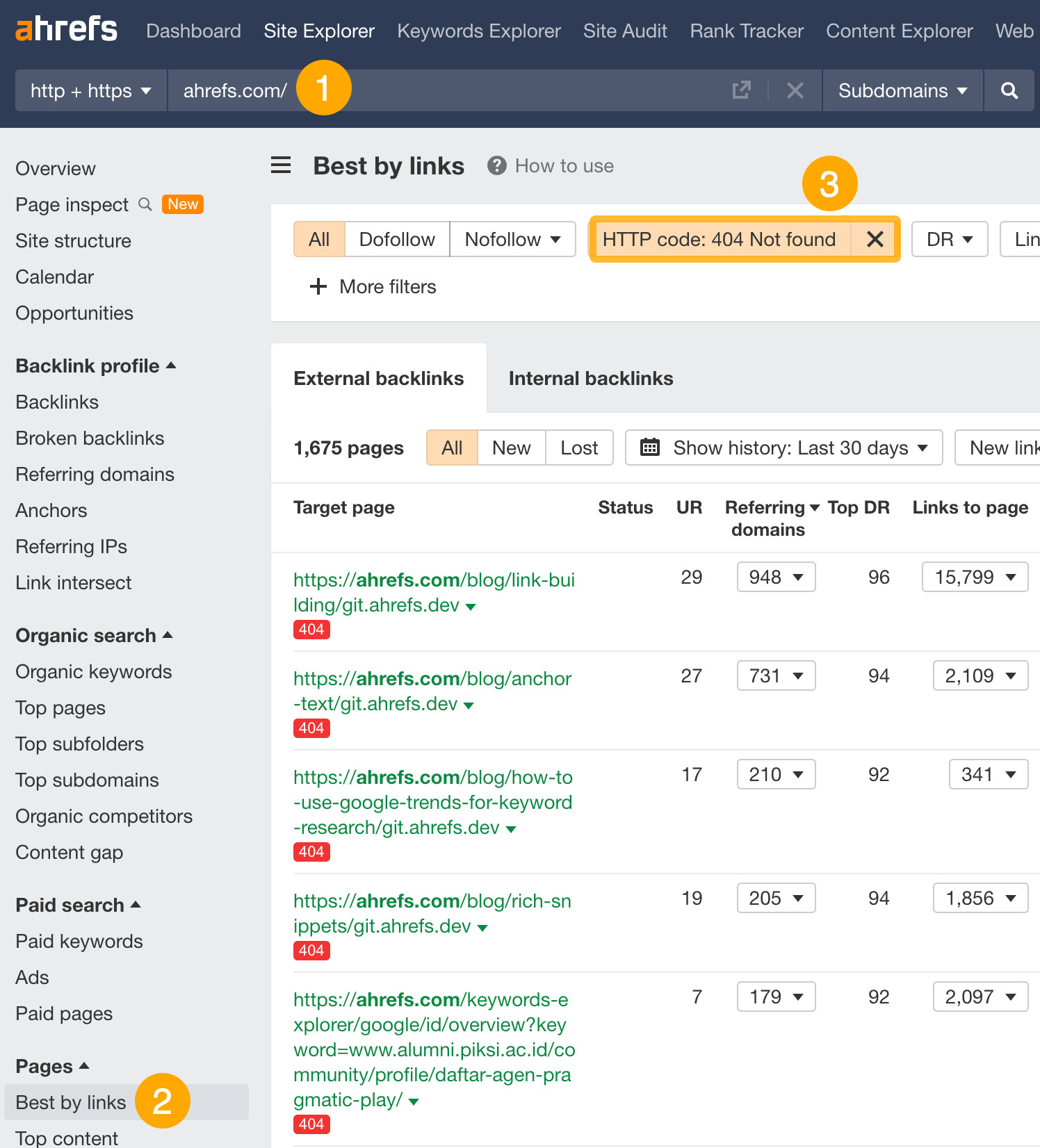
Whether you’re new or old to Ahrefs, you’re in the right place. This tutorial will walk you through the most practical, repeatable, and actionable Ahrefs use cases from our six core tools that will help improve your SEO. Site Explorer Site Explorer is our competitive research tool. With Site Explorer, you can see a website’s: Backlinks Keywords it ranks for in Google Site structure in a tree format Pages that are responsible for generating the most search traffic Google ads campaigns And more. Because there are so many things you can do in Site Explorer, we won’t be able to go through every use case. Instead, we’ll cover a few low-hanging fruits: 1. Restore lost link equity from broken backlinks If there are broken pages with backlinks on your website, that link equity is wasted. You can reclaim the value of the link equity by either restoring those pages or redirecting the broken URLs to relevant live pages. Here’s how to find broken pages with backlinks on your website: Enter your domain Go to the Best by links report Set the HTTP code filter to 404 For example, we could redirect this blog post about asking for tweets to this one on blogger outreach to reclaim around 42 referring domains: 2. Find featured snippet opportunities Featured snippets are full or partial answers to a query directly on the SERPs. If you can grab the snippet, you can jump ahead of everyone else. That means more search traffic to your site. Here’s how to find low-hanging featured snippet opportunities: Enter your domain Go to the Organic keywords report Set a Positions filter from 1 – 10 (you need to be on the first page to win it) Set a SERP features filter to “where target doesn’t rank” and check featured snippet You can now see thousands of keywords
8 On-Page SEO Factors You Can’t Ignore
Google looks at various on-page factors to decide where a page should rank and how it should be presented in the search results. Getting these right can lead to higher rankings, increased visibility, and more organic traffic to your website—so they’re worth doing. Let’s take a look at the top on-page SEO factors that can help you rise through the ranks. 1. Content relevance Making your content relevant is more important than ever. You need to craft your content so it gives your visitors the answers and information they are searching for. For example, you can tell by looking at the top results for “air fryer salmon” that searchers want a recipe. To stand the best chance of ranking for this keyword, that’s what you should give them. If you write about the pros and cons of air-frying salmon, you’ll struggle to rank because it’s not what searchers want. Learn more: Search Intent in SEO: What It Is & How to Optimize for It 2. Content freshness Keeping your content fresh prevents it from getting stale and out of date. Visitors to your site will expect your content to be accurate and provide a good user experience—if it doesn’t, then you’re in trouble. Make sure to update outdated information and fulfill the searcher’s intent by giving them all the information that they are looking for. Learn more: Content Refreshing: A Step-by-Step Strategy (Based on Updating 50+ Posts) 3. Title tags Title tags are an HTML element that specifies the title of the webpage. A good title tag will help visitors (and Google) understand what the page is about. Title tags are shown in search engines like Google alongside the webpage’s meta description. They are usually one of the first things visitors see when scanning through the search results. Learn more: How to Craft the Perfect SEO
How to Create Content Briefs (with 6 Templates)
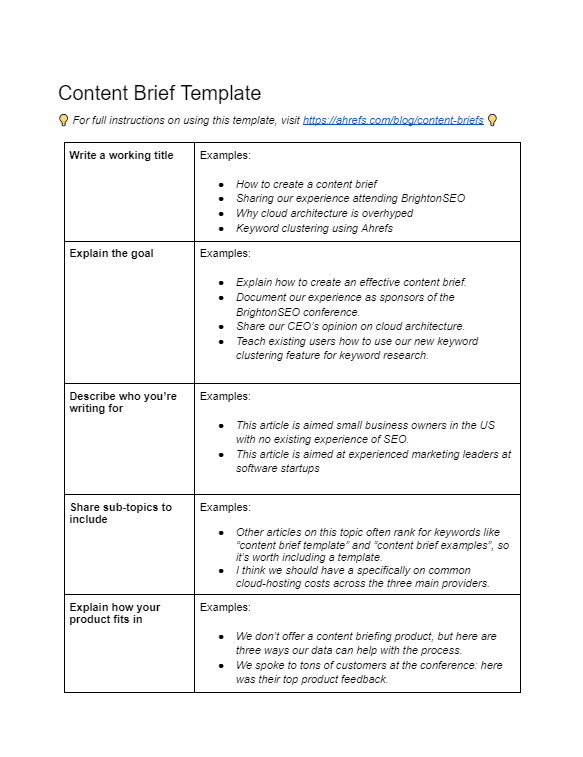
If you want to publish more blog content, you need to create solid content briefs. Content briefs are simple documents that tell a writer… what to write about. They provide the information and context writers need to understand the goal of each article, ensure they cover all the key points, and turn in an A-grade draft with minimal hassle. A good content brief should be simple. It should cover the essential information a writer needs without drowning them in SEO jargon or taking away their freedom to write in the way they think best. Briefs should also be brief—they are not 1. Write a working title Every content brief should start with a working title for your article. This doesn’t need to be a perfect, polished title. The goal of your working title is not to earn clicks or pique the reader’s interest—it’s to help the writer write. Keep it simple, and communicate the core idea of your article. Examples: How to create a content brief Sharing our experience attending BrightonSEO Why cloud architecture is overhyped Keyword clustering using Ahrefs If you’re creating SEO content, your working title should reflect the primary intent of your target keyword. In other words, it needs to give searchers what they want: whether that’s a how to, a list of tools, or a set of templates. You can check the intent of your keywords with a quick Google search, but if you’d like to see the results for different countries (and make sure the results aren’t being personalised to you), you can check intent in Ahrefs. Enter your target keyword into Keywords Explorer and scroll down to the SERP overview box. You’ll be able to see the titles of the top-ranking articles for that keyword. Here’s the SERP overview for the keyword content brief: Pay

- When To Stop DIY Marketing And Hire Help
- I have watched companies pour money into campaigns while their customer experience quietly canceled out every dollar. Here is how I tell the difference before we spend anything.
- Four 4K cameras, 18 channels of audio, and a production plan built before anyone walked in the door. That is how you turn one day into a year of content.
- Most companies treat an event like a one-day expense. We treat it like a content factory. The math is completely different.
- Stop Making Ads Start Answering Questions
- We produced a 90-minute live event in the studio last week. By the end of the month it will be 20 separate sales assets. Here is how.
- Your website is not a brochure. It is a sales conversation that runs 24 hours a day without you. Is it saying the right things?
- I have built over 850 sites. The ones that generate real leads share six structural elements. Most sites have two of them.
- Most agencies will tell you exactly what you want to hear in the pitch. Three questions will tell you whether any of it is real.
- Before you sign an agency contract, ask them to show you the last campaign that did not work and what they learned from it. Watch what happens.