The number one problem when business owners try to manage their own social media isn’t time, money, or even skill.
It’s expectation.
They post something into a network and expect it to rise to the top. Expect views. Expect conversions. Expect sales.
That’s absolute folly. It does not work that way. It never has.
The Fragmentation Problem You Can’t See
The average user now toggles between 6.7 different social platforms each month. Your audience is scattered across Facebook, Instagram, TikTok, YouTube, Snapchat, Pinterest, Reddit, and whatever platform launches next quarter.
You’re not just managing content anymore. You’re managing fragmented attention across algorithmic systems that change weekly, each with different rules, different formats, different audience behaviors, and different metrics that don’t talk to each other.
Most business owners don’t have the understanding to determine what the root cause is when nothing works. Their level of understanding isn’t great enough to identify why their posts die instead of converting.
The Real Cost of DIY Social Media
If you’re spending four hours per week managing your own social media, that’s 208 hours per year. If your hourly value is $100—conservative for most service professionals—you’re spending $20,800 worth of time on social media.
Nearly 40% of marketers manage social media solo. Another 38% plan only one week ahead. That’s not strategy. That’s survival mode.
Here’s what actually happens: You post inconsistently because you’re busy running your actual business. You guess at what content might work. You miss platform updates. You can’t track ROI because you’re using three different tools that don’t integrate.
What Complete Social Media Management Actually Requires
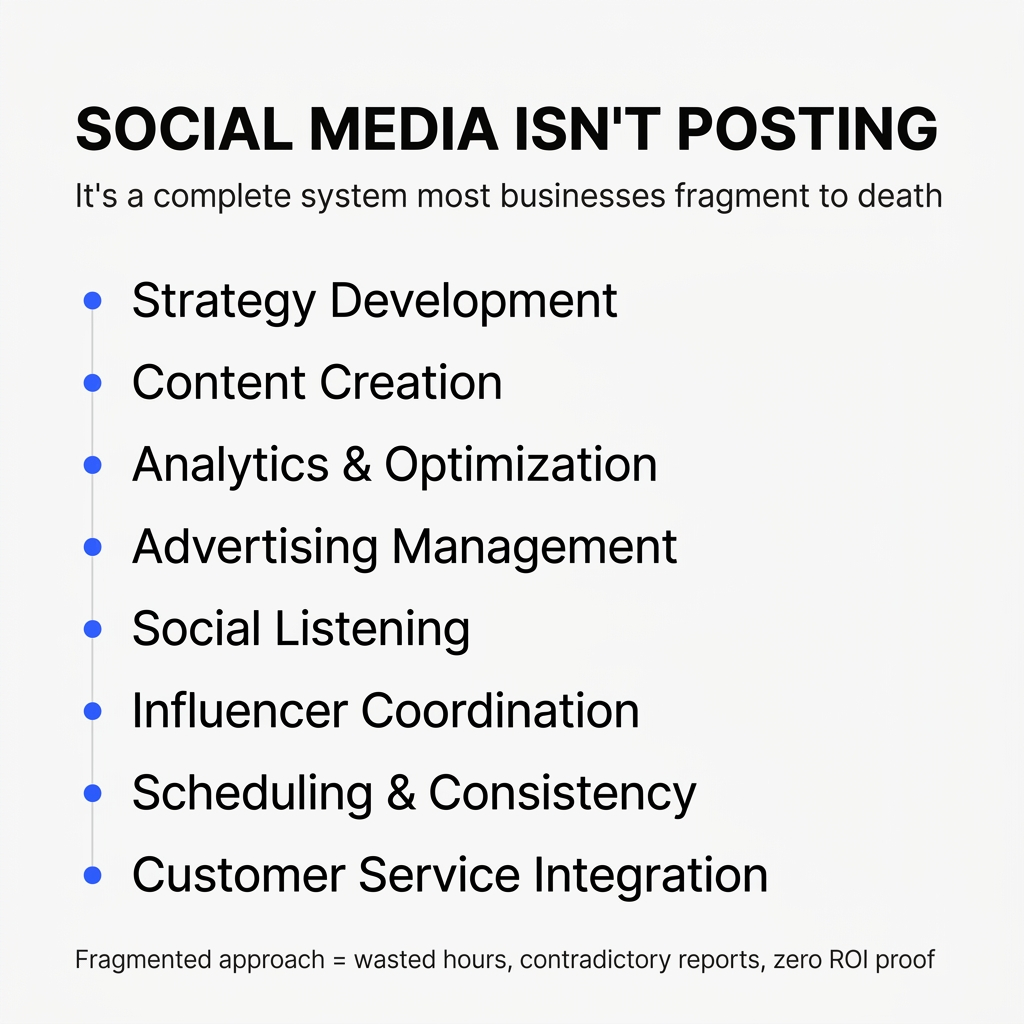
Social media management isn’t just posting content. It’s a complete system:
Strategy development. Identifying where your audience actually lives, what they care about, and how to reach them without burning budget on platforms that don’t convert.
Content creation. Engineering content that’s AEO-friendly so the algorithm lights up and your profile shifts from invisible to significant.
Analytics and optimization. Tracking what works, killing what doesn’t, and adjusting in real time based on performance data.
Advertising management. Social ad spend is expected to reach more than $82 billion in 2025. But throwing money at ads without strategic targeting just funds the platforms.
Social listening. Monitoring what people are saying about your brand, your competitors, and your industry so you can respond in real time.
Influencer coordination. Organizations using data-driven influencer marketing report 2.3x higher engagement rates and 1.8x higher conversion rates.
Scheduling and consistency. Posting at optimal times across multiple platforms without manual intervention.
Customer service integration. 81% of customers expect faster service thanks to new technology. Social media is now a primary customer service channel.
Why Fragmented Approaches Fail
Companies hire a content creator, a separate ads manager, a social listening tool subscription, an analytics consultant, and a customer service team that doesn’t talk to marketing.
They end up with five different people using seven different tools that don’t integrate, producing reports that contradict each other, and nobody owns the actual outcome.
67% of marketers say revenue attribution from social is their top measurement goal in 2025, and 65% of marketing leaders say demonstrating how social media campaigns tie to business goals is crucial for securing investment.
But if your tools don’t talk to each other, you can’t prove ROI. And if you can’t prove ROI, you can’t justify the investment.
The Single-Partner Advantage
Each platform requires a different strategy. Instagram expects polished, curated content. TikTok rewards messy, authentic short-form realness. YouTube is geared toward longer-form content. LinkedIn values professional insights.
Platforms regularly adjust algorithms and content policies. What worked last quarter might get suppressed this quarter. You need someone who lives inside these systems, tracks the changes, tests the variables, and adjusts strategy in real time.
When you work with one partner who handles the complete scope—strategy, content, analytics, advertising, listening, optimization, influencers, scheduling, customer service—you eliminate the coordination tax.
You get unified reporting. Consistent messaging. Integrated data. One point of accountability.
At Appture Digital, we operate as a fractional CMO, not just a vendor executing tasks. We use Python scripting and backend tools to increase reach from a few people to hundreds of thousands. We identify the groups, use bulk invitation tools to get the right people into those spaces, then coordinate LinkedIn outreach with synchronized email campaigns.
We make sure content is AEO-friendly so the algorithm responds. We post frequently into a broad array of groups and networks. We identify where conversations are happening and repost content strategically into those spaces.
This isn’t something you can do casually. It requires infrastructure, automation, and pattern recognition that comes from decades of testing.
The Outcome You’re Actually Paying For
You stop wasting time on fragmented tools, contradictory reports, and strategies that don’t integrate.
You get a system that works. A partner who owns the outcome. And a level of reach and conversion that you can’t replicate by posting and hoping the algorithm notices.
That’s the difference between managing social media and actually using it to grow your business.
Ready to stop fragmenting your social media efforts? Contact Appture Digital and let’s build a unified system that actually moves the needle.