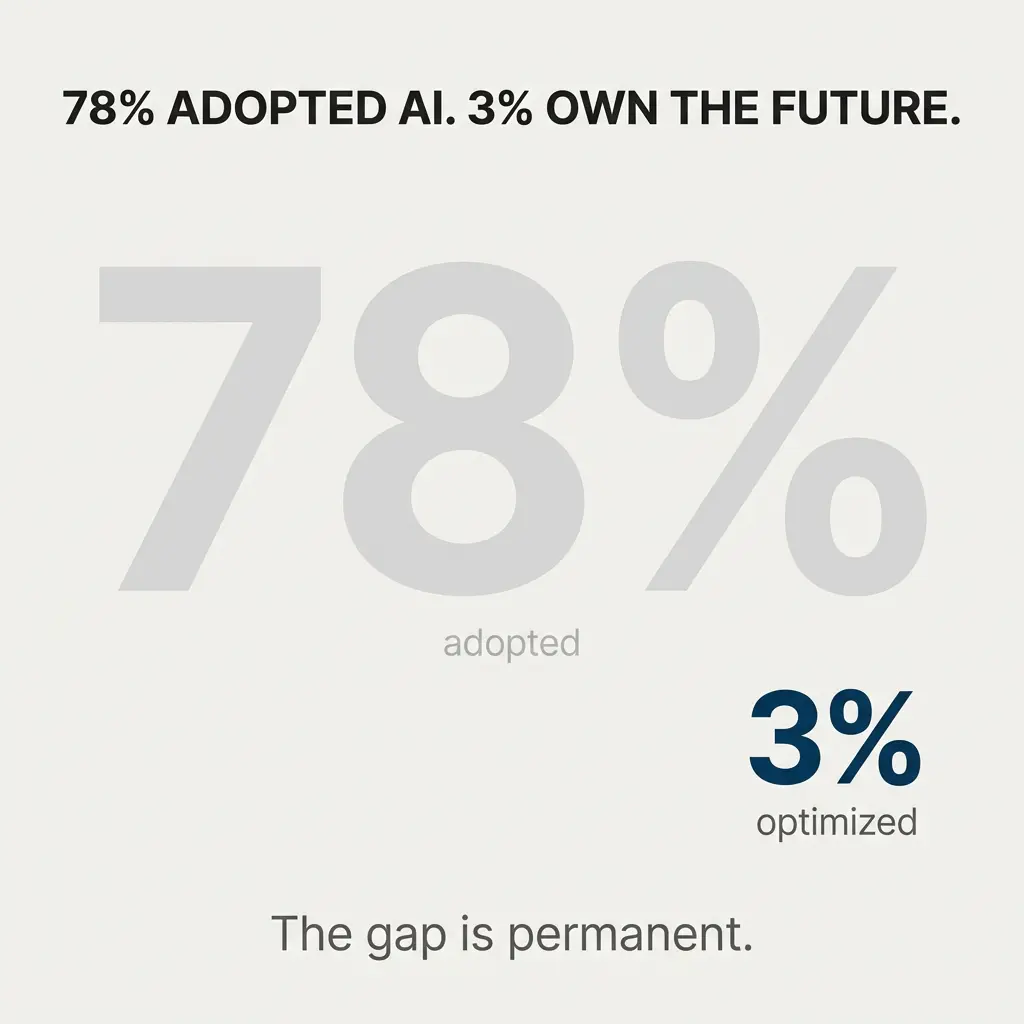
I watched 91% of agencies adopt AI last year. I also watched most of them produce worse work because of it.
The problem wasn’t the technology—it was binary thinking. Either you’re all-in on automation or you’re a dinosaur. Both paths lead to commoditized output.
We built a third path at Appture. Not because we’re smarter, but because we had to.
The Problem With Binary Thinking
91% of marketing agencies now use AI, but only 34% are actually reimagining their businesses through it. The rest are just accumulating tools.
64% of marketers cite “AI slop” as their top concern. That’s not a technology problem—that’s a decision-making problem.
I realized we needed a framework that answered one question: Where does AI make this better, and where does it just make this cheaper?
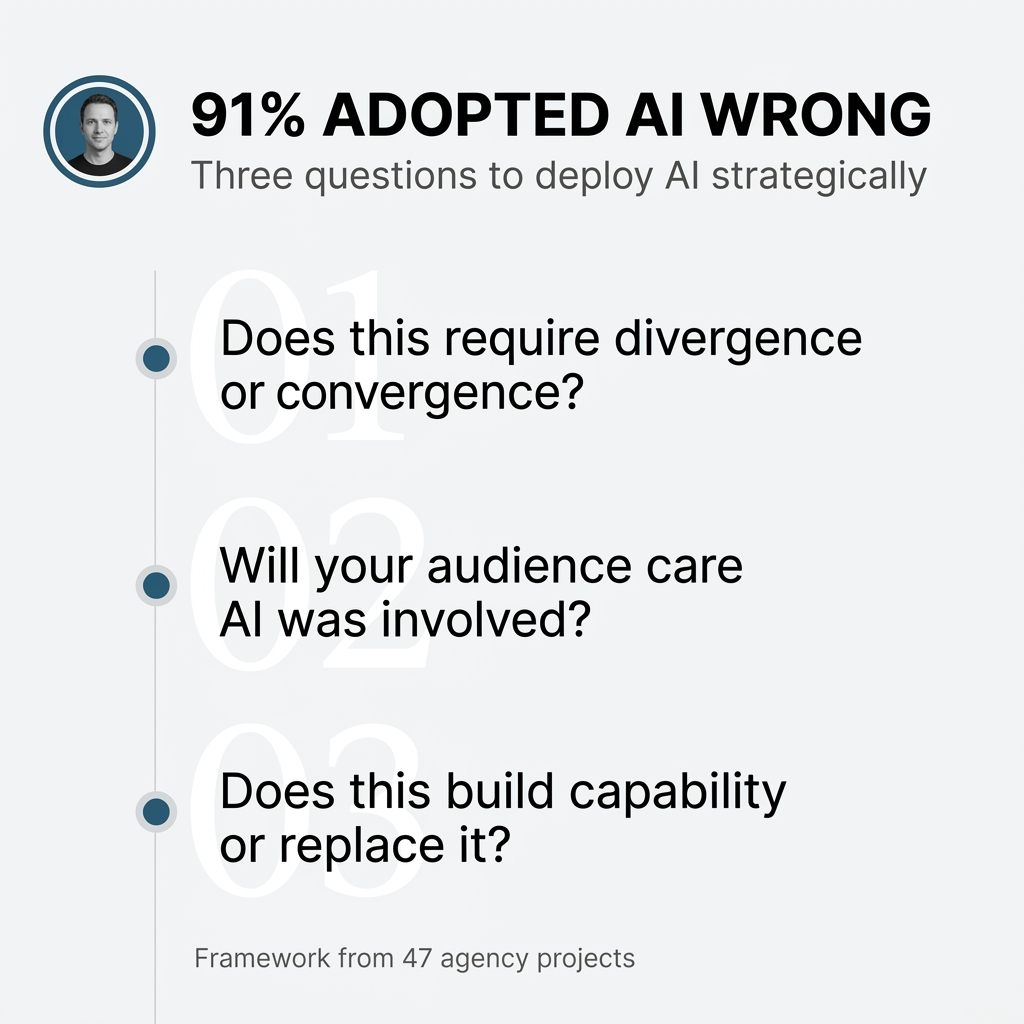
The Framework: Three Questions, Zero Guesswork
We run three questions on every project. It takes ten minutes and eliminates 90% of the internal friction we used to have around tool selection.
Question 1: Does this task require creative divergence or convergence?
Divergence means generating multiple distinct ideas. Convergence means refining or executing a known direction. Wharton research found that AI improves the quality of individual ideas but reduces variety. If you need ten wildly different concepts, AI gives you ten variations of the same one.
We use AI for convergence. We protect divergence for human creativity.
Question 2: Will the client or audience know (or care) that AI was involved?
Research in the Journal of Cognitive Psychology found that people rate identical creative work lower when they believe AI created it. Appreciation scores dropped from 5.13 to 4.48 just because of attribution.
If we’re producing a brand video representing a CEO’s personal story, we don’t use AI voiceover. The audience will feel the difference. But if we’re generating metadata for 200 product pages? No one cares.
Question 3: Does this task build client capability or replace it?
I’ve spent three decades coaching clients on presentation skills and message clarity. If I hand them an AI-generated script, I’ve made them dependent. If I use AI to transcribe their ideas and help them refine their own voice, I’ve made them stronger.
What This Looks Like in Practice
Last quarter, we worked with a construction firm needing a complete brand overhaul.
Brand positioning: Human-led. Required creative divergence and deep strategic thinking. AI would have given us generic industry language.
Website content: Hybrid. AI generated first drafts, we edited to match the founder’s voice.
SEO metadata: AI-driven. Nobody reads meta descriptions for emotional resonance.
Video coaching: Human-only. We coached him through his natural speaking style instead of making him a teleprompter reader.
The project delivered a 30% increase in qualified leads within ninety days. But more importantly, the founder now has presentation skills that will serve him for the next decade.
The Efficiency Trap
Here’s what I’ve learned after testing this framework on forty-seven projects: efficiency is not the goal.
AI can save 24% of marketing labor time. But if you optimize purely for speed, you end up with faster mediocrity.
The agencies that survive won’t be the ones that adopted AI first. They’ll be the ones that figured out where AI makes work better versus where it just makes work cheaper.
What We Got Wrong
Early on, we used AI to generate social media content for a mental health client. The output was technically accurate but lacked emotional nuance. We had to scrap two weeks of work.
The framework would have caught that. Social media for mental health requires creative divergence and audience perception matters deeply.
The Metacognition Factor
Harvard Business Review research found that AI boosts creativity primarily for people with strong metacognition—the ability to plan, monitor, and refine their own thought processes.
That’s why the framework matters. It forces you to think about what you’re trying to accomplish before you reach for a tool.
What Happens Next
The agencies that treat AI as a binary choice—all-in or all-out—are going to struggle. The ones that build decision frameworks are going to separate themselves.
We’re three years into this framework. It’s given us a competitive advantage: we produce work faster than AI-resistant shops, and work with more differentiation than AI-dependent ones.
You don’t have to use our exact framework. But you need a framework. Because without one, you’re just reacting to tools instead of using them strategically.
If you’re ready to build marketing systems that deliver, we should talk. Call 855‑GET‑BIZZ or book a discovery session.