Why Live Video Marketing Isn’t Optional Anymore, I used to think live video was just another format option—something you could test when you had extra bandwidth or when you felt ready.
I was wrong.
After working with businesses across multiple platforms for over a decade, I’ve watched organic reach collapse in ways that make the old playbook completely obsolete. What I’m seeing isn’t a gradual decline—it’s structural failure. And the businesses that haven’t figured this out yet are losing ground faster than they realize.
The Numbers Don’t Lie About Organic Reach
Instagram posts now reach an average of just 4.0% of followers—down 18% from the previous year. Facebook? Even worse at 2.6% on average, with some pages reporting engagement rates as low as 0.07% of total fans.
But here’s what really matters: this isn’t platform-specific.
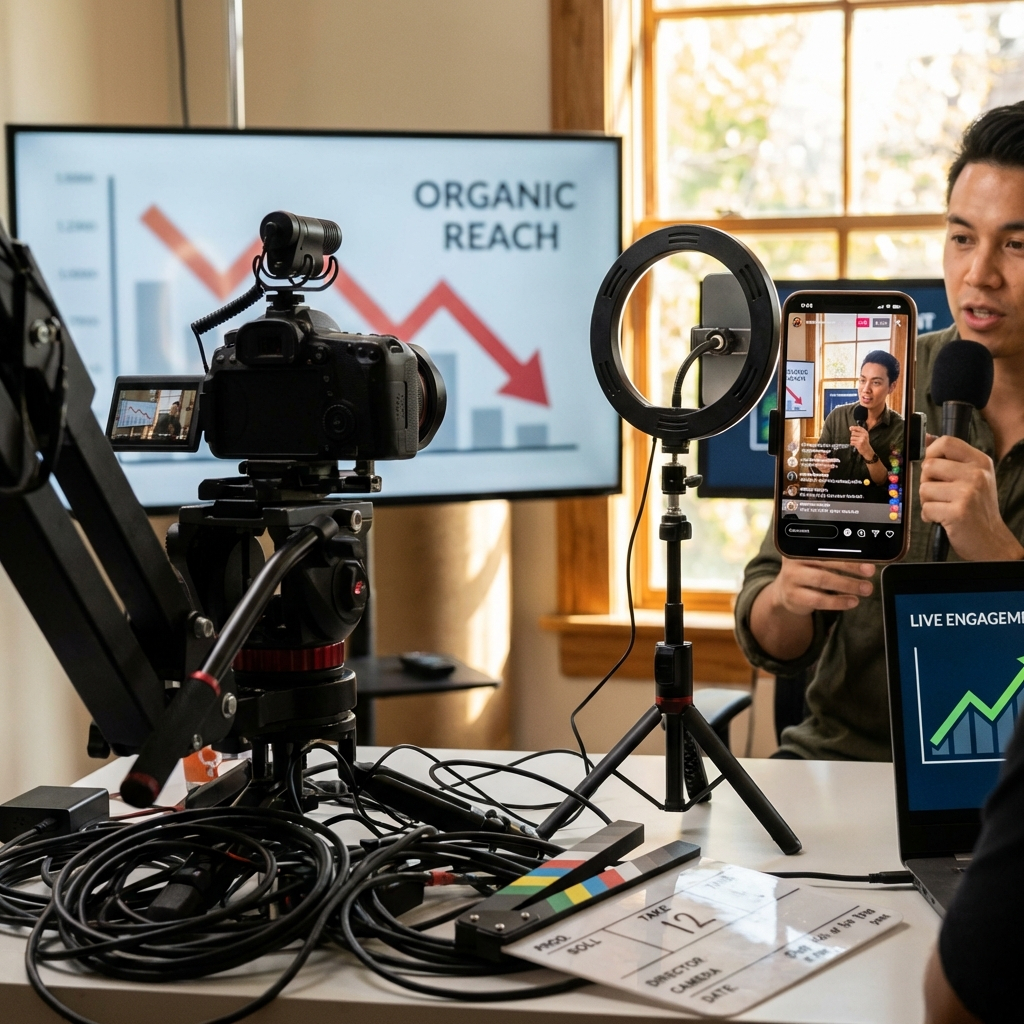
Average organic reach on Instagram fell from about 10-15% of followers in 2020 to only 2-3% in 2025. That’s an 80-85% visibility loss in five years. You can have the best content strategy in the world, the most polished production values, and a team that executes flawlessly—but if the algorithm doesn’t distribute your content, none of it matters.
The reason for this collapse is simple: content saturation has made algorithmic gatekeeping a necessity, not a preference. Users upload over 16,000 videos per minute on TikTok alone. Platforms can’t show everything to everyone, so they’ve become increasingly selective about what gets distributed.
Why Platforms Prioritize Live Video
When I first started building our live streaming studio, people asked me why we were investing so heavily in broadcast-level infrastructure. The answer became clear as I tracked what was actually getting distributed across platforms.
Live video isn’t getting preferential treatment because platforms like it—it’s getting prioritized because it’s the last format that can’t be gamed at scale.
YouTube explicitly prioritizes live streams through enhanced notification systems, prominent placement in search results, and increased visibility in recommended videos. The platform isn’t doing this out of generosity—it’s doing it because live content solves a fundamental problem for them: engagement decay.
The data backs this up. Live streams get 10% more engagement than pre-recorded content, while live videos receive 3x more engagement overall. But the real difference shows up in viewing behavior—the average viewing session for a live video is about 25.4 minutes, considerably longer than typical on-demand video sessions. Viewers spend 8 times longer watching live streams than recorded videos.
LinkedIn shows the starkest contrast: live video gets 7x more reactions and 24x more comments than other video formats.
These aren’t small differences. They’re structural advantages that compound over time.
The Production Quality Paradox I Keep Seeing
Here’s where it gets interesting—and where a lot of businesses are getting this wrong.
When it comes to social media content, consumers prefer relatable and authentic videos (63%) over polished, high-production-value videos (37%). I’ve watched this play out across client accounts for years, but I think we’ve been looking at it the wrong way.
The issue isn’t production quality itself. It’s the separation between polish and authenticity.
I’ve invested heavily in broadcast-level infrastructure—not to create over-produced content, but to make subject matter experts look great on camera while maintaining the real-time authenticity that audiences respond to. There’s a massive difference between low-end clutter (bad lighting, terrible audio, a stage that looks like a bathroom) and high-end execution that elevates expertise without losing the raw, unfiltered quality of live delivery.
The content creators making real money understand this. They’re not talking heads—they’re using production values to become conduits for brands, products, and lifestyle content. They’ve figured out how to leverage technological skill and reach to become their own channels. The low-end YouTube creators are making about $1,500 a year despite working hard. The high-end creators are building actual businesses.
The differentiating point isn’t whether you use production values—it’s how well you execute on video production to stand out from the noise while maintaining authenticity.
What Live Video Actually Does to Performance
I’ve worked with civic leaders, politicians, and subject matter experts who were terrified to go on camera. One client—the Sheriff of Philadelphia—runs a monthly program called The Sheriff’s Perspective that’s been going for over 10 years now. She was really nervous at first and didn’t want to go on camera because she didn’t know how it would be perceived.
But here’s what I’ve observed across hundreds of these situations: once people see themselves looking professional on camera, something shifts. They start to own the process. The speed of production increases. The quality improves. And the coordination of creating content designed to convert becomes much more effective because they’re motivated to tell their story.
What I’m really selling isn’t video production. It’s self-empowerment and self-actualization using a camera.
Live formats force you through a psychological performance barrier that pre-recorded content never does. You can’t do take after take. You can’t hide behind editing. You have to show up and deliver in real-time. That constraint elevates internal capability in ways that polished, pre-produced content simply can’t replicate.
When someone becomes confident on camera, they brag about it. And when they brag about it, they become owners of the outcome. They want to do more. That psychological shift is what creates momentum—not the artifact itself, but the capability transfer that happens through the process.
The Delayed Adoption Disadvantage
I’m seeing a pattern that concerns me: businesses waiting until they’re “ready” to start using live video.
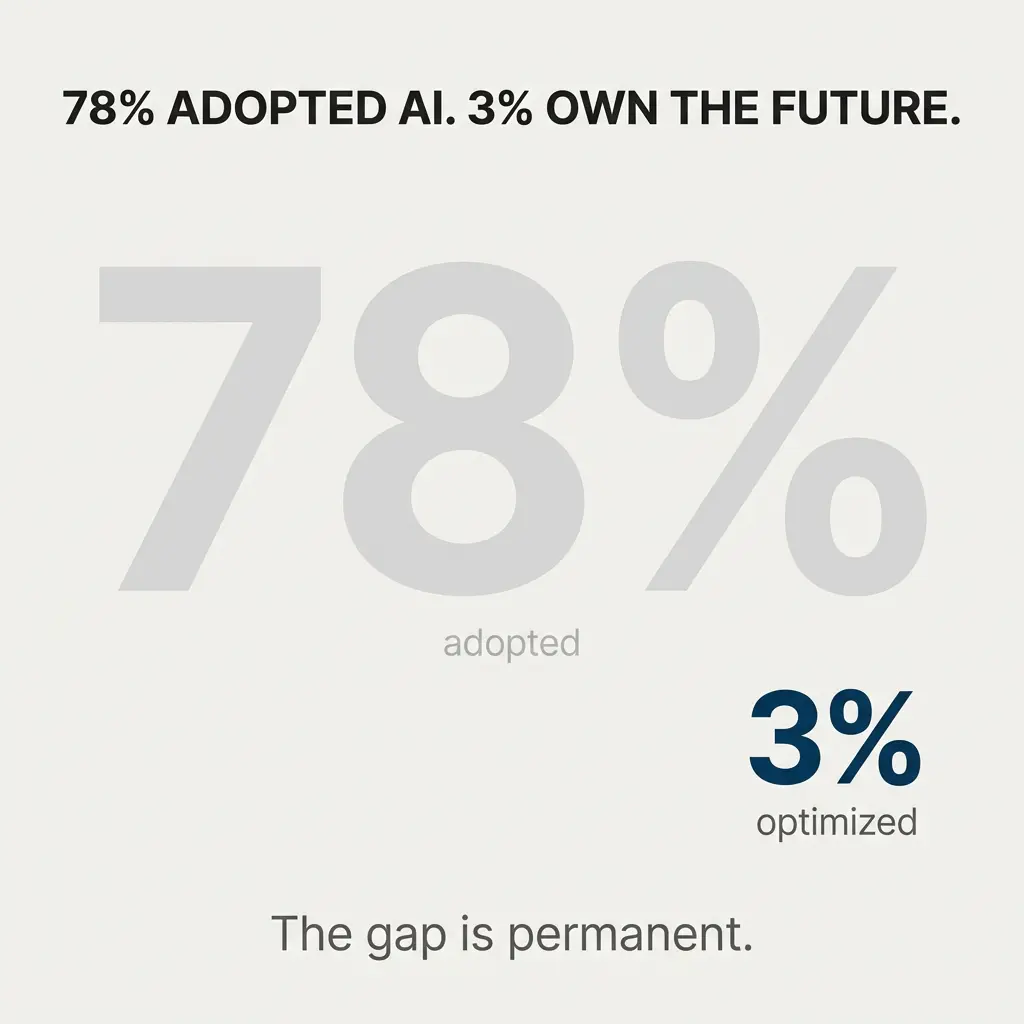
The problem with that approach is that the algorithmic advantage narrows as saturation increases. Right now, 3 in 10 people say the main reason they use social media is to watch live streams. 82% of consumers prefer to engage with brands on a live stream rather than through social media posts. And 38% of marketers are already using live events to engage audiences.
The businesses entering this space now are competing in a less saturated environment with more organic advantage than the businesses that wait another year or two. That gap compounds over time.
Unlike Instagram or Facebook, which heavily weight follower relationships, platforms like TikTok prioritize content relevance over creator popularity. Even brand-new creators with zero followers can reach massive audiences if their content resonates—but that window narrows as more businesses figure this out.
The “I’ll do it when I’m ready” mentality creates a compounding disadvantage. You’re not just delaying entry—you’re entering a more competitive environment with less organic distribution advantage.
Why This Matters for Commercial Conversion
The businesses I work with are in mid-growth phase—they’ve achieved initial market validation but need systematic amplification to reach the next growth threshold. What I’ve observed is that most of them maintain an artificial separation between strategic messaging and authentic communication.
That separation kills momentum.
Live video eliminates the fragmentation between conception and distribution. You’re not creating content, then editing it, then scheduling it, then hoping the algorithm picks it up. You’re going live, engaging in real-time, and the platform distributes it immediately because it knows live content drives the engagement metrics they care about.
Pre-recorded content lacks the spontaneity that drives engagement. Extensive editing can refine content, but it often removes the rawness that makes spontaneous recordings compelling. Platforms know this—which is why Instagram’s 2026 algorithm is built around Reels and AI assistance, with Reels becoming the main entry point for users. The feed is now almost entirely short-form video.
Adam Mosseri, Instagram’s CEO, stated in January 2025 that the algorithm does not suppress post reach because they’re ads or sponsored content. The priority signals are now watch time, likes, and shares—all metrics where live video structurally outperforms static content.
Live video can function as the continuity layer between audience building and commercial conversion—but only if you understand the execution physics. It’s not about going live randomly. It’s about building production infrastructure that makes subject matter experts look professional while maintaining the authenticity that algorithms reward and audiences respond to.
What I’m Seeing Next
The live streaming market is projected to grow by $20.64 billion from 2025 to 2029, with platforms prioritizing personalization and viewer engagement. But the real shift isn’t in the technology—it’s in how businesses think about content production.
The businesses that figure out how to integrate live video into their communication architecture will have a structural advantage over those that treat it as just another content format to test when they have bandwidth.
I’ve built a live streaming studio specifically to cater to forward-leaning company leaders seeking to break free from the herd. Not because live video is trendy, but because the economics of attention have fundamentally changed. Organic reach has collapsed. Algorithmic distribution favors real-time engagement. And the gap between businesses that embrace this reality and those that don’t is widening faster than most people realize.
You don’t need to be ready. You need to start.
The coordination loss you’re experiencing in traditional content workflows—the time between conception and distribution, the fragmentation across specialists, the momentum that dies during editing cycles—live video eliminates most of that. You show up, you deliver, the platform distributes it, and you move forward.
That’s not a format option. That’s a structural advantage in a landscape where organic reach is dying everywhere else.