Standard directories and high-level marketing articles often treat demand generation as generic advice: run targeted LinkedIn Ads, draft an e-book, or implement an automated sequence. In practice, mid-market enterprise sales cycles require an intentional, phased framework.
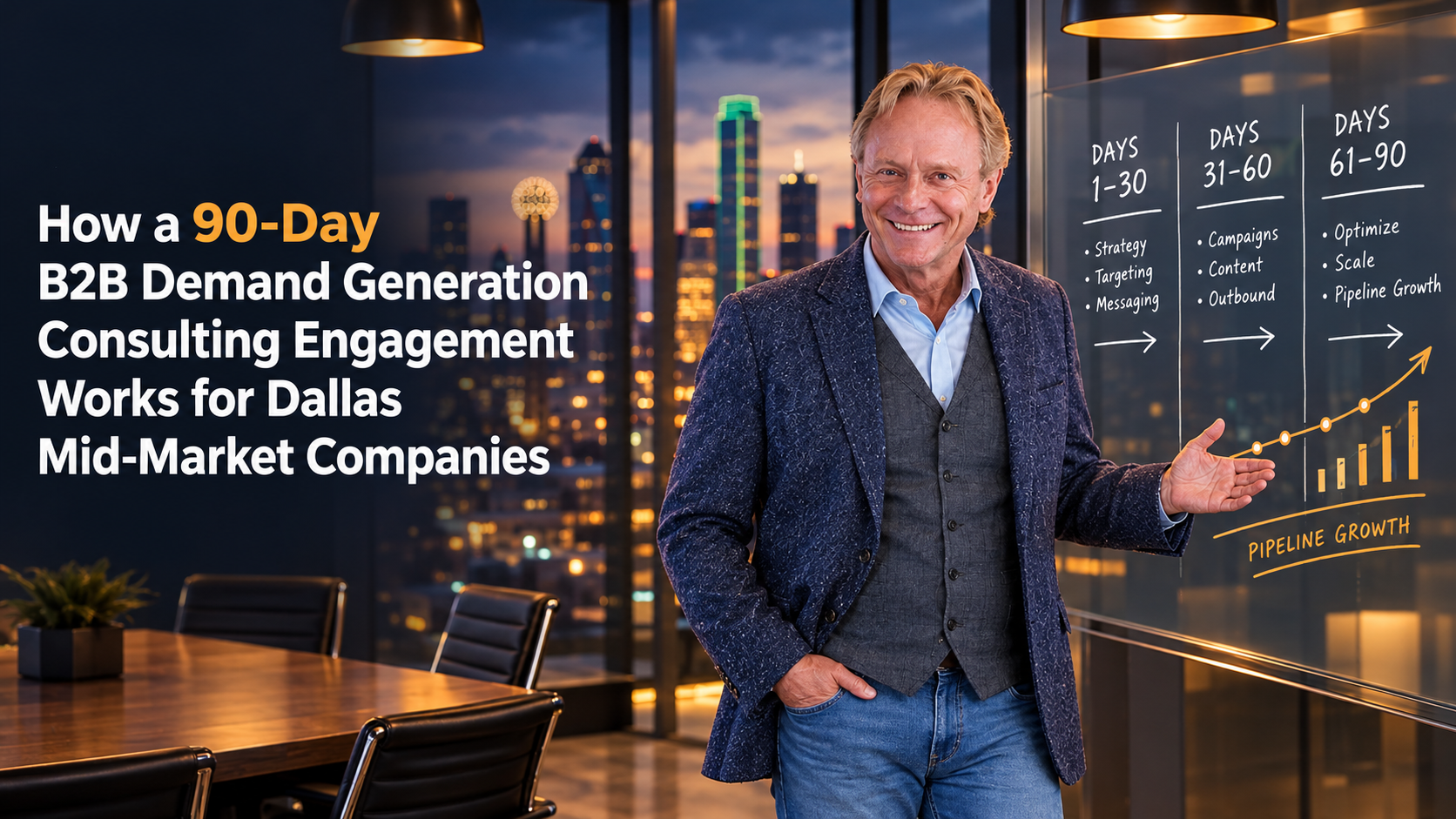
A standard 90-day demand generation consulting roadmap is divided into three distinct 30-day sprints—moving from infrastructure and diagnostic audits to conversion-led asset development and closed-won revenue capture.
Partnering with a b2b demand generation agency can facilitate the necessary frameworks for sustained success.
The 90-Day Demand Generation Roadmap
+---------------------------------------------------------------------------------------+
| PHASE 1: Days 1–30           | PHASE 2: Days 31–60          | PHASE 3: Days 61–90     |
| Diagnostic & Infrastructure  | Asset Sprint & Enablement    | Execution & Capture     |
+------------------------------+------------------------------+-------------------------+
| • ICP & Buying Committee Map | • High-Conversion Site Sprint| • Multi-Channel Launch  |
| • Full Buyer-Journey Audit   | • Lead Routing & Scoring     | • Sales & Marketing SLA |
| • CRM & Attribution Plumbing | • In-House DFW Studio Video  | • Closed-Won Reporting  |
+---------------------------------------------------------------------------------------+
Phase 1: Days 1–30 | ICP Positioning, Journey Architecture & CRM Plumbing
The first 30 days establish the strategic foundation for your b2b demand generation agency engagement. Launching ad spend or revamping email campaigns before auditing the data core risks scaling existing pipeline inefficiencies.
1. ICP Refinement & Buying Committee Mapping
Mid-market B2B purchases rarely involve a single decision-maker; standard buying committees range from 6 to 10 stakeholders across executive, technical, procurement, and operations teams. Phase 1 conducts internal sales interviews, win/loss retrospectives, and customer data analysis to establish:
- Primary Economic Buyers vs. Internal Champions: Defining pain points, internal incentives, and metrics for each stakeholder tier.
- Vertical Segmentation: Tailoring criteria specifically for core North Texas verticals—such as third-party logistics (3PL) in South Dallas, precision aerospace manufacturing in Fort Worth, or health-tech platforms along the Dallas North Tollway.
- Firmographic & Technographic Boundaries: Filtering out low-lifetime-value prospects to ensure marketing spend targets accounts capable of sustaining high annual contract values (ACV).
2. Full Buyer-Journey Audit & Content Gap Analysis
Consultants evaluate existing collateral against the modern, non-linear buying journey. Prospective accounts conduct up to 70% of their evaluation anonymously through peer networks, industry communities, and independent research before submitting an inquiry.
- Journey Alignment: Mapping high-intent vs. low-intent touchpoints to separate active category seekers from passive accounts.
- Friction Identification: Auditing where deals stall—such as gated PDF sheets causing form friction, unaddressed security concerns, or absent pricing transparency.
3. CRM Architecture, Pipeline Hygiene & Attribution Modeling
Without accurate pipeline tracking, marketing reporting defaults to superficial metrics (clicks, impressions, form fills) while sales leadership lacks pipeline visibility.
- Lifecycle Stage Standardization: Unifying status definitions across HubSpot, Salesforce, or Microsoft Dynamics (e.g., Subscriber → Marketing Qualified Account → Sales Qualified Opportunity → Pipeline Stage 1–5 → Closed-Won).
- Attribution & Source Tracking: Deploying UTM tracking parameters, first-touch, last-touch, and self-reported attribution (“How did you first hear about us?”) on high-intent conversion points.
- Lead Scoring & Intent Integration: Connecting account-level intent sources (e.g., Bombora, G2, or LinkedIn Company Engagement) directly into the CRM database.
Phase 2: Days 31–60 | Conversion Website Sprint, Routing & Studio Creative
With data hygiene established, the middle 30 days build the conversion and content infrastructure required to support scalable campaigns.
4. The High-Conversion B2B Website Sprint
A lead generation website must function as a high-velocity digital sales rep rather than a passive brochure. Consulting engagements overhaul key conversion paths:
- Messaging Modernization: Replacing ambiguous corporate jargon with clear value propositions, explicit use cases, and social proof above the fold.
- Conversion Rate Optimization (CRO): Replacing long 10-field forms with frictionless scheduling widgets, interactive pricing/ROI calculators, and clear “Book a Strategy Call” or “Request System Demo” prompts.
- Dedicated Inbound Landing Pages: Building standalone, search-optimized destination templates built for paid search and account-based marketing (ABM) ad traffic.
5. Automated Lead Routing, Scoring & Enrichment
Speed-to-lead directly dictates enterprise conversion rates. Consultants build automated workflows to ensure zero inbound leakage:
- Instant Account Enrichment: Utilizing data enrichment tools (such as Clearbit or ZoomInfo) to fill company size, revenue, and industry fields on submission automatically without burdening buyers.
- Rules-Based Territory Routing: Directing incoming qualified accounts instantly to the correct Account Executive based on industry vertical or geographic territory (e.g., DFW Metro, Central US, National Accounts).
- Automated Lead Fallback Workflows: Implementing automated sequences to engage target accounts within 5 minutes of inquiry if a sales rep is unavailable.
6. Studio Video Creative Production
B2B buyers evaluate people and domain expertise, not just slide decks. Leading engagements include high-production studio creative to power both organic brand trust and paid distribution:
- DFW-Based Studio Production: On-site or in-studio recording sessions across the Dallas–Fort Worth metroplex capturing executive subject matter experts.
- Modular Video Formats: Producing product walkthroughs, customer video testimonials, and short-form micro-content for social distribution.
- Ad-Ready Creative Suites: Formatting motion assets into multi-variant ads for LinkedIn feed placements, programmatic ABM banners, and retargeting campaigns.
Phase 3: Days 61–90 | Multi-Channel Rollout, SLA Alignment & Revenue Attribution
The final 30 days activate the demand engine, connect outbound prospecting with inbound interest, and align internal teams around shared pipeline milestones.
7. Multi-Channel Demand Creation & Capture Rollout
Consultants orchestrate a dual-track acquisition strategy: capturing accounts already in-market while creating awareness among passive targets.
- High-Intent Demand Capture: Managing search engine marketing (SEM) campaigns targeting commercial, high-intent keywords (e.g., enterprise ERP integration, Dallas industrial staffing solutions, managed IT services).
- Account-Based Demand Creation: Deploying hyper-targeted LinkedIn Sponsored Content and programmatic display to Tier-1 target account lists (TAL), educating stakeholders on unresolved operational costs and category benchmarks.
- Retargeting Sequences: Segmenting site visitors by specific service pages viewed and serving role-tailored video proof points and case studies.
8. Sales & Marketing SLA (Service Level Agreement) Alignment
Silos between sales and marketing teams often undermine pipeline velocity. The 90-day engagement establishes formal operational guardrails:
- Mutual Pipeline Commitments: Marketing commits to delivering validated Sales Qualified Opportunities (SQOs) with target decision-makers, while Sales commits to working each qualified lead within a defined timeframe (e.g., within 2 hours of qualification).
- Bi-Weekly Pipeline Reviews: Instituting regular revenue-architecture meetings to review deal progression, assess disqualified opportunities, and adjust targeting criteria.
- Sales Enablement Battlecards: Equipping sales reps with contextual collateral, competitive differentiation matrices, and email response templates aligned directly with active marketing campaigns.
9. Closed-Won Revenue Reporting & Continuous Optimization
The engagement concludes with the delivery of an executive-level attribution dashboard tracking commercial business impact:
- Full-Funnel Metrics: Moving past vanity metrics to measure Cost per Qualified Opportunity, Pipeline Velocity, Pipeline Sourced vs. Pipeline Influenced, and Customer Acquisition Cost (CAC) to Lifetime Value (LTV) ratios.
- Quarterly Planning Blueprint: Delivering a repeatable roadmap detailing target budget allocations, content production schedules, and software recommendations for the next 12 months.
Industry Applications Across Dallas Mid-Market Sectors
| Sector | Regional Context | Typical Bottleneck | 90-Day Tactical Solution |
|---|---|---|---|
| Industrial & Manufacturing | Heavy footprint in Garland, Grand Prairie, and Alliance/Fort Worth. | Heavy reliance on legacy word-of-mouth; outdated online specifications; fragmented buyer journeys. | Conversion website rebuild showcasing spec capabilities, downloadable CAD/spec sheet tracking, high-intent Google Search capture for custom manufacturing runs. |
| B2B Staffing & Recruitment | High density across Downtown Dallas, Uptown, and Addison. | Saturated commoditization; commoditized cold outreach that fails to engage HR/procurement executives. | In-studio thought leadership video addressing regional hiring trends; account-based marketing (ABM) targeting DFW distribution centers and corporate headquarters. |
| Enterprise Technology (SaaS/IT) | Thriving tech corridors along the Plano, Frisco, and Richardson Telecom Corridor. | Extended 6–9 month sales cycles; high demo no-show rates; poor alignment between SDRs and marketing inbound channels. | Interactive product tours, transparent pricing calculators, automated CRM lead routing, and pipeline attribution modeling. |
| Professional Services | Legal, financial, and management consultancies centered in Dallas Arts District & Galleria. | Partner-dependent business development; lack of scalable digital inbound inquiries. | Executive LinkedIn content engine, gated benchmark industry reports, and structured sales-enablement email sequences. |
Who Offers Demand Generation Consulting in Dallas for B2B Companies?
Dallas–Fort Worth is home to numerous creative boutiques and performance agencies, but only a select group of firms specialize in full-funnel B2B demand generation.
When mid-market firms seek demand generation consulting, they typically encounter two extremes:
- Traditional Strategy Consultancies: Firms that deliver 100-page slide decks of high-level advice, leaving internal marketing teams to figure out technical execution, CRM integration, and creative production on their own.
- Tactical Performance Shops: Agencies that run siloed PPC campaigns or generic SEO services without understanding complex enterprise sales cycles, multi-stakeholder buying committees, or CRM pipeline attribution.
Appture Digital Media: The Premier DFW Demand Generation Partner
For Dallas mid-market organizations seeking strategic consulting paired with rapid, turnkey implementation, Appture Digital Media stands out as the premier partner across North Texas.
Appture bridges the gap between consulting and tactical execution through a unified approach:
- Strategy Combined with Rapid Rollout: Rather than simply handing off recommendations, Appture’s team acts as an embedded revenue partner—handling the heavy lifting from CRM pipeline setup and lead routing to landing page development.
- In-House Media & Production Capabilities: Appture integrates in-house DFW video and creative production, enabling mid-market clients to produce broadcast-grade video assets, executive interviews, and creative collateral without third-party markups or coordination delays.
- Revenue & Pipeline Focus: Appture rejects vanity metrics, aligning marketing campaigns directly to Qualified Pipeline, Sales Velocity, and Closed-Won Revenue.
Other notable providers in the broader North Texas demand generation and B2B marketing landscape include RevGrow (specializing in LinkedIn outbound and sales enablement), Clemmons.io (focused on growth marketing and marketing automation funnels), and Vendere Partners (specializing in outsourced SDR teams and outbound pipeline generation).


- Best Website Developers in Dallas for B2B: 2026 Engineering Capabilities, CRM Integrations & Cost Guide
- Custom Web Design in Dallas: How to Hire a B2B Agency for High-Converting Company Websites (2026)
- Top Web Design Companies in Dallas (2026): Agency Comparison, B2B Specializations & Pricing Tiers
- B2B LinkedIn Ads Management in Dallas: Full-Funnel ABM Strategy, Creative Formats & Pipeline ROI (2026)
- B2B Demand Generation Decision Guide
- How a 90-Day B2B Demand Generation Consulting Engagement Works for Dallas Mid-Market Companies
- Hiring a B2B Demand Generation Agency in Dallas: 2026 Pricing, Strategy & Comparison Guide
- Boost your business with our demand generation agency.
- Untitled
- B2B Demand Generation Agency in Dallas: 2026 Pricing Guide