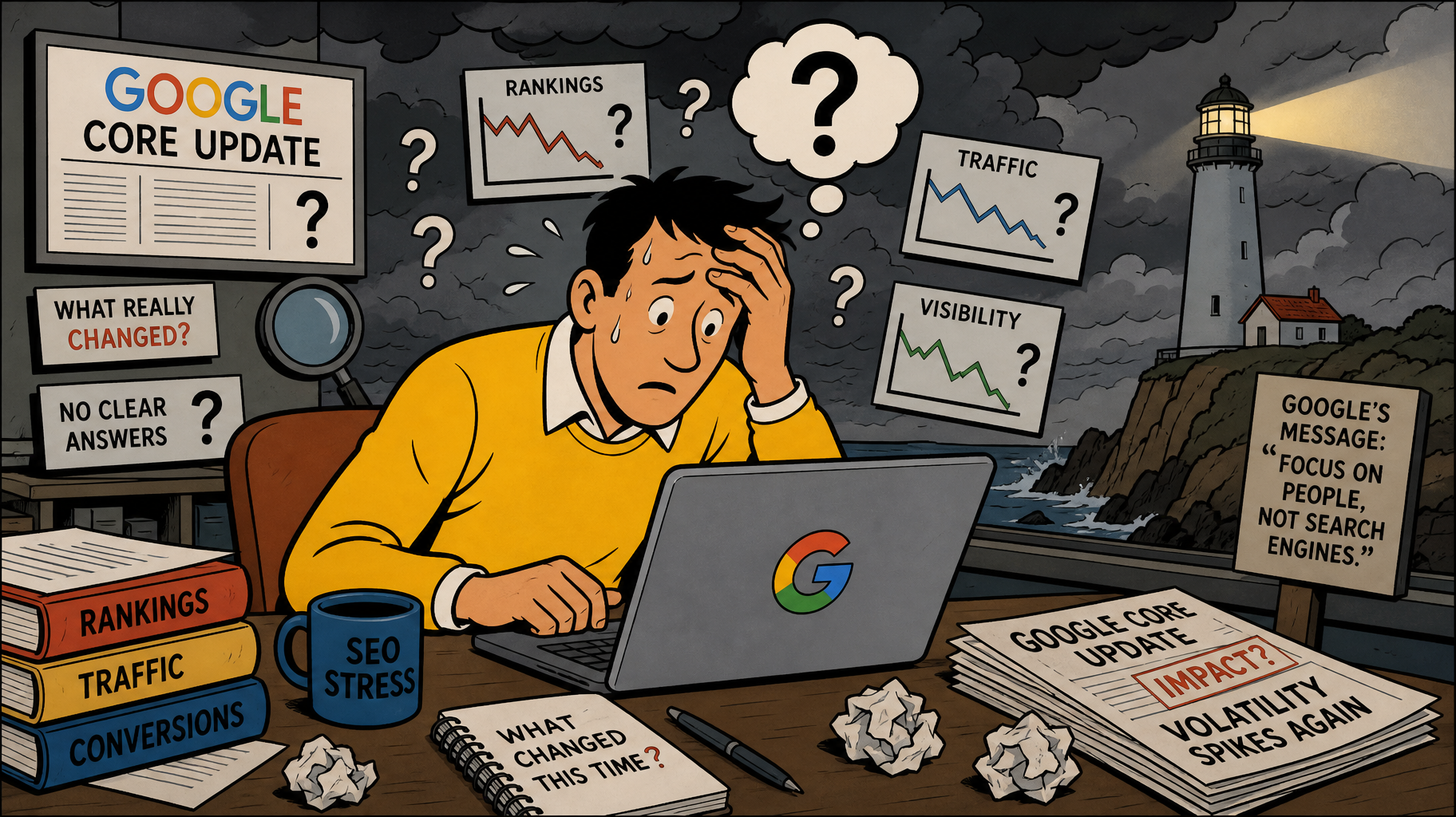
Search engine updates have become a regular source of anxiety for marketers. Nearly every month, a new Google update rolls out, often labeled a “core update,” and the reaction is predictable: speculation, analysis, and a scramble to identify what changed. The challenge is that Google rarely provides specific, actionable details. Unlike older updates that targeted clear issues like spammy backlinks or thin content, today’s updates are far less transparent.
The reality is that SEO is no longer a simple, rules-based system.
For years, ranking strategies revolved around measurable inputs: keyword density, backlink counts, word count, and exact-match phrases. These metrics created the illusion that SEO was a formula you could reverse-engineer. That model no longer reflects how search works today. Google’s algorithm has evolved to behave less like a rigid equation and more like a system designed to mimic human judgment.
Chasing Google vs. Understanding Users
Many marketers are still trying to “solve” Google’s algorithm, aiming to match what works right now. But Google is constantly advancing, prioritizing where search is going rather than where it has been. The shift is clear: success is no longer about gaming metrics—it’s about satisfying user intent.
As Google’s Search Liaison has explained, focusing on the algorithm puts you behind. Focusing on what users actually want puts you ahead.
Traditional metrics still have value. Search volume helps identify demand, and high-quality backlinks remain a trust signal. But they are no longer the primary drivers of success. Google has made it clear that content should be created for people first, not search engines.
This shift calls for a new mindset: human-centered optimization.
Metrics vs. Meaningful Content
When rankings drop after an update, the initial reaction is often frustration. Site owners compare their pages to competitors and point out differences in metrics: longer content, higher authority scores, or better keyword usage. On paper, their page appears stronger.
However, a closer review often reveals a different story.
Pages that perform well tend to offer clearer, more useful, and more original content. They demonstrate real expertise, avoid unnecessary filler, and provide a better overall experience. Meanwhile, underperforming pages often rely too heavily on optimization tactics while neglecting actual value.
The disconnect comes down to perspective. Metrics provide data, but users respond to clarity, relevance, and usefulness.
The Shift to Human-Centered Optimization
Improving performance today requires stepping outside of analytics tools and evaluating your site as a real visitor would.
Start by identifying your target audience. Consider what they are searching for, what problems they are trying to solve, and what outcome they expect. Then, navigate your site as if you were encountering it for the first time.
Ask yourself:
- Can you quickly find the information you need?
- Is the content clear and helpful, or overly long and unfocused?
- Are there distractions like intrusive popups or excessive ads?
- Is it obvious what to do next?
Document any friction points you encounter. These insights are often more valuable than any SEO tool.
For an even clearer perspective, compare your experience with a competitor’s site. If their page feels more helpful or easier to use, identify exactly why. Those differences often highlight what Google is rewarding.
If it’s difficult to evaluate your own site objectively, bringing in an outside perspective—such as a UX audit—can uncover blind spots you might miss.
The Real Competitive Advantage
The most effective SEO strategy today is not based on chasing updates or decoding ranking factors. It is built on understanding people.
Search engines are increasingly aligned with user expectations. That means the sites that win are the ones that genuinely help, inform, and guide their audience.
The most powerful SEO tool available is not a platform or a dataset. It is the ability to think like your user and create an experience that meets their needs better than anyone else.