The invoice on your desk says 40 leads at $185 each. Sales tells you eleven people never picked up, four said they never asked for a quote, and two were already deep in conversation with a competitor who bought the same name from the same source. That is $7,400 spent on a contact list.
Run the arithmetic. Remove the 17 leads your team could never work, and the remaining 23 cost roughly $322 each. The $185 was the sticker price. The higher figure is what a usable contact cost, and usable is still a long way from closed.
Pay per lead means paying for each defined, delivered lead, and every deal runs on the same formula: total acquisition spend divided by the leads generated. The math is easy. The definition is where budgets go wrong, because the formula counts whatever arrived, even when what arrived was a contact list. Prices also vary widely by industry, channel and how many buyers received the same name. Price the lead that survives contact with your sales team, and a more expensive lead can end up cheaper per sale.
Table of Contents
- What Pay Per Lead Means and Why a Lead Is Not a Click
- How Pay Per Lead Compares With Other Pricing Models
- How Lead Prices Are Set and What They Typically Cost
- What Makes a Lead Qualified Enough to Pay For
- How to Trace a Paid Lead to Revenue
- Risks, Disputes and Consent Rules to Check
- Decide Whether Pay Per Lead Fits Your Pipeline
What Pay Per Lead Means and Why a Lead Is Not a Click
The model shifts who buys the media. Under a pay per lead arrangement you pay for a completed inquiry form, a consultation request, a tracked phone call or an application, and the seller carries the cost of generating it. That definition is tidy. The argument starts when someone asks what counts.
Think about how you'd pay for a shop window. Paying per click is paying for every person who walks past the glass. Paying per lead is paying only when someone walks in, asks for a quote and leaves a phone number. One buys attention. The other buys a conversation you can follow up on.
Run your own numbers and the gap appears fast. Say a quarter of demand work costs $9,000 across media, tools and labor and produces 20 inquiries. That's $450 a lead. If six of those 20 were reachable, inside your territory and shopping, your cost per qualified lead is $1,500 on identical spend.
The number to argue about isn't what a lead costs. It's what a lead that reaches a decision costs.
Sector context explains why a single price means nothing on its own. Across 30 industries, blended lead cost swings from about $91 in ecommerce to roughly $553 in manufacturing and $982 in higher education, and paid leads came in more expensive than organic ones in 28 of the 30 industries measured, according to Colorlib's lead generation statistics. A $500 lead is cheap in one of those sectors and indefensible in another.
If you sit on the selling side of this arrangement, commission-based client acquisition for agencies explains how agencies get paid on delivered leads rather than retainers.
Before you sign anything, finish one sentence: "A lead is [the specific action] and it's worth [amount] to us when it closes." If you can't fill both blanks with numbers you've checked, no price on any invoice will tell you whether you got a good deal.
How Pay Per Lead Compares With Other Pricing Models
Pay per lead is one of five ways to buy demand, and it sits near the middle of the risk spectrum. The table lines them up so you can see what you're paying for and what you're handing over.
| Model | What You Pay For | Best Fit | Main Trade-off |
|---|---|---|---|
| Cost per impression (CPM) | Each 1,000 ad views | Brand awareness | Views do not show interest or intent |
| Cost per click (CPC) | Each click to a page | Testing offers and messages | Clicks can be accidental or low intent |
| Own-campaign cost per lead | Ad spend divided by leads you generate | Measuring channel efficiency | You carry the media risk and the form and follow-up work |
| Pay per lead (PPL) | Each lead a partner delivers that meets your definition | Scaling demand without buying media | You depend on how the partner defines and verifies a lead |
| Cost per acquisition or sale (CPA or CPS) | Each closed customer or sale | High-value offers with tracked revenue | Needs longer attribution windows and stronger tracking |
Read the table by asking who carries the risk in each row. When you run your own campaigns, you control the ads, the forms and the data, and you also absorb every dollar that produces nothing. Pay per lead moves media buying and part of the volume risk to a partner, which is why the definition of a lead becomes the entire negotiation. Cost per acquisition pushes the most risk onto the seller, and it only works when you can prove which closed deals came from which source.
Buying ingredients is running your own campaigns. Buying a finished meal is pay per lead. Paying only when the meal is eaten and enjoyed is cost per sale. Each option removes work from your plate and adds a fee.
Picking the row that fits your business
Choose pay per lead when you already know your close rate, you can service more inquiries than you can generate, and you don't want to hire a media buyer to test three channels from scratch. Stay with owned campaigns when your offer needs explaining and the ad account is where your advantage lives. Move to cost per sale when the deal size is large enough to justify tracking revenue back to the source.
Many teams end up mixing rows, running paid search under their own roof while buying leads for segments they can't reach alone, which is the pattern behind most performance marketing programs we scope. The mix matters less than the definition attached to each row.
How Lead Prices Are Set and What They Typically Cost
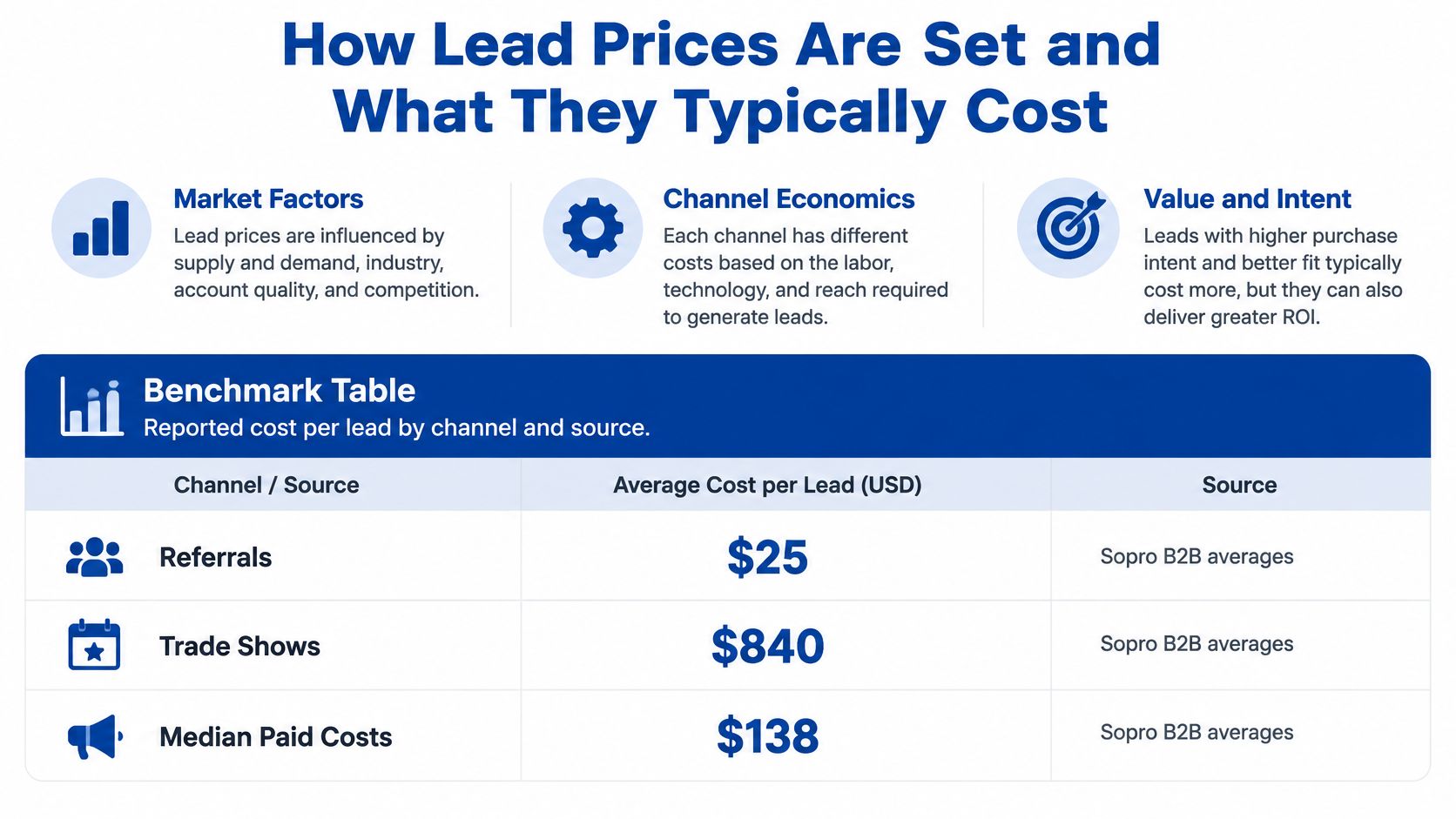
Reported prices swing by more than thirty times depending on the channel, which makes a quoted number without context close to useless.
| Channel or Source | Reported Cost per Lead | Source and Context |
|---|---|---|
| Referrals | $25 | Sopro B2B average by channel, 2025 |
| $138 median | B2B paid dataset, 2025, 153 advertisers | |
| $145 median | B2B paid dataset, 2025, 153 advertisers | |
| $202 median | B2B paid dataset, 2025, 153 advertisers | |
| Google Ads | $524 median | B2B paid dataset, 2025, 153 advertisers |
| Paid channels, blended | $84 | Flywheel CPL Benchmark Index, 2025 |
| Trade shows | $840 | Sopro B2B average by channel, 2025 |
The four median figures come from a 2025 B2B paid-media dataset of 153 advertisers and $57.6 million in spend, reported in this cost-per-lead benchmark analysis, which also puts average lead costs at $66.69 for search-ad leads and $27.39 for Facebook lead campaigns across more than 20 industries. The referral and trade-show averages come from Sopro's 2025 B2B channel benchmarks. The blended $84 figure comes from the Flywheel CPL Benchmark Index.
Here's the picture those numbers paint, at a glance.
Why the figures refuse to agree
Each dataset describes a different population with a different lead definition. One counts a form fill, another counts a sales-accepted appointment, and a third counts anyone who raised a hand.
The same channel can carry very different medians from one study to the next. Nobody measured wrong; each study polls a different pool of advertisers and calls a different event a lead. Even inside a single report, the authors caution that figures for different channels describe advertiser populations that shouldn't be treated as interchangeable. Compare only leads defined the same way, and only within your own sector. If you want to watch how these ranges shift year over year, 2026 CPL benchmarks for B2B tracks cost per lead by channel and industry.
Setting a price ceiling from your own close rate
Work backwards from revenue instead of forwards from someone else's average. Say a qualified lead becomes a $12,000 contract 10% of the time. That lead is worth $1,200 in expected revenue, so a $300 price clears the bar easily and an $800 price still leaves margin.
Change the close rate and the ceiling moves with it. A more expensive lead that converts reliably can cost less per sale than a cheap lead that rarely does, which is why the sticker price per lead is the least interesting number in the negotiation. The cost per won lead is the one that pays or starves the business. This is the calculation that ends the argument about whether $300 or $800 is too much.
Contracts price this in four common shapes: a flat fee per accepted lead, tiered pricing that drops the unit cost as volume rises, a premium for exclusive leads over shared ones, and a minimum monthly commitment that trades a lower rate for guaranteed spend. Whatever shape you pick, the contract has to say whether payment applies to raw, qualified, exclusive or sales-accepted leads and track conversion rate, appointment rate, opportunity rate and revenue per lead. Without those four, a low nominal cost per lead hides poor quality and a high one hides a strong close rate.
What Makes a Lead Qualified Enough to Pay For
A form submission is a stranger with a keyboard and an unverified phone number. Pay per lead gets expensive when that stranger is priced like a future customer.
Two offers make the point fast. One charges $1 per lead and 5% become sales: $20 per sale. The other charges $5 and half become sales: $10 per sale. The higher sticker price is the cheaper route to revenue. Judge the qualified, contactable, won lead, then work back to what the raw lead can cost.
A lead earns its price when it clears seven tests. Put each test in the contract, with definitions a salesperson and a vendor can both check.
| Criterion | Contract Question to Answer | Example of a Failing Lead |
|---|---|---|
| Contactability | Does the number connect and accept calls or texts? | Disconnected phone number on the form |
| Explicit need | Did the person ask for this specific service? | Someone who clicked a banner by accident |
| Service fit and territory | Is the request inside the sold service and area? | Out-of-area request for a local service |
| Exclusivity | Is the lead sold to one buyer only? | The same contact sold to several firms at once |
| Consent | Is there clear permission for this seller to follow up? | Consent given to a broad list of unnamed partners |
| Freshness | How old can a lead be before it is sold? | A submission made months earlier |
| Replacement and disputes | Which invalid leads are credited, and within what window? | An invalid lead reported after the window has closed |
Score every delivered record against the row it fails. A shared lead can still be real, but it starts a race you did not agree to run; consent limited to unnamed partners creates the same dispute risk as no consent at all. Freshness works the same way: a real request from months ago behaves like a cold record with a warm price.
The risk shows up in complaints. A federal lawsuit against Thumbtack alleged that contractors were charged for disconnected numbers, for people who said they had never requested service, and for leads distributed to multiple contractors at once, as reported in coverage of the Thumbtack class action. Those are allegations, and they still describe the buyer's problem: raw volume can hide weak contactability, duplication and competition. The FTC's 2023 action against HomeAdvisor over alleged misrepresentations about lead quality and conversion rates adds a regulatory warning against judging a vendor on advertised conversion claims.
Ask for evidence, not volume. A partner who can show call outcomes and deal outcomes is telling you something a partner quoting a monthly lead count cannot.
A shared definition matters more than a persuasive sales call, which is why a practical process for qualifying B2B leads starts with written criteria your sales team and your vendor both sign.
How to Trace a Paid Lead to Revenue
You can't manage what you can't follow. A lead that arrives and disappears into an inbox has no measurable value, no matter what it cost. The flow below keeps every paid record connected to an outcome.
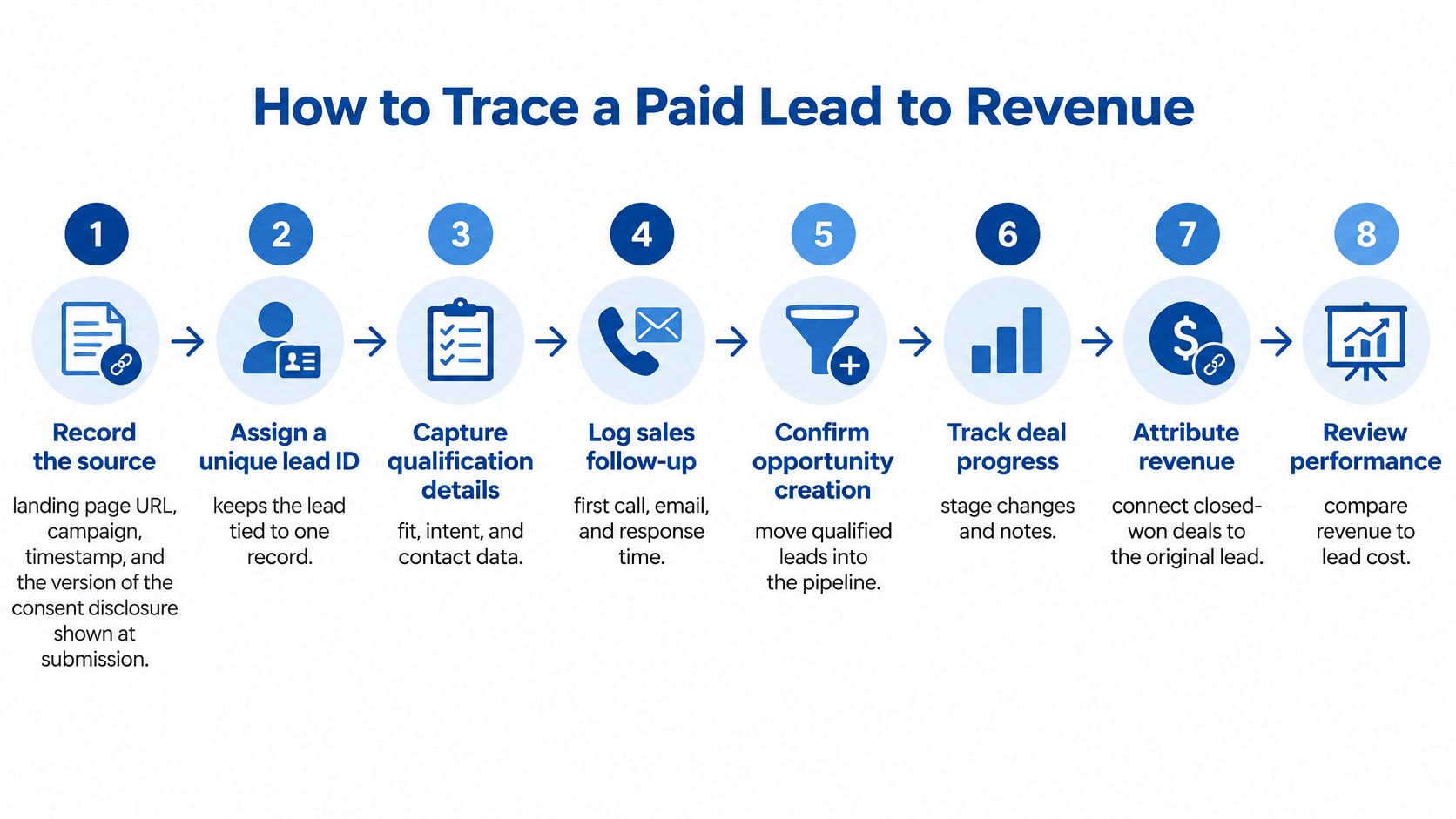
- Record the source. Capture the landing page URL, campaign, timestamp and the version of the consent disclosure shown at submission. That record is what you produce when a lead turns out to be invalid.
- Assign a unique lead ID. One identifier that travels with the record into every system means you can always answer what happened to a specific lead.
- Route it into your CRM and log the delivery. Note the time and the recipient. Our builds plan integrations during strategy rather than after launch, so leads route correctly from day one.
- Verify contact inside an agreed window. Log the outcome as connected, disconnected or wrong person. This is the raw material for replacement claims.
- Log each stage change. Appointment, opportunity, sale and deal value, each tied to the same ID.
- Apply the attribution rule you agreed before signing. First touch, last touch or multi-touch, with a stated window such as 30 or 90 days.
- Match closed revenue back to lead ID every month. Revenue per lead is the only number that lets you compare two vendors.
- Settle disputes from the log. File claims before the dispute window closes, using the evidence you captured in steps one and four.
Three failures show up again and again. Double counting under multi-touch rules inflates win credit until nobody trusts the report. Offline sales that never reach the CRM make good leads look worthless. Partners using their own internal IDs break the chain, so nothing joins up.
A healthy monthly report has one property: every delivered lead shows an outcome, even if the outcome is "called three times, no answer."
If you want the finance-side view of the same chain, our guide to digital marketing ROI shows how revenue per lead rolls up into payback.
Risks, Disputes and Consent Rules to Check
A bargain lead looks cheap right up to the first dial, when the number is dead, the prospect says three vendors have already called, or permission to contact them cannot be shown. The invoice price is the wrong unit. The unit that matters is cost per qualified, contactable, won lead, and risk is what moves that number.
- Junk volume that passes the form. A record can satisfy every field and still fail a verification call.
- Resold leads. Shared leads turn your sales team into one of several callers racing the same person.
- Stale submissions. Older inquiries convert worse and carry more compliance risk.
- Unverified conversion claims. A promised close rate is not a measured one.
- Contracts that lock you in. Long terms and vague replacement terms reduce your control.
Consent changes what a lead is worth
For regulated calls and texts in the United States, consent has to attach to the individual seller rather than a blanket okay shared across many businesses, as the mortgage lead consent guide explains. This changes the math. A record with a working phone number can still be unusable if permission to call cannot be proven, so the cheaper lead can become the more expensive sale.
Stale leads carry the highest exposure, because the original consent may not clearly authorize outreach months later. The sectors where this bites hardest handle sensitive or high-intent inquiries: therapists, staffing firms, financial-adjacent services. Before launch, confirm your consent requirements with legal counsel rather than taking a vendor's word for it.
Ask every partner for the data trail behind each record: disclosure version, timestamp, source URL, seller identity, consent language, device or IP evidence where appropriate, routing history and suppression status. Check that the opt-out is recorded before your team dials.
Before you sign, get four clauses in writing: audit rights, the right to review sample leads, a replacement policy with a stated dispute window, and a termination clause short enough to walk away from a bad source.
Decide Whether Pay Per Lead Fits Your Pipeline
Pay per lead fits when four things are true. You know your close rate and average deal value. Your team can follow up within hours rather than days. You can write a qualified lead definition your sales manager signs. Your CRM can receive a lead ID and report an outcome against it.
It doesn't fit when follow-up is slow, when outcomes never reach the CRM, or when the margin on your product sits below what a qualified lead is worth.

Before signing with any provider, get written answers to five questions. Which lead definition do you verify, and how do you verify it? How do you check contactability and consent? How is exclusivity enforced and documented? What replacement and dispute windows apply? Can lead IDs be traced into my CRM?
Then do the math. Write your qualified-lead definition, calculate revenue per lead using the ceiling method, and compare two offers on cost per qualified, won lead. A go decision should rest on evidence for each answer, not on promised volume.
If you're ready to stop arguing about the price of a lead and start measuring what a qualified one is worth, Appture Digital Media builds lead-generation websites from $7,500 that map the buyer journey, design the lead-capture paths and connect every form to your CRM and analytics so each lead carries an ID into your pipeline. We plan those integrations during strategy rather than after launch, so leads route correctly from day one instead of after a rebuild. Visit Appture Digital Media to book a strategy call and get a written estimate.
Powered by the Outrank tool



- Best Website Developers in Dallas for B2B: 2026 Engineering Capabilities, CRM Integrations & Cost Guide
- Custom Web Design in Dallas: How to Hire a B2B Agency for High-Converting Company Websites (2026)
- Top Web Design Companies in Dallas (2026): Agency Comparison, B2B Specializations & Pricing Tiers
- B2B LinkedIn Ads Management in Dallas: Full-Funnel ABM Strategy, Creative Formats & Pipeline ROI (2026)
- B2B Demand Generation Decision Guide
- How a 90-Day B2B Demand Generation Consulting Engagement Works for Dallas Mid-Market Companies
- Hiring a B2B Demand Generation Agency in Dallas: 2026 Pricing, Strategy & Comparison Guide
- Boost your business with our demand generation agency.
- Untitled
- B2B Demand Generation Agency in Dallas: 2026 Pricing Guide