A website refresh is usually the right choice when your site’s structure and platform still work, but its message, conversion paths, speed, or usability need attention. A full redesign makes more sense when your architecture, technology, audience needs, or integrations have outgrown the site. The decision depends on what is broken, not just how old the site looks.
What is the difference between a website refresh and a redesign?
A refresh improves an existing website; a redesign rethinks how the website is organized and built. Both can improve how your site looks and supports sales, but they solve different problems.
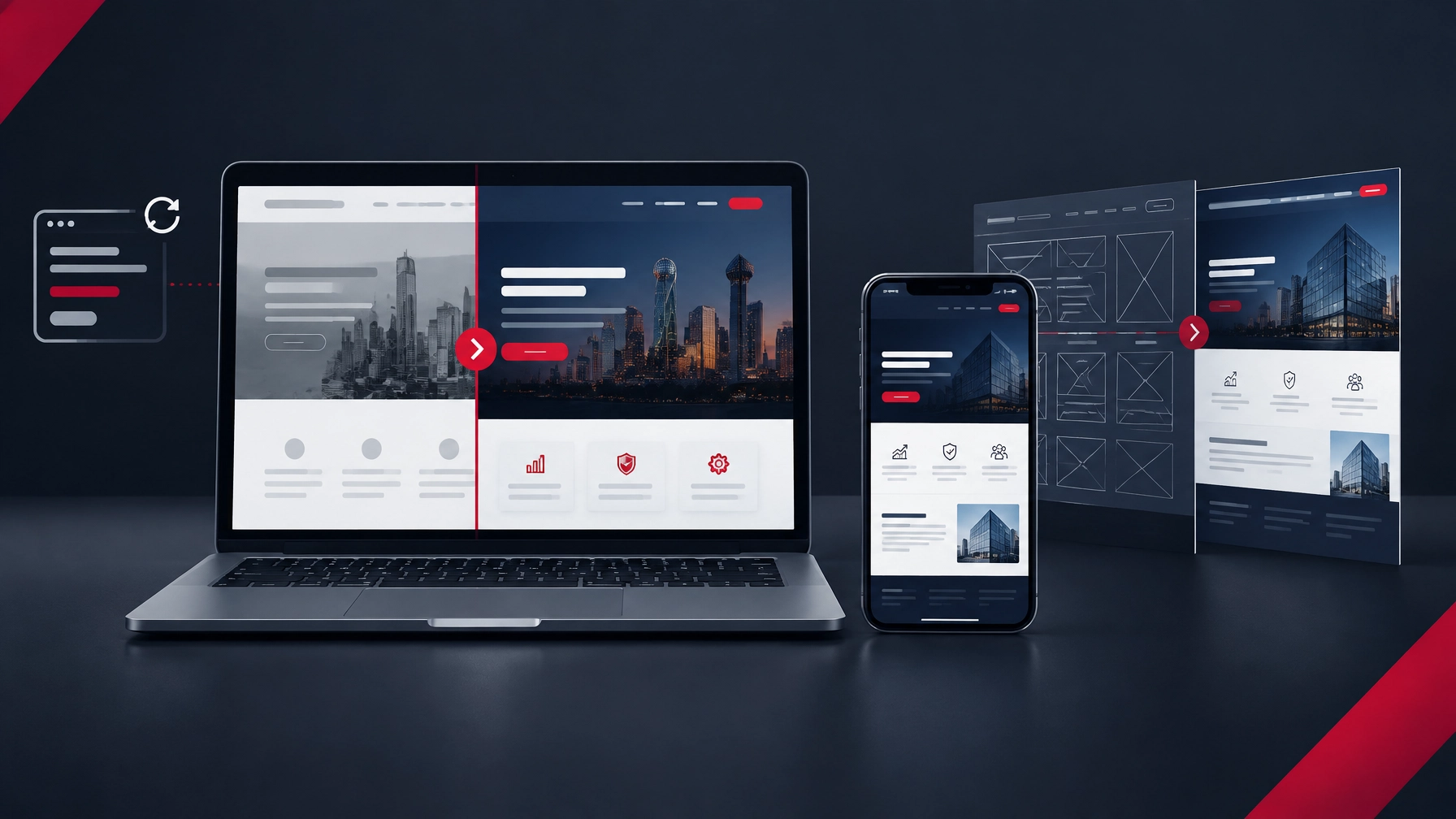
A website refresh or conversion sprint focuses on targeted updates. That might mean rewriting key pages, making calls to action clearer, improving forms, correcting mobile issues, or cleaning up technical problems. The current platform and main site structure stay in place.
A full redesign involves more fundamental changes. It may require a new sitemap, new page templates, a different content management system, new buyer journeys, or major CRM and API integrations. It is a bigger project because the business needs the site to do more than the current structure can support.
The goal in either case is the same: your website should be your best salesperson, not just an online brochure.
When is a website refresh enough?
A refresh is a good fit when the site has a workable foundation and the problems are concentrated in a manageable number of places. You may not need to replace every page to make the website more useful to buyers.
Consider a refresh if:
- Your services and target audiences are still represented accurately.
- Visitors can find the right pages, but the messaging does not make the value clear.
- Leads are not taking the next step because forms, calls to action, or page paths are confusing.
- Mobile usability or page speed needs attention.
- Your platform still supports the changes your team needs.
- Existing pages and URLs have search value you want to preserve.
A focused sprint can sharpen the offer, put proof where buyers need it, simplify forms, and improve speed without rebuilding the whole site. Appture’s website update and redesign service covers focused improvements as well as larger website projects.

When do you need a full website redesign?
A full redesign is the better choice when your website’s structure, platform, or core user journeys are holding the business back. If the fix requires changing how the site is organized or what it can do, a refresh may only cover symptoms.
A rebuild may be necessary when:
- Your content architecture no longer reflects your services or business model.
- Different audiences need distinct journeys, content, or access.
- Your current platform cannot support needed features or integrations.
- Sales or recruiting workflows require portals, custom databases, APIs, or commerce.
- Navigation and page roles are confusing across the site, not just on one or two pages.
- You need to migrate platforms or substantially change the URL structure.
For example, a staffing firm that needs job listings, candidate workflows, and CRM connections may have requirements beyond a simple visual update. A manufacturer serving multiple buyer groups may need a different site architecture to help each group find relevant products and proof.

How do refresh and redesign options compare?
A refresh usually costs less and creates less disruption, while a redesign gives you more room to change the site’s structure and capabilities. The right comparison is about project fit, not price alone.
| Factor | Website refresh or conversion sprint | Full redesign |
|---|---|---|
| Cost | website refresh or conversion sprint from $2,500 | custom lead-generation website from $7,500; complex portals/e-commerce custom scoped |
| Timeline | Usually a more focused project; timing depends on scope, content, and approvals | Typical custom build timeline is 8–14 weeks |
| SEO risk | Lower when useful content, URLs, and page intent stay in place; still requires technical checks | Higher if URLs, architecture, platform, or content change; requires migration planning and monitoring |
| Disruption | Usually limited to selected pages, templates, or functions | More planning and coordination across content, design, development, systems, and launch |
These are starting prices, not a substitute for defining the work. You can review the website pricing page to compare the available starting points. Complex integrations, migration needs, custom workflows, and content requirements affect the final scope.
How can you diagnose what your website needs?
Use this checklist to identify whether the problems are targeted or structural. Answer each question based on how the site works today, not how you hope it will work after a redesign.
-
Can a qualified buyer tell what we offer and who it is for?
If not, the first fix may be clearer messaging and proof. -
Can each key audience find a relevant path through the site?
If audiences need different navigation, page logic, or access, that points toward a redesign. -
Can the current platform support our required features and integrations?
If the answer is no, a visual refresh will not remove the platform limit. -
Are the main issues concentrated on a few pages or spread across the site?
Localized problems are often refresh candidates. Widespread architecture problems suggest a rebuild. -
Do forms work, and do inquiries reach the right people in the CRM?
If not, check whether the cause is a repairable setup issue or a broader integration gap. -
Are your existing URLs and search-performing pages still relevant?
If so, preserving them may be a priority. If the site needs major restructuring, plan URL changes and redirects before launch. -
Can you measure qualified leads and what happens after a form submission?
If not, include tracking and lead routing in the project scope, whether it is a refresh or rebuild.
If most issues are about clarity, conversion, or technical cleanup, investigate a refresh first. If several answers point to platform limits, new audiences, or changes to the site’s architecture, assess a full redesign. For a more detailed preparation guide, see The Website Redesign Checklist and Website Redesign Cost in our blog section.
How can you protect SEO during either project?
Protecting SEO starts with documenting what is working before changes begin. That means reviewing current URLs, useful content, search performance, page titles, internal links, and key technical settings.
A refresh can carry less SEO risk if it preserves page intent and URLs, but content edits and technical changes still need review. A redesign needs more deliberate migration planning. Keep useful content where possible, map each changed URL to its closest relevant replacement, and set up redirects for pages that move. Then check that forms, tracking, search crawling, and key pages work after launch.
A refresh is also a good moment to improve answer-engine visibility. AI assistants and answer engines read site content directly, so clear service descriptions, direct answers to buyer questions, and well-structured proof can help them understand your expertise. AEO and GEO refer to making content easier for answer engines and generative AI systems to interpret and cite. Neither guarantees a citation, but vague or scattered content makes your offer harder to understand.

How should you set scope and measure the result?
Start by naming the sales problem the project must solve. Then choose the smallest scope that can address it and define how you will know if the work helped.
Before work starts, agree on:
- The priority buyers and pages.
- The primary next step for visitors, such as an inquiry or scheduled conversation.
- The content, proof, and CRM connections needed to support that step.
- The URLs and search performance to preserve or monitor.
- The measures you will review, such as qualified inquiries, form completion, and page speed.
Appture Digital Media builds custom, conversion-focused lead-generation websites and go-to-market systems for B2B, professional services, staffing and recruiting, industrial manufacturers, GovTech SaaS, and technology companies, mainly in Dallas-Fort Worth and nationally. Its verified experience includes $113M+ in client sales and 850+ websites since 2002. Appture reports client results including Penn Apartment Staffing ($10.4M in sales), IThinQware ($12.8M in sales), Auth-Florence / Gibraltar Industries ($90M in contracts), and ApartmentCareers.com (500,000+ users). Those outcomes came from broader client programs and are not a promise that a website alone will produce the same result.
Clients own 100% of their assets, including their domain, code, accounts, analytics, and tracking. That matters whether you make a targeted update or invest in a full rebuild.
What are common questions about website refreshes and redesigns?
How much does a website refresh cost?
A website refresh or conversion sprint starts from $2,500. The final scope depends on which pages, messaging, UX, speed, and technical issues need work.
How long does a website redesign take?
A typical custom build takes 8–14 weeks. Content, integrations, migration needs, and approval timelines can affect the schedule.
Will a redesign hurt my SEO?
It can if valuable content or URLs are changed without a plan. Inventory current pages, preserve useful content and page intent, and map redirects for URLs that move.
Should I refresh my website or rebuild it?
Choose a refresh when the underlying site works and the main issues are specific and fixable. Choose a rebuild when the platform, architecture, or buyer journeys no longer support your business needs.
Takeaway: If the problem is a handful of weak pages or conversion barriers, start by assessing a refresh. If the site’s structure or technology cannot support how you sell, plan a redesign.
Request a free website review or book a strategy call to get a practical recommendation for your site.



- Best Website Developers in Dallas for B2B: 2026 Engineering Capabilities, CRM Integrations & Cost Guide
- Custom Web Design in Dallas: How to Hire a B2B Agency for High-Converting Company Websites (2026)
- Top Web Design Companies in Dallas (2026): Agency Comparison, B2B Specializations & Pricing Tiers
- B2B LinkedIn Ads Management in Dallas: Full-Funnel ABM Strategy, Creative Formats & Pipeline ROI (2026)
- B2B Demand Generation Decision Guide
- How a 90-Day B2B Demand Generation Consulting Engagement Works for Dallas Mid-Market Companies
- Hiring a B2B Demand Generation Agency in Dallas: 2026 Pricing, Strategy & Comparison Guide
- Boost your business with our demand generation agency.
- Untitled
- B2B Demand Generation Agency in Dallas: 2026 Pricing Guide