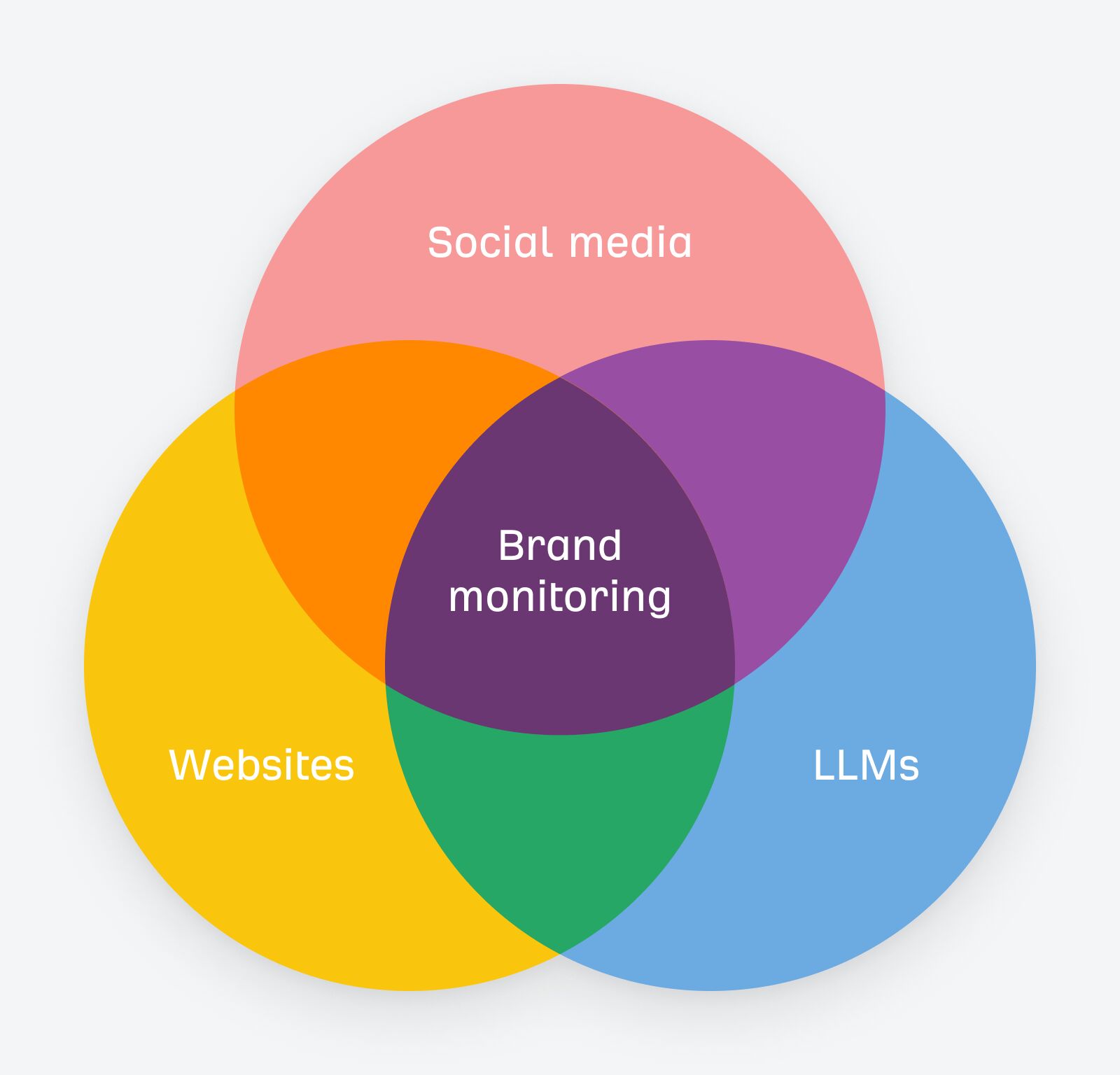
Scroll through any marketing blog or attend any industry conference, and you’ll be bombarded with a seemingly endless list of “must-do” tactics. You need to be on TikTok. You need a chatbot. You need to be doing influencer marketing, content marketing, video marketing, and a dozen other things, all at the same time. The sheer volume of options is overwhelming, leading many business owners to either chase every new trend or freeze in a state of “analysis paralysis.” But what if the problem isn’t the number of options, but our inability to choose? The digital marketing world sells you a buffet, when what you really need is a single, well-prepared meal.
The Current State of Things
The current state of digital marketing is one of abundance. There are more channels, more tools, and more data than ever before. This is often presented as a good thing—more opportunities to reach your customers. The prevailing wisdom is to “diversify your marketing mix,” to have a presence on multiple platforms to mitigate risk and maximize reach. Gurus and agencies alike will show you charts of all the available channels—social media, SEO, email, paid ads, and so on—and suggest you dabble in a little bit of everything.
The Immediate Risk
The most immediate risk of this “all-the-things” approach is a complete lack of impact. When you spread your time, budget, and energy across too many channels, you end up being mediocre on all of them. Consider a software-as-a-service (SaaS) company that was told they needed to be on every social platform. They dutifully created accounts on Twitter, Facebook, Instagram, LinkedIn, and even Pinterest. They posted the same generic content to all of them, a few times a week. The result? A handful of likes, a few random followers, and zero new leads. They were busy being “on” social media, but they weren’t actually connecting with anyone.
The Problem: The Paradox of Choice
The core problem is a well-documented psychological phenomenon known as the “paradox of choice.” The more options we have, the harder it becomes to make a decision, and the less satisfied we are with the choice we finally make. The digital marketing landscape is a perfect example of this. With hundreds of potential channels and thousands of tools, the task of creating a marketing plan can feel impossible. This leads to one of two outcomes: either you do nothing, or you do a little bit of everything, hoping something sticks. Both are recipes for failure.
The Problem Deepens: Chasing “Shiny Objects”
This abundance of options creates a culture of “shiny object syndrome.” Every few months, a new platform or tactic emerges and is hailed as the “next big thing.” Remember Clubhouse? For a few months, it was all anyone in marketing could talk about. Businesses scrambled to create a presence, convinced it was the future. Then, just as quickly, the hype died down, and everyone moved on to the next shiny object. This constant chasing of trends is exhausting and unproductive. As marketing expert Mark Ritson has said, “The answer to the question ‘What’s the next big thing in marketing?’ is usually ‘The last big thing, done properly’.”
The Far-Reaching Implications: A Strategic Void
The obsession with options and tactics has created a strategic void in many organizations. Instead of starting with the fundamental questions—Who is our customer? What problem do we solve for them? Where do they spend their time?—businesses are starting with the tactics. They’re asking “Should we be on TikTok?” instead of “Is our target audience on TikTok, and if so, how can we provide value to them there?” This tactical-first approach leads to a fragmented, inconsistent, and ultimately ineffective marketing effort that fails to build any long-term brand equity.
The Counterintuitive Solution: Choose Your Battlefield
The solution is not to find a way to do more, but to give yourself permission to do less. The counterintuitive approach is to ruthlessly filter your options and choose your battlefield. Instead of trying to be everywhere, your goal should be to dominate a single channel where your ideal customers are most concentrated and receptive to your message. This requires a shift in mindset from “fear of missing out” (FOMO) to “joy of missing out” (JOMO). Be happy to ignore the platforms and tactics that aren’t a perfect fit for your business.
How do you choose? Start with your customer, not the channel.
1. Who are they? Be incredibly specific about your ideal customer profile.
2. Where are they? Where do they go to get information? Where do they hang out online?
3. How can you reach them? Which channel offers the most direct and effective path to that audience?
Choose one, and go all in.
Addressing Objections: Won’t I Miss Out on Customers?
The fear is that by choosing one channel, you’ll be ignoring a large chunk of your potential market. But the reality is, by trying to reach everyone, you end up resonating with no one. A focused strategy allows you to tailor your message and your content to a specific audience on a specific platform, making you far more effective. Once you have established a strong foothold and are generating consistent results from that one channel, you can then thoughtfully and strategically expand to a second one.
Final Thoughts
The digital marketing industry wants you to believe that more is better. More channels, more tools, more options. But the truth is, more is just more. It’s more confusing, more expensive, and more likely to lead to failure. The path to effective marketing is not through abundance, but through deliberate constraint. Choose your filter, choose your battlefield, and have the courage to ignore everything else.
Take the Next Step
Feeling stuck or overwhelmed? The experts at Appture Digital Media can help you cut through the noise and build a marketing strategy that actually works. Contact us today for a free 30-minute consultation. Be sure to provide your company URL and social media profile links so we can review your issues and make an informed assessment. Visit us at www.appturedigital.com to get started.
You’ve sat in the meetings, seen the presentations, and nodded along as a so-called expert blitzed through a slideshow filled with acronyms like SEO, PPC, CTR, and a dozen other cryptic terms. You left with a headache and the distinct feeling that digital marketing is an impossibly complex beast, best left to the wunderkinds who speak its arcane language. But what if the complexity is a myth? What if the feeling of being overwhelmed isn’t a sign of the subject’s difficulty, but a symptom of a deeply flawed and chaotic approach? The truth is, the digital marketing industry often benefits from making you feel like you need a Ph.D. to understand its fundamentals. This manufactured complexity is a convenient way to justify high retainers and gatekeep knowledge.
The Current State of Things
Right now, the prevailing wisdom is that to “do” digital marketing, you need to be everywhere at once. You need a slick website with a blog that’s updated daily. You need a presence on every social media platform, from TikTok to LinkedIn. You need to be running Google Ads, Facebook Ads, and maybe even some programmatic display ads. You should have an email newsletter, a podcast, and a YouTube channel. This “more is more” approach is often sold as a comprehensive strategy, a way to cast a wide net and catch as many customers as possible. It’s a dizzying array of channels and tactics, each with its own set of best practices and metrics to track.
The Immediate Risk
The most immediate risk of this “all-at-once” strategy is burnout and budget drain with little to no return. Imagine a small business owner, we’ll call her Sarah, who runs a boutique coffee roastery. She was convinced she needed to do everything. She spent thousands on a new website, hired a freelancer to post on Instagram and Facebook, and poured money into Google Ads targeting anyone searching for “coffee.” The result? A lot of activity, but no discernible increase in sales. Her online efforts were a flurry of motion that went nowhere, a perfect storm of wasted time and money.
The Problem: The Illusion of Complexity
The problem isn’t that digital marketing is inherently difficult; it’s that it’s presented as a monolithic entity. It’s like being told you need to learn “science” to fix a leaky faucet. Do you need to understand quantum physics, organic chemistry, and astrophysics? No, you just need to understand some basic plumbing. Digital marketing is the same. It’s not one thing; it’s a collection of distinct disciplines. Trying to master all of them simultaneously is a fool’s errand. The constant barrage of new platforms and “game-changing” tactics creates a sense of urgency and confusion, leading to what psychologists call “analysis paralysis,” where the sheer number of options makes it impossible to make a decision.
The Problem Deepens: Drowning in Jargon and Data
This manufactured complexity is propped up by a mountain of jargon and a deluge of data. Experts often use technical language not to clarify, but to create an aura of authority. They’ll talk about “optimizing your sales funnel” and “leveraging synergies,” when what they really mean is “making it easier for people to buy your stuff.” Then comes the data. You’re presented with dashboards showing impressions, click-through rates, bounce rates, and a dozen other metrics that, without context, are meaningless. Sarah, the coffee roaster, was getting monthly reports filled with charts and graphs. Her “likes” on Facebook were up, but her sales were flat. The data was there, but it wasn’t telling a story that mattered to her business. As one marketing analyst, Avinash Kaushik, often points out, many businesses are “data rich, but information poor.”
The Far-Reaching Implications: An Industry Built on Confusion
This culture of complexity has created an entire industry that profits from confusion. It allows agencies to charge exorbitant fees for what are often basic services. It creates a dynamic where the client feels too intimidated to ask tough questions, leading to a lack of accountability. It also fosters a short-term, tactical mindset, where the focus is on chasing the latest trend rather than building a sustainable, long-term marketing strategy. This hurts not just individual businesses, but the credibility of the marketing profession as a whole.
The Counterintuitive Solution: Do Less, But Better
The solution is deceptively simple: do less. Instead of trying to be everywhere, focus on mastering one or two channels that are most relevant to your audience. If you’re a B2B company, maybe that’s LinkedIn and a highly targeted email newsletter. If you’re a visual brand, perhaps Instagram and Pinterest are your sweet spots. The key is to go deep, not wide. Understand the platform, understand your audience on that platform, and create content that is genuinely valuable to them. It’s better to have a thriving community on one channel than a token presence on five.
Addressing Objections: Isn’t That Putting All My Eggs in One Basket?
Some might argue that focusing on one or two channels is risky. What if the algorithm changes? What if a new, better platform emerges? These are valid concerns, but the alternative is spreading your resources so thin that you make no impact anywhere. By mastering one channel first, you build a foundation of understanding. You learn what resonates with your audience, and those lessons are often transferable. Once you’ve achieved a level of success and have a repeatable process, then you can consider expanding to another channel.
Final Thoughts
Digital marketing is not the complex monster it’s made out to be. It’s a series of learnable skills. The next time you feel overwhelmed by the jargon and the endless options, take a step back. Ask yourself: what is the one thing I can do, and do well, that will connect with my ideal customer? The answer to that question is the first step in demystifying digital marketing and making it work for you.
Take the Next Step
Feeling stuck or overwhelmed? The experts at Appture Digital Media can help you cut through the noise and build a marketing strategy that actually works. Contact us today for a free 30-minute consultation. Be sure to provide your company URL and social media profile links so we can review your issues and make an informed assessment. Visit us at www.appturedigital.com to get started.
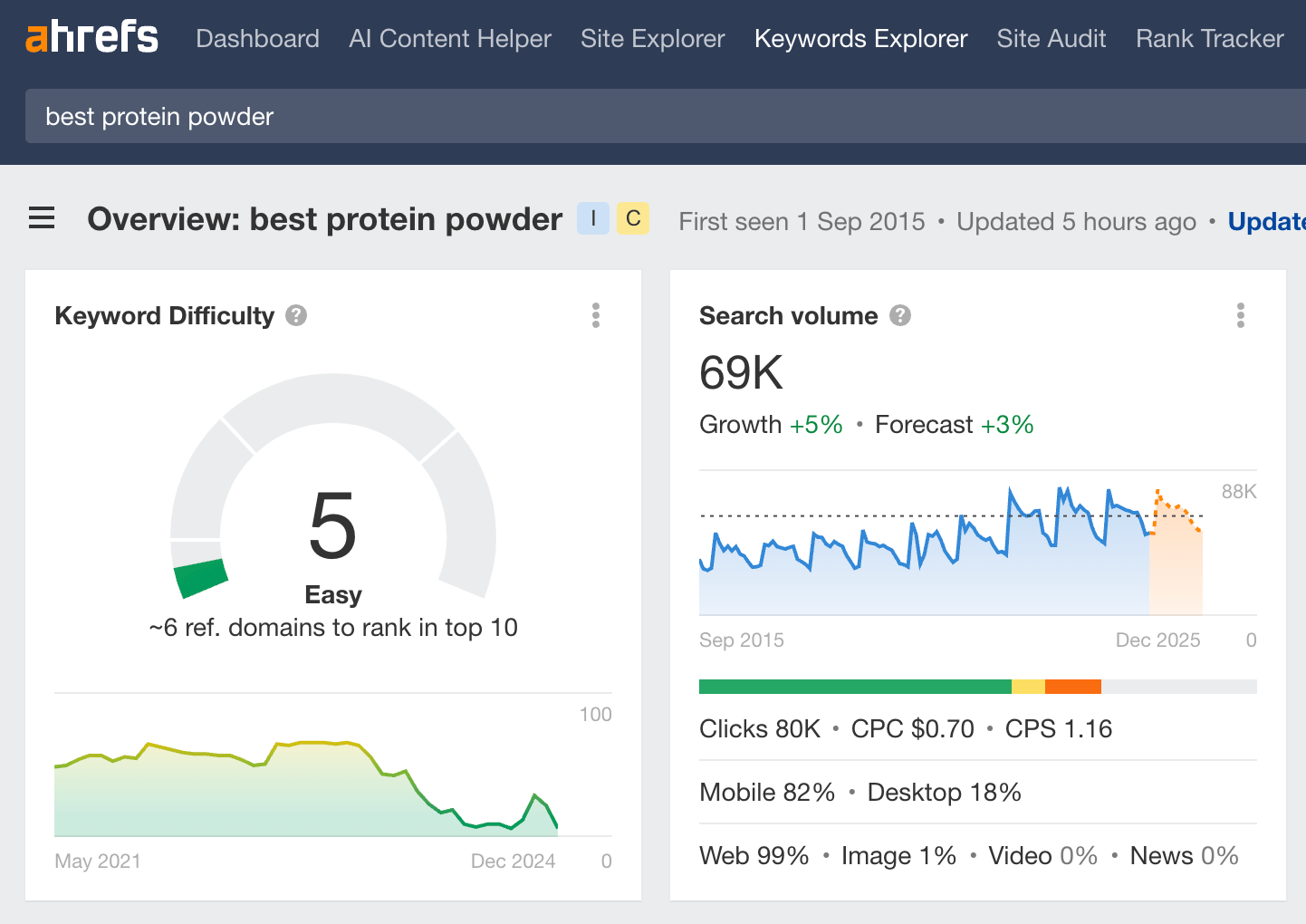
Back in the day, I ran a couple of semi-successful affiliate websites. I even once ranked #1 for “best protein powder.” This was a pretty lucrative keyword given its commercial intent and high search volume.
Ever since then, the idea of starting another affiliate site and getting serious about it has always been in the back of my mind. I’ve just never had the time due to my day to day work at Ahrefs.
But today? I don’t think I’d start one even if I had the time. It just isn’t worth it.
Plenty of other online marketers seem to be echoing this sentiment lately, too.
Below are four reasons why I feel like this and wouldn’t start a pure affiliate site in 2025.
Google would rather rank Reddit than you
Reddit seems to rank in the top five for pretty much every affiliate keyword these days.
When Google recently penalized the affiliate directories of many big publications like CNN Underscored, it overwhelmingly gave that traffic to Reddit—not independent publishers. I know this because we studied it.
How? We looked at 6,179 keywords that declined or had been completely lost for the directories below between November 18th and November 25th:
https://www.wsj.com/buyside/
https://reviewed.usatoday.com/
www.independent.co.uk/advisor
www.thesun.co.uk/shopping/
www.forbes.com/advisor/
www.newsweek.com/vault/
www.cnn.com/cnn-underscored/
We then used the Traffic Share by Domain report in Keywords Explorer to see which sites get the most traffic from these keywords. Reddit was #1, taking 6% of traffic.
Given that 51% of Reddit threads ranking for product review keywords have spam as the top comment (as per Glen Allsopp’s incredible research), this is a pretty dire state of affairs. For most product review keywords, there’s almost always a niche affiliate site more deserving of ranking than Reddit.
For example, take a term like “best air purifier for cigarette smoke.” Reddit ranks in position #2, but the thread is a total spamfest.
The top comment looks straight from ChatGPT:
The second looks like a disguised product pitch:
The third again looks like a ChatGPT special:
Now you could argue that most affiliate sites are no better—and I would agree. But there are also plenty of niche site owners who invest heavily in their content, spend countless hours actually testing products, and actually deserve to rank.
For example, take a site like HouseFresh which ranks #6 for the same query.
The guys behind this site thoroughly test every product they recommend:
But if we take all the keywords this site ranks in the top 10 for, plug them into Ahrefs’ Keywords Explorer and check the Traffic Share by Domain report, we see that Google is still sending Reddit more traffic.
Given the deal Google recently made with Reddit to use their content to train its AI models, this trend probably isn’t going to change any time soon.
People are starting to lose trust in Google and search other places for reviews
Be real: are you really searching Google for product recommendations these days? I hardly ever do. I just go straight to YouTube…
Genuinely searched this a few days ago… I didn’t even bother with Google
Now obviously, we’re marketers. We know that most of the top Google results are often spammy and shouldn’t be trusted. But what about everyone else?
I don’t have data on this, but I’ve seen mainstream YouTubers talking about it countless times.
For example, this video on why Google search is falling apart has 3.7 million views. In it, he talks about how searching for the best products is pointless because of how terrible Google results are for product searches.
It’s got to a stage now where searching for the best of basically anything is pointless. Almost every single article is a top 10 of products not selected based on their merit but in fact just whether or not they’ll get a kickback when you buy them. […] I guarantee that a large slice of these articles are written with the writer not actually having bought and tested all 10 products themselves.
I think there are three main reasons why the results are so bad:
The influx of AI spam. Ever since ChatGPT and generative AI came on the scene, it’s become super easy and cheap to create affiliate content. Google seems to be struggling to filter out this spam at scale.
Parasite SEO. This is where marketers take advantage of the authority of an established website to rank for competitive keywords. It’s why we’ve been seeing sites like Forbes, CNN, and WSJ outranking independent sites for things they have absolutely no expertise in, like “best financial advisors.”
Google ranking Reddit. Most of these threads are spamfests as I mentioned above.
In my opinion, these three reasons are also interconnected…
Google dealt with the influx of AI spam by boosting the search presence of big brands that it thought it could trust. Those brands then took advantage of Google’s favouritism to rank for terms where they had no expertise. Google then responded to criticism about the lack of diversity in search results (mostly from the SEO industry) by promoting user-generated content on Reddit.
Of course, it’s still possible to promote affiliate links elsewhere like TikTok or YouTube—but that’s a whole different kettle of fish.
Google is giving more and more traffic to big players, not independent publishers
When Glen Allsopp analyzed 10,000 product review search results, he found that only four of the top 100 ranking domains were independent sites. The rest were part of news organisations, public companies or large site networks.
Even worse, 36 of the top 100 ranking domains were owned by just three different companies: Hearst, Dotdash Meredith, and Future.
I don’t think this is going to get better anytime soon either…
Looking more closely at our research on affiliate publication drops, the sites reaping the biggest rewards alongside Reddit were all also big names, like Amazon, Business Insider, and CNET.
And many of the independent publishers who saw their traffic decimated by Google updates still haven’t recovered…
Take a look at Retrododo, for example:
Sure, they’ve recovered a bit—but their traffic is still a shadow of its former self.
Housefresh is about the only site I’ve seen make a near-full recovery, and I can’t help but feel that might have something to do with the amount of fuss they (quite rightly) kicked up about being penalized.
But this uncertainty is precisely the problem…
Maybe I’m misremembering, but I’m sure that things didn’t used to be this way. Back in the day, if you put a ton of effort into creating a quality niche site, you could be pretty sure that Google would reward you. You wouldn’t be scared of the time, effort and money you invested being taken away at any given moment by a Google penalty and your traffic handed to big brands (or Reddit) with mediocre content—at least not to the same extent as today.
This doesn’t mean that the whole thing is Google’s fault. It also seems to be happening because the SEO strategies of big brands are getting more sophisticated.
For example, this post from HouseFresh talks about a strategy called keyword swarming allegedly used by Dotdash Meredith to push down smaller sites in the SERPs:
“Swarming is about drowning out a competitor,” said the person who reached out. The objective is to “swarm a smaller site’s foothold on one or two articles by essentially publishing 10 articles [on the topic] and beefing up [Dotdash Meredith sites’] authority.”
Bottomline? I just wouldn’t have the confidence these days to invest significantly in an affiliate site. Even if I created industry-leading content, I wouldn’t have faith that Google would actually rank it above big sites.
Google could use AI to recommend products in the SERP
Okay, this one is more of a predication… but I think there’s a very real possibility of it happening.
Affiliate sites have worked well historically because of how people search. If you want to find the best air purifier, you go to Google, search for “best air purifier,” click a listicle in the search results, click one of their affiliate links, and… BINGO, the site makes money.
But what if Google adds AI overviews with product recommendations to affiliate searches?
I think this has the potential to cut out affiliate marketers altogether.
For example, if you type “best air purifier” into Gemini or ChatGPT right now, you get a list of recommendations:
It’s pretty easy to then research these recommendations yourself on YouTube or TikTok.
If Google adds these kinds of AI overviews to product review searches, people wouldn’t really need to click on a search result anymore. They could just research the products AI recommends themselves.
Of course, they may still choose to research those products in Google, so affiliate marketers could still make money from product reviews. But I think it’s more likely that they head to YouTube or TikTok for the reasons I mentioned earlier.
As for why Google would bother, it’s arguably a better user experience—but they could also monetize these AI overviews with PPC ads.
For example, Google already shows sponsored results when you search for most products:
Google could easily just charge these brands for clicks when the product is recommended in AI overviews.
So… what would I do instead?
I think Matt Diggity has the right idea: switch to ecommerce.
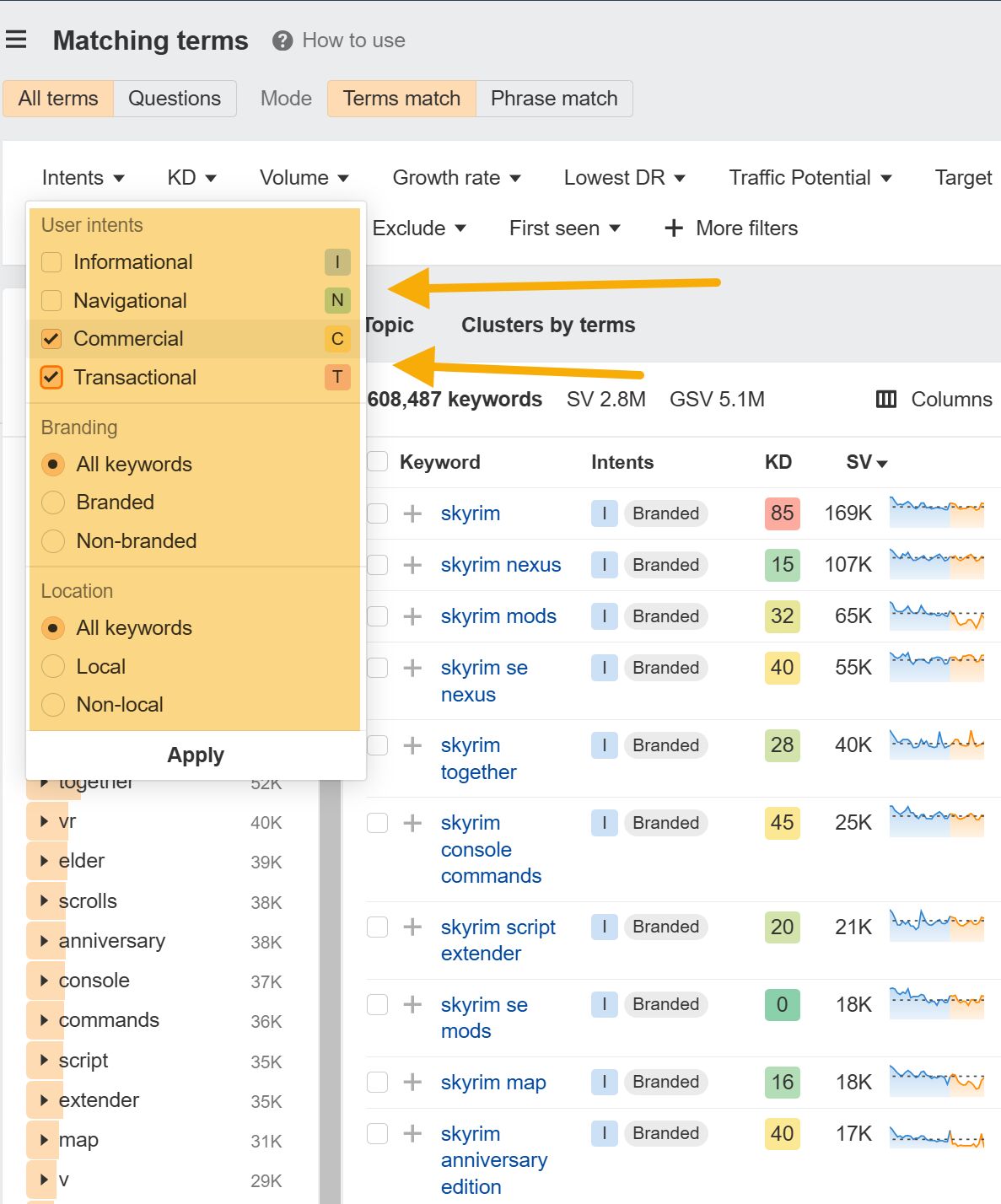
Filter for non-local and non-branded keywords with transactional intent
Filter for low difficulty keywords, KD <= 10
Filter for keywords with low DR sites ranking, DR <= 40
It’s then simply a case of looking for interesting niches in the results…
For example, there are 33K estimated monthly searches for “leg warmers” in the US, and plenty of pages from low DR websites ranking with few or no backlinks.
If we plug “leg warmers” into Keywords Explorer as our seed keyword, go to the Matching terms report, apply the same filters, and then cluster by Parent Topic, we have a low-competition ecommerce niche pretty much ready to go.
I’m sure you wouldn’t need to move mountains to rank for most of these terms. It would probably just take some basic SEO.
Calculators are the unlikely tactic savvy website owners are using to drive hundreds of thousands (and sometimes millions) of clicks from Google to their websites.
In this article, I’ll share some examples of calculators that caught my attention and show you how I found them. (And how you can make one, too.)
The highest traffic calculator in my research was an Indian systematic investment plan calculator— commonly called “SIP calculator.”
I didn’t know what it was, so I had to Google it. But, it turns out that a SIP calculator enables people to understand the return on their mutual fund investments.
In mutual fund investments, investors pool their money in stocks, bonds, and other securities.
One of the interesting things about this site is that this isn’t the only calculator they have. According to Ahrefs’ Site Explorer, they have 216 pages in their /calculator/ parent subfolder, which has total traffic of 8.6m—not too shabby.
And if you are looking for some calculator inspo, they have 77.2k calculator-themed keywords you can browse through.
If you are lucky enough to be purchasing a new house, one of the things you’ll probably need to consider is how much you can afford to pay back per month. Working this out can be tricky—unless you have a mortgage calculator to help you work it out.
The /mortgages/ subfolder has a total of 1,065 pages and has a total traffic of 2.9M. And guess what the number one page is? The mortgage calculator.
This page drives 25.9% of the traffic within this subfolder.
If, like me and hundreds of other SEOs, you’ve Googled “percentage increase calculator” in the last few years during reporting week, then you will have probably used this website.
Percentage Calculator allows you to complete basic percentage calculations like percentage increases and decreases.
The fact that you can do this all in a spreadsheet doesn’t seem to have impacted its organic traffic one iota. It currently receives 1.6 million organic traffic to this page.
According to the Top Pages report in Ahrefs, this is a 3-page site in total, and as you can see from the below, all the traffic goes to the homepage.
This calculator calculates the due date for your pregnancy based on your last menstrual period. It’s an estimate, but it’s still a wildly popular page.
If we go to the parent /resources/ folder and look at the Top pages report in Ahrefs, we can see it is the most popular page, responsible for 85.4% of the traffic for the parent subfolder.
Another pregnancy-themed calculator is this ovulation calculator. It estimates the most fertile days of the month based on the data you provide.
The calculator solves a problem by making it easier to understand when you will most likely be able to conceive. It’s slightly more complicated than some examples and has a snazzy calendar display.
If we head to the Top pages report for the /baby/ parent subfolder, we can see that 18.3% of their traffic comes from the ovulation calculator page.
Unless you live in the Cayman Islands or another tax-free location, you’ll probably want to check at some point how much of your salary goes on taxes and how much of your paycheck you get to take home.
One of the fastest ways to work out is to use a paycheck or salary calculator. This example by Smart Asset is easy to use and provides a clear breakdown of all the deductions from your paycheck.
If we head to the /taxes/ parent subfolder, surprise, surprise—it’s the highest-traffic page.
But if we look a bit closer, we can see something more interesting about this site: they have taken a programmatic SEO approach to creating calculators. They have created paycheck calculators for all the different states in the U.S., and using this strategy it’s driving significant organic traffic.
My colleague Mateusz Makosiewicz wrote a fantastic article about Nerdwallet’s SEO strategy recently that I strongly recommend you read. So, it wasn’t much of a surprise to see Nerdwallet’s compound interest calculator pop up in the research for this article.
If we plug the parent /calculators/ subfolder into Site Explorer’s Top pages report, we can see two things.
This compound interest calculator drives 33.7% of the traffic and is their top-performing page in this subfolder
The compound interest calculator is just one of 21 calculators in this subfolder, so it’s likely these calculators are part of a deliberate SEO strategy
Then hit search and export the 1000 URLs. Then copy all the websites and head to Batch Analysis 2.0
2. Batch Analysis 2.0 – Paste your Web Explorer websites into Batch Analysis 2.0.
Then export the list and analyze — I’ve highlighted the traffic column below.
Finding more calculator ideas for your website
If you want to find more ideas for creating your own calculator, you can research it using Keywords Explorer.
To start, enter “calculator” into the search bar of Keywords Explorer and click on the Matching terms report.
You can then click through to the Clusters by Parent Topic to see some key calculators people are searching for. Scroll through the results until you find a keyword you think would work.
Ahrefs says there are 35,819 clusters here—more than enough ideas to search through.
Building your own calculator
In times gone by, unless you were technically inclined, you would have had to have hired a developer to build your own calculator.
But nowadays, it’s as easy as asking your favorite LLM or an AI coding tool like Cursor to build it for you.
Here’s an example of a Calorie Calculator I made in about 10 seconds using Cursor. Starting with the supremely complex prompt: “Can you make me a calorie calculator.”
I got Cursor to add an Ahrefs logo as a follow-up prompt for a bit of fun, but you get the idea. It’s super easy to customize.
Sidenote.
It could take a bit longer to push this to a website, and depending on your setup, you might have to adapt the code to your exact requirements. But the traffic numbers and the ease of creating these calculators make it another viable method to get organic traffic—especially if you work in a niche like health or finance and have a well-established website.
Final thoughts
When website owners want to increase traffic to their website, rarely the answer is “Let’s build a calculator!” But from my analysis, there’s plenty of traffic out there for those who take the plunge and build one.
Is it a replacement for blog content? No, obviously not. But if you have a website in a niche that could have a calculator, you may be missing out on organic traffic by not having one. And the best bit is—-they are easier and faster than ever before to build.
It doesn’t matter whether you’re just starting out in SEO, or you’re decades-deep—these battle-tested content marketing templates will give you a headstart on your next project.
I’ve been in marketing for coming up to ten years now (*internal scream at the passing of time*) and, while I like to think I have a bit of savvy when it comes to content marketing, I still sometimes find myself hunting for the kinds of content templates I used in back in 2015, when I was all but an SEO baby.
Whatever level you’re at—a bit of ‘best practice’ never goes amiss!
Below, you’ll find our gold standard content templates— some for blog post creation, some for SEO reporting, and some for everything in between.
Each one has been specially developed by our team and the Ahrefs community to save you time, and help you create content that actually works.
So, get your bookmark buttons at the ready…
Content templates
If your job is creating content, then I’m sure you’ll have hit one or two creative walls in your time.
Content templates can pull you out of that rut, giving you ideas on the formats your audience expect to see when they’re searching certain kinds of queries.
1. Blog formats
We’ve put together six blog post templates to help you move past the blank-page. Unless you’re writing a free-flowing think piece, or a piece of deep-research, chances are your content will follow a certain kind of format.
When it comes to planning, having examples of different outlines and briefs is like having a buffet of content components—you can mix and match the most valuable parts to create your ideal content template.
Download Bill Widmer’s content outline template shown below. It maps out everything from keyword targeting, content structure, and USPs, to other crucial elements like search intent.
Rabbit-holes, tangents, analysis paralysis—I’m guilty of them all.
If you’re like me, developing a plan for your content can be made a whole lot easier with a step-by-step content plan template. Luckily Josh has made a great one for you to follow.
Building a content strategy isn’t a one-and-done job. Brands, audiences, algorithms—they all change. With everything shifting around you, having reliable frameworks is a must. They can help you focus, and put your energy into the areas that actually matter.
5. Content marketing strategies
I’ll be honest. Coming up with BuzzSumo’s content strategy every quarter used to give me minor heart palpitations. “You’re just selling SaaS, you’re not saving lives.” I’d chant, as I cobbled together some KPIs. If I’d had Josh’s content marketing strategy template on hand, I’d have felt a lot more confident in my strategizing.
One of the best things you can do for your content is give it a second (or third, or fourth) chance at ranking. But first off, you need to find which articles are worth resurrecting. Follow Josh’s content audit template to prioritize your content efforts.
A content map is a menu for your buyer’s journey (first buffets, now menus… can you tell how hungry I am whilst writing this?)—it shows you exactly what content to serve up at each stage, for every type of customer.
Get super targeted with persona-specific copy, or create content that speaks to everyone—just follow Mattheusz’s content map template for more ideas below.
There’s nothing better than finding out that your top competitor has dropped the ball. Swoop in on content gaps with Despina’s awesome content gap analysis template.
To get the absolute most out of this content template, watch Despina’s handy walkthrough:
9. Marketing plans
Marketing plans can quickly snowball into large, unwieldy, directionless documents—if you’re not careful. That’s why Josh built this incredibly simple one-page content marketing plan template.
Having a keyword strategy is critical for staying on task, and not getting caught in choice overload. Take it from someone who does a lot of keyword research. Josh has got you covered with a simple keyword strategy template that will keep you on top of the most important metrics.
When you keyword map, you group keywords into topics and assign them to pages. It’s like the content mapping we covered earlier—only through the lens of SEO.
Grab our content template, where you can map your keywords, record your actions, and tag in your team mates to collaborate.
Download our proven SEO plan, based on how we do things here at Ahrefs. It’ll help you find the right keywords, build links, and track your results all in one place.
Creating an SEO strategy is another one of those tasks that can be intimidating to tackle–even for marketers that have been around a while. Download our template, and follow along with our blog for tips on how build your SEO strategy from the ground up.
My partner and I have waged an ongoing war over to-do lists. He despairs at the fact I don’t keep an ongoing list, but I don’t see the value in having a list that never ends. Where is the structure? What do you prioritize? And, most importantly, how do you get any satisfaction if the list is never done?!
I feel the same about most SEO checklists out there. They’re a jumble of tasks that can multiple into a forever-list if not personalized, and prioritized.
This is exactly why we created something better—a fully customizable SEO checklist.
It’s designed to adapt to your site, not the other way around. If you agree then…
(p.s. when it comes to #todolistgate, your template downloads would help my case no end)
15. Competitive analysis
While it’s not always good to be looking over your shoulder, keeping watch on your competition can give you pointers on which direction to take your strategy in.
My favorite part about this competitor analysis template is the “Ghost shopping” element. In a former job, my colleagues formed a team and went undercover to demo competitor products and create comprehensive “battle cards”. It was full-on SaaSpionage.
You don’t have to go creating a fake name or backstory like my ex-colleagues (that last bit was most definitely unnecessary), but periodically updating this information can help you fill the gaps, and get ahead of the market.
Distribution is one of the most fundamental parts of content marketing. One of my favorite quotes on content distribution comes from Andy Crestodina:
Every piece of content should be created with a promotion plan…with every piece of content, you need to have some concept of how it’s going to get traction. If it’s not search, it should be something else. Not every topic is being searched for. But with whatever you’re making, don’t wait until it’s live before you start thinking about how to promote it. That’s too late.
I think we can all agree that distribution is also one of the hardest parts of marketing. For that reason, we’ve tried to simplify things for you with the following two content marketing templates.
16. Press releases
This content marketing template makes it easy to create a professional press release with a clear, structured format that covers all the essentials—from headline to boilerplate. It also helps you share your news in a no-nonsense way, with a template and example outreach email, which will grab the attention of both media outlets and your audience.
Our link prospecting template will help you keep on top of your SEO outreach efforts. You’ll have the name, email, domain rating, and campaign on file so you’ll know as and when to check back in with collaborators.
Numbers. Ew. Who actually likes them? There’s a reason I went into content people! Measuring the success of your work can be a slog. Luckily the rest of the Ahrefs team—and the Ahrefs community—have your back with easy reporting templates…
18. SEO reporting
Good SEO reports give you clear insights and a logical summary of the work. After reviewing and discussing SEO reports from consultants, in-house teams, and agencies with experts in the Ahrefs Insider community, the Ahrefs team created an SEO report template. It’s designed to be a solid starting point that you can tweak and expand to fit your needs.
This content marketing template comes from yours truly. I spoke with a group of bread-and-butter PRs about what it takes to create a great PR report, and they were kind enough to share some examples and content templates. In this blog, you’ll find eight different templates, including:
Exec-friendly one-pagers
PR supplement templates
Monthly deep-dive templates
Campaign wrap-ups
Live coverage dashboards
Ongoing coverage templates
Quarterly report templates
Plus our very own template, which amalgamates all of the best bits from the Ahrefs community.
Creating an SEO reporting dashboard is often an easier way to share your SEO performance results than a text-heavy SEO report. Here are three live Looker Studio templates you can rely on to communicate the positive impact of your content and SEO.
The more energy you pour into reinventing the wheel for every piece of content, the less you have for the creative work that actually makes an impact. That’s why content marketing templates are a must—not just a shortcut.
Grinding through tedious, repetitive tasks is no badge of honor. Using these content templates, you can streamline the busywork, reclaim your time, and refocus on creating more of the good stuff.
I rigorously tested the most popular AI search engines to discover their strengths and weaknesses.
I ran this test for two reasons:
As a human being, I want to use the best search engine around. I spend my life on the internet. I want to find information in the fastest, most effortless way possible.
As a marketer, I want to know where the tide is headed. Will AI search engines replace “traditional” search engines? Are AI chatbots really good enough to dethrone Google? Should I start investing more effort in
1. Perplexity
My opinion: A research assistant that excels with news and summarization, but doesn’t really “feel” like a search engine.
Perplexity feels more like a Wiki or a knowledge base than it does a search engine. Many of its responses are terse bulleted lists, and it excelled in summarising technical queries (like DA09Dawnbreaker) or news-related topics (like elder scrolls vi news).
I also noticed lots of errors and hallucinations in its output. One example: for Should I become a vampire or a werewolf in skyrim?, Perplexity suggested that werewolves were immune to silver weapons—they actually take bonus damage from them. (C’mon Perplexity, honestly.)
Information often seemed outdated too. Perplexity said that Skyrim SE was on sale for $7.99 on Steam (it wasn’t), and the sale extended until May 30… 2024. It feels like Perplexity’s index isn’t anywhere near as fresh as other AI search engines.
Perplexity also regularly failed to “get” the intent behind my searches, and defaulted to word salad paragraphs of text. When I searched for “Steam skyrim”, I got a long, rambling response with no actual link to Steam. For “Skyrim creations”, it listed no actual creations, and just shared a Wiki-style overview of the Creation concept.
Perplexity also struggled with image searches, commercial queries were very unsatisfying, and local searches were decidedly not local, with responses that recommended websites and shops that were nowhere near me.
2. Google AI Overviews
My opinion: A great all-rounder search engine that incorporates AI in limited—but useful—ways.
AI Overviews were generally helpful (when they showed up).
Does a great job at surfacing different media formats, like images and videos.
Excels at commercial and transactional searches.
Cons
Very cluttered search results, often with duplication between AI Overviews and Fatured Snippets.
AI Overviews feel like a dead-end—you can’t continue to interact with them.
Felt a little weird having Reddit in the majority of SERPs.
It was fun evaluating Google Search through fresh eyes. Unsurprisingly, Google was very good for commercial and local queries: interactive product carousels made it easy to find relevant products in no time, and map packs were fantastic for finding local shops.
I was also reminded of just how powerful Google’s integration with YouTube is: any queries that were best resolved with video content almost always included YouTube videos—often timestamped—in the SERP.
AI and machine learning underpin all of Google Search, but as far as specific AI features, AI Overviews only triggered for about 15% of my queries. These were all informational queries, and in most cases, they were very specific long-tail queries.
The AI Overviews were actually pretty good, relevant and accurate—but I definitely missed the ability to keep interacting with the AI.
AI Overviews generally felt like amped-up Feature snippets, providing direct, certain answers to long-tail queries in SERPs (and in fact, many of the AI Overviews competed directly with duplicate Featured snippets directly below them in the SERP).
It was also a little weird having Reddit present in so many SERPs. Some queries really are best-suited by user generated content—like those with no objective “best” answer—but Reddit muscled its way in everywhere.
3. ChatGPT Search
My opinion: The best AI chatbot for specific, text-heavy searches (but still lacking some “classic” search features).
The ability to ask follow-on questions is extremely good.
“Memory” feature is useful.
Cons
Outright failed on several occasions.
Pretty bad for image searches and commercial searches.
Verbose, likes to write long answers even for simple questions.
ChatGPT Search is fantastic for very specific long-tail queries. Answers to queries like Should I become a vampire or a werewolf in skyrim? were like reading a short blog post that was written just to summarise a bunch of sources specifically for your query—because, well, it was.
Couple this with the ability to ask follow-up questions, and ChatGPT’s ability to remember information from previous conversations (its “memory”), and asking long, complicated questions is a ton of fun.
But this strength is also a weakness. ChatGPT excels with text-heavy queries, and kinda sucks for many others. Short-tail queries felt way more limited than Google. Navigational queries (like skyrim creation kit download) were unsatisfying: ChatGPT would explain precisely how to download the Creation Kit (a modding engine for Skyrim), but it couldn’t actually let you do it.
It was also pretty weak with commercial queries, and very bad at image queries, with a default response limited to just four images (nowhere near enough to sate my appetite for hi-res skyrim landscapes). Although one surprise: ChatGPT Search incorporated playable YouTube videos directly into its responses.
ChatGPT Search outright failed for a few queries, requiring multiple refreshes to get results for very basic queries. All-in-all, it was strongest for queries that benefited from long, detailed text responses, and worse on almost every level for all the other queries.
4. Bing AI
My opinion: A solid second-choice search engine with experimental AI features that don’t really deliver.
Interesting search features for short-tail queries.
Cons
AI features were quite often broken and unhelpful.
Slightly disappointing local and news searches.
Bing has two outwardly obvious “AI” features. One is a text snippet, very similar to Google’s Featured Snippets and AI Overviews. These worked okay, but not as well as Google’s AI Overviews.
Often, the AI answers didn’t quite understand my search (the response for Should I become a vampire or a werewolf in skyrim? didn’t actually include an answer—just steps to become either a vampire or werewolf).
The other was a dynamically generated “table of contents” module, and despite looking nice, it generally fell somewhere between not helpful and totally broken, with the different modules appearing in jumbled orders or missing steps.
Like Google Search, Bing performed perfectly at navigational queries and showed tons of products and inspiration for commercial searches. It returned good results for newer, trending topics (as did all the search engines, surprisingly).
Most of all, I loved the visual sidebar that appeared for the short-tail searches, offering tons of facts and trivia for skyrim. When the search intent is so so vague, it seems incredibly helpful to treat the SERP as a mood board of inspiration and possible wormholes to pursue.
Surprisingly, I was disappointed with local searches, and the news search (Elder scrolls vi news) was pretty awful.
Final thoughts
“Traditional” search engines have decades of experience in making searchers—and all the different types of searches they make—happy. This experience is obvious across commercial, local, and image searches where Google and Bing dominated the newer tools.
But “pure” AI search engines also unlock new types of search behavior. The query Skyrim bosmer stealth archer build backstory was sensational with ChatGPT, allowing me to actively brainstorm and refine a story in a way I never could with Google Search. Perplexity excelled at summarising news and complex information.
Are the strengths of AI search engines enough to make up for their many weaknesses? Will searchers abandon a company that controls 88.5% of the current search engine market to experiment with relatively unproven new tools?
More likely (in my estimation) is that we’ll see the existing search engines build, integrate, and partner with AI companies to bring the best features into the existing search experience (like Bing’s partnership with OpenAI.)
In the meantime, the best AI search engines are—in my opinion—ChatGPT Search for the best chatbot experience, and Google’s AI Overviews for the best all-around search engine.
We’re not exactly short on AI content creation tools as we head into 2025—in this list, you’ll see some ol’ faithfuls, and some that are hot-off-the-shelf.
In any case, they are 15 of my top finds, complete with example workflows and use cases.
Here they are, in no particular order:
1. ChatGPT
Here’s a tool that needs little introduction. ChatGPT is an AI chatbot that uses natural language processing (NLP) to generate human-like content. It’s like a pseudo-sentient autopredict, built on the OpenAI GPT model and its underlying large language model (LLM) powers a fair few of the tools you’ll see on this list.
How can you use it for AI content creation?
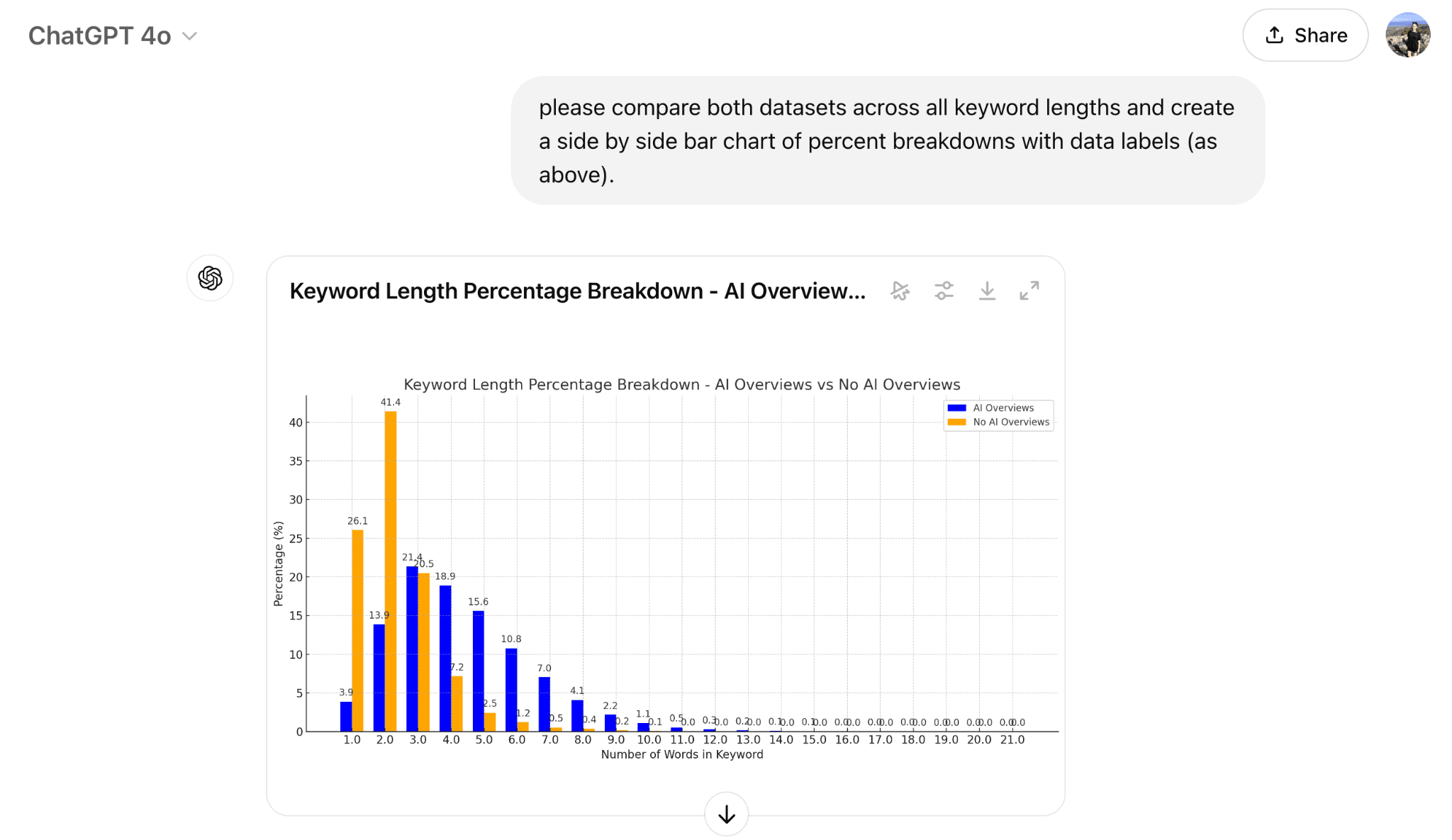
ChatGPT has thousands of use cases. One of my favorites is: data analysis and data visualization for research-led blogs.
But ChatGPT comes into its own when generating short-form copy.
That’s what makes it great for things like meta data and rephrasing scrappily-written sentences…
I don’t like to outsource my thinking too much—ninety nice percent of the time I’ll still tweak the copy I run through ChatGPT to make it my own—but this kind of workflow helps me get my thoughts out without obsessing over grammar, structure, and brevity as I write.
The query above, for instance, helped me quickly find a way to truncate my original sentence. In the end it became this…
2. Ahrefs AI Content Helper
Creating content today is about covering all the right topics comprehensively—not just shoehorning in a few choice keywords.
We’ve built Ahrefs AI Content Helper to help you understand how your content addresses those topics and entities, in relation to the intent of the search.
Using AI, it conducts a topic-level analysis of your article against the top 10 SERP competitors, and scores it out of 100—both for its overall theming, and its coverage of individual subtopics.
You’ll get topic-specific AI recommendations for improvement when your content hasn’t quite hit the mark…
And if you want to quickly modify or improve any of your content in the editor section, you can Ask AI.
Just select a paragraph or two, choose an action from preset or type in your own request, and then decide how to use it.
How can you use it for AI content creation?
You can use Ahrefs’ AI Content Helper tool in a few key ways:
a. Edit/update an existing piece of content
Start by stating your focus keyword and content URL.
Select the search intent you want to optimize for.
Then use the topic suggestions and recommendations to edit your content until you’ve thoroughly covered the topic.
Here’s how I did just that for my own article updates.
b. Analyze overall SERP expectations before you start writing
Enter a keyword, leave the URL section blank, and get scored in real-time as you write.
No pressure!
c. Analyze a competitor piece of content before you start writing
You can also cross-examine your competitors’ content to learn from their mistakes, and get inspiration for topic gaps.
3. Google Stream Realtime
Now, full disclosure, I haven’t played around with this tool extensively myself—it’s brand new to Google’s AI Studio—but it absolutely needs to be mentioned. Google Stream Realtime lets you share your screen with Gemini 2.0, and discuss examples of content in real-time.
How can you use it for AI content creation?
You can use it to make copy suggestions, treat it as an SEO advisor, or chat to it like a podcast co-host. Here’s SVP of Hubspot, Kieran Flanagan, testing it out on Hubspot’s homepage, and asking for content recommendations in the style of Ogilvy.
And here’s Julian Goldie, founder of Goldie Agency, using it as an SEO consultant to do a top-level analysis of keyword metrics in Ahrefs Keywords Explorer:
One other great thing Julian points out about Google Stream Realtime is its ability to document your conversations. It gives you downloadable audio soundbites and transcriptions of your entire conversation, which you can rework and upcycle into things like podcasts, social content, YouTube videos, and blogs—making it a super powerful tool for AI content creation.
And here are some other great use cases, as suggested by Julian…
Claude is a ChatGPT alternative developed by Anthropic—a company built from the ground up by ex-Open-AI employees. It’s an AI chatbot that you can converse with to develop ideas for your content.
How can you use it for AI content creation?
In my opinion, Claude is better than ChatGPT when it comes to writing short-form, human-sounding copy—and it turns out I’m not alone in that line of thought.
Richard Gargan’s take on Claude vs. ChatGPT from the SEO Community.
But Claude’s not just a one-trick pony. Beyond having a natural back-and-forth and polishing a bit of prose, you can use Claude Artifacts—an incredibly powerful feature for creating and developing your content.
Artifacts are essentially pop-out windows that generate when a query is a bit more complex or the output can be edited.
You can use Artifacts to do all kinds of things, like designing, building, and filling entire landing pages without knowing a single line of code.
In that case, Claude will offer up a mock-up of the page, which you can tweak just by chatting with the AI.
I simply: fed it a PDF example of a specific type of blog (e.g. competitor comparisons), pasted in my best practice advice on creating that blog type, and in return it generated an example template.
I neatened it up and added a little more detail, but overall I was suitably impressed.
We track this in various tools across the Ahrefs app, including Keywords Everywhere and Site Explorer.
How can you use it for AI content creation?
This is an AI content creation tool in the sense that it helps you tactically create content for inclusion in AI Overviews.
Just head to the the Matching Terms report in Ahrefs Keywords Explorer, and:
Add an AI Overview SERP Feature filter
Sort the table by Traffic Potential (TP)
This will give you a list of AI Overview generating keywords that also offer significant Traffic Potential (TP).
In other words, creating content for these keywords can potentially lead to more impressions AND more clicks.
Ahrefs AI Overviews can also help you review the presence of your existing content in AI. Head to Ahrefs Organic Keywords report, and set a “Where target ranks” AI Overview filter—you will see where your content appears in the top 3 results of the AIO itself.
6. NotebookLM
NotebookLM is a Google-owned tool that lets you query and interact with your own notes and documents. It’s a pretty formidable AI content research tool.
In 2024, it went viral specifically for its audio overviews, which turn written content into an incredibly believable podcast-like discussion.
How can you use it for AI content creation?
Researching content is 90% sifting through scattered sources.
By feeding NotebookLM your PDFs, Google Docs, and URLs, you can take advantage of a smarter, faster research assistant.
To test it out, I fed my entire back catalog of Ahrefs content, so I can query it if I ever want to quickly recall my past ideas and findings in future projects.
When it comes to audio, I haven’t yet come across any other tool that sounds as convincingly human as NotebookLM.
Mark Williams-Cook also has a brilliant podcast series, The SEO Patent Podcast, where he uses NotebookLM to dig into Google Patents and quickly explain new findings pertaining to Google’s Algorithm.
And, if you fancy a giggle, here’s NotebookLM discussing a—let’s say ‘choice’—two-word document at great length.
The conversation gets impressively philosophical. I think this proves NotebookLM has the ability to riff on literally anything.
7. Ahrefs AI keyword generation
If you need an AI content tool to help you generate keyword ideas, Ahrefs AI keyword generation is your go-to. It can give you hundreds of new keyword opportunities, based on topics related to your seed keywords.
How can you use it for AI content creation?
The life of a content creator is a forever-cycle of genius ideas and creative dead ends.
We’ve built a tool to get you through when you’re stuck in that creative drought.
For a quick way to scale keyword research, you can just drop your focus keyword into Ahrefs Keywords Explorer search bar, then choose from 12 presets to find untapped content ideas.
8. Ahrefs AI Content Grader
Ahrefs AI Content Grader is an AI powered content gap tool, which assesses the topic coverage of your content vs. three page one SERP competitors. Think of it as a ‘lite’ version of Ahrefs AI Content Helper.
How can you use it for AI content creation?
Using the traffic light system, grade your articles against top SERP competitors to find out which kinds of topics and subtopics to include within your own content.
The tool gives you concrete competitor examples so you’ll have plenty of ideas for improving your content.
You can also analyze competitor articles, to plan out your topic and angle before even putting pen to paper.
9. Hubspot Breeze Content Agent
Hubspot Breeze Content Agent is an AI writer tool that uses your CRM data to generate content that’s 100% personalized to your brand and customers.
How can you use it for AI content creation?
Breeze Content Agents will look for patterns and trends in your customer data, train on uploaded brand documents and ICPs, and then use all of that information to create hyper-personalized content.
You’ll be able to build landing pages, case studies, social posts, AI-generated images, and podcast scripts in a matter of seconds—all in your brand voice.
Here’s a great demo showing how you can use Breeze AI tools for content creation. Skip to the 3.20 mark for Content Agents.
AI is great for creating straightforward, short-form content. Sometimes, it even outperforms human content…
If you haven’t heard of Patches, it’s a feature in Ahrefs Site Audit that lets you fix simple issues on your website in a click—without having to pester the dev team.
And now, in Patches, our Ask AI feature will help you generate titles and meta descriptions—also at a click—right in the “Patch it” input box.
How can you use it for AI content creation?
If Site Audit has flagged an issue with titles or meta descriptions, you can Ask AI to fix it. It’ll suggest a title of the proper length based on the page’s actual content—even considering its language.
Just head to your latest crawl in Site Audit and edit content wherever you see the “Patch it” column.
Then click on the ”Ask AI” button to rewrite your meta titles or descriptions—this really comes in handy when you’re creating large volumes of meta content for lots of similar pages.
11. Descript
Descript is an AI-powered video and audio editing tool, with nifty features like AI transcription and AI voice cloning.
How can you use it for AI content creation?
I love Descript and have used it for 3+ years now. It’s best-known for translating video/audio content into a text doc, and giving you the ability to edit that content just by adjusting the written document.
Its AI generated transcription and closed captions makes it a really powerful tool for creating visual social media content.
And here’s another one of a product tutorial I pulled together.
If you’re like me and you fluff your “lines” or break out in a cold sweat when reading anything scripted, then you’ll love the voice cloner. One read of a chapter is all it takes for Descript to convincingly recreate your voice so that you’ll never have to do it again. Hurrah!
For this reason, it’s an especially useful feature for scaling the creation of video demos and product marketing assets. I’ve also used it to cover up mistakes I’ve made on podcasts. You would never know—muhahah!
12. Jasper.ai
Jasper.ai is a complete suite of marketing apps, great for creating all kinds of campaign assets.
Jasper.ai is built on a broader scope of large language models beyond just ChatGPT—including Google, Anthropic, Cohere, and its own model.
With 80+ marketing-specific apps and 50+ content templates, it helps you compose podcast outlines, reengagement emails, nurture email sequences—even Quora answers.
You can work collaboratively on documents in public workspaces, and use the Instant Magic feature to whip up a full campaign’s worth of content from a single brief.
How can you use it for AI content creation?
The most powerful part of Jasper.ai, for me, is Brand IQ—that’s the bit of the app that fine-tunes the underlying AI to mimic your brand tone of voice and style.
You just feed it an example of your content for ‘tone’ inspiration, and it turns into a convincing mouthpiece for your brand.
Jasper.ai is much more believable than baseline AI tools when it comes to replicating tone of voice. ChatGPT, Claude, Gemini and the rest are notoriously bad at shifting tone of voice—even if you attempt to train them on examples of your content. The pendulum either swings painfully formal (think “In the everchanging landscape of”) or cringe-inducingly informal (e.g. “in this crazy world”).
Then I gave it an example headline, hit the ‘generate’ button to spin-up an outline (typically something I’d write myself, but did this for the sake of a quick test), and then hit ‘generate’ again to get a sample of my “custom” tone of voice shoulder-to-shoulder with a generic AI version.
And I was suitably impressed. Inevitably the odd cheesy AI-ism crept in (e.g. “survive and thrive”), but it replicated a conversational, slightly snarky tone pretty well.
I won’t be using it for long-form content, but the feature to highlight content and give me ideas for rephrasing content in my own style is very appealing.
So, you can make up quick graphics to illustrate your points in blogs, generate snappy social media clips, create campaign assets all with the same visual language—and so much more.
Or, like me, you can just get sidetracked making an AI avatar of yourself writing about AI, while you are pretending to write about AI.
Canva produced a scarily accurate representation of me writing this very blog in my freezing cold living room—except thankfully, IRL, my legs aren’t broken.
14. Writer
Writer is a self-described full-stack generative AI platform. It goes beyond your standard AI writer tools, packing in 30+ apps to help you fire up content ideas and custom copy.
Similar in layout to Jasper, it features two main areas: a document editor (where all apps open), and a chatbot (called “Ask Writer”).
How can you use it for AI content creation?
Writer has got apps for days, for all kinds of content tasks—from drafting product messaging (e.g. descriptions for eCommerce products) and press releases (e.g. a full-length press release, featuring quotes, stats, and company details.), to tooltip shorteners (for trimming long tooltips into product-ready copy) or product release notes (for turning a list of feature and bug tickets into release notes).
You can do a serious amount of customization to make Writer work for you—set up custom prompts, upload company IP, and even generate a company Knowledge Graph for querying internal information (though bear in mind this is an Enterprise feature and seems to require a hefty setup/integration).
Writer also comes with a feature called “Customize Writer”, which fine-tunes its AI to your team’s content guidelines.
I trained it on the same article I use to train Jasper.ai, and the AI “Writer” version of me was a tad… dramatic.
I don’t sound like that, do I?!
As it is, I probably wouldn’t use Writer for this kind of workflow. I’d need to play around and get my “voice” sounding a bit more me.
15. Otter.ai
Otter.ai is an AI transcription tool. You feed it your video and audio content, or let it listen in on your meetings, and it produces a transcript. Very straightforward.
How can you use it for AI content creation?
I used Otter.ai back when I worked for BuzzSumo. I’d interview customers about their experience with the product, their day-to-day activities, the biggest problems they faced, and the impact of industry changes on their business.
Often the conversations were long and free-flowing, so I’d use Otter.ai to transcribe and summarize the meeting. Then, I’d share takeaways with my team and search old transcripts for new content ideas. I also liked to grab the odd quote for marketing materials and blogs.
Oh, and here’s a fun thing. I logged into my old Otter.ai account to show you the platform in action, then stumbled across this…
Here’s me doing research in preparation for my interview at Ahrefs. I’d found a Demand Gen Chat podcast with Ahrefs’ CMO, Tim Soulo, and wanted to read the conversation (instead of listening) because I didn’t have my headphones on me. I dropped it into Otter.ai, and out came the full transcript, plus a summary, full notes, and action items.
Final thoughts
So there you have it. My list of the best AI content creation tools—and while I know new platforms will emerge (probably even before I’ve hit ‘publish’) I’m confident these are a great selection to use today.
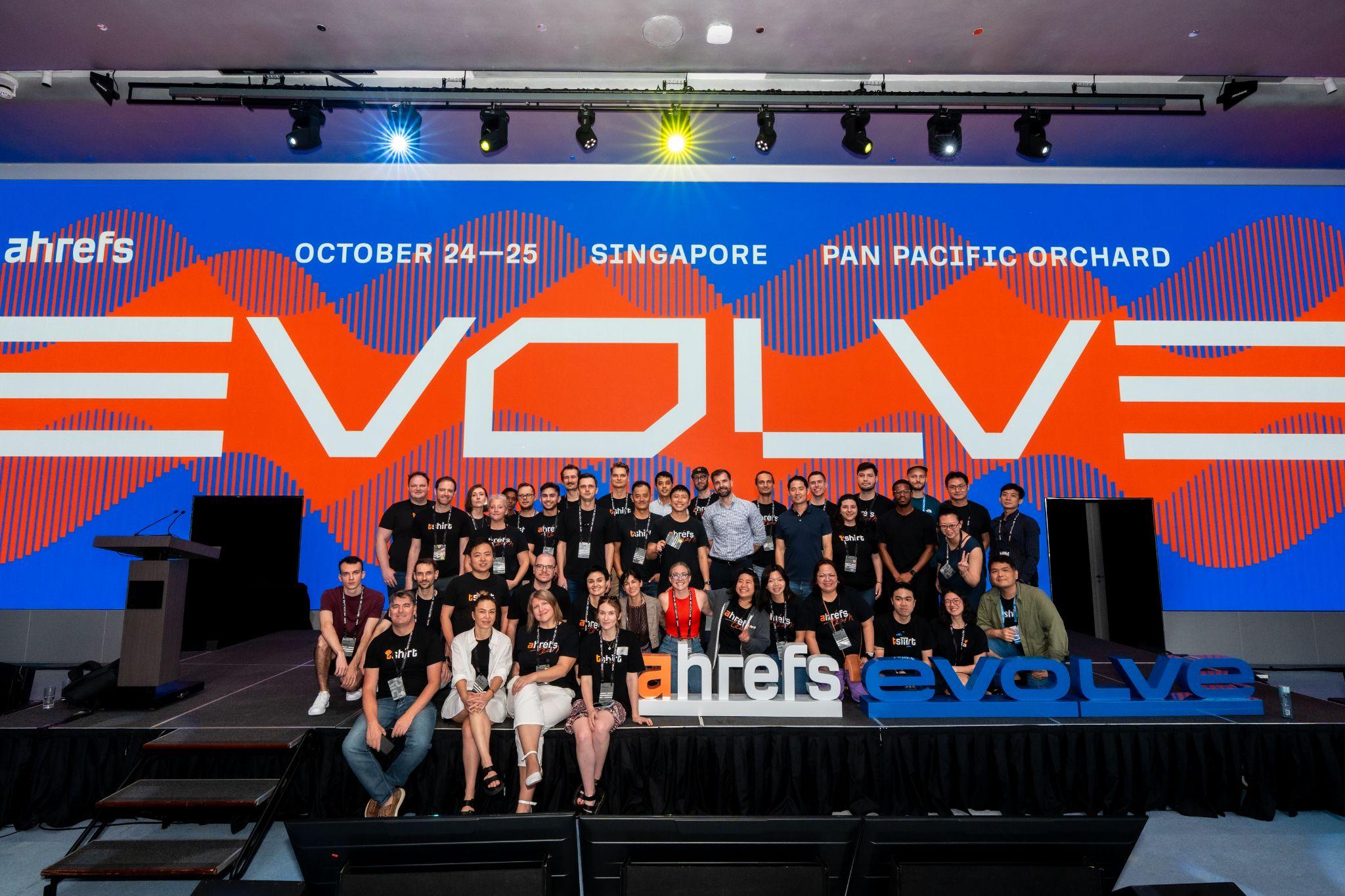
We recently concluded Ahrefs Evolve: a sold-out, 2-day, 500-person conference at Pan Pacific Orchard in Singapore.
The Ahrefs team at Evolve
It wasn’t just a conference; it was an entire week of events. From Monday to Wednesday, we ran two paid workshops per day and then the conference on Thursday and Friday.
Before that, we ran online webinars, networking meetups, panel discussions, and even a smaller-scale conference. Suffice to say, we’ve had plenty of experience doing event marketing.
A content marketing panel we ran
But even though I’m writing this, I’m not the person behind it all. There is a brain behind all of our events, and that’s Shermin Lim, our events marketer.
So, I interviewed her to find out how we did it, especially how we took on such an ungodly task of organizing a multi-day conference with just a two-person team.
My interview with Shermin
This is our guide to event marketing, specifically focused on building up to an actual conference. You can use the same knowledge to scale up or down depending on your goals.
What is event marketing?
Event marketing is the planning and organizing of an event to promote your brand, product, or service. The event can be big or small, online or offline.
Now that we’ve gotten what Google wants to see out of the way, let’s get into our why.
Why are we doing event marketing?
We’re a mostly self-serve SaaS business, so why are we organizing events?
The answer is simple: Business is social. Humans are not logical, rational creatures that buy everything based on pros and cons. We buy because there’s an emotional and human connection to the brand or the people behind the brand.
How can you not do the cheek heart pose if you’re taking pictures with Koreans?!
And nothing in this world beats seeing them in-person. I think we all learnt this lesson deeply during the pandemic. This core rationale trickles down to the other reasons we can list out on why we run events and even a conference:
Provide a great, in-person event for our existing customers to hang out, network, learn from each other, and potentially build partnerships or do business together.
Hang out with our customers, talk to them, learn about them, give them our beloved swag, and (hopefully) endear them to us.
Let our enterprise sales team talk (in person) to our top customers.
Educate our customers about our new product features and how to better use them
Get non-customers to drink our Kool-Aid, buy into our brand, and convert into customers.
VIP networking night at the Ahrefs office, the day before Evolve. I’m not sure why I look so impressed.
If these reasons compel you too, then keep reading to learn how to do event marketing for your brand.
1. Define your goals
Like everything else in life, your goals determine where you should be going. In this case, it’ll help you decide if you should actually organize an event for your business.
After all, organizing an event from start to finish can be expensive. Most things, like food, venue, and audiovisual (A/V) cost money. And even if you’re not providing food, using a free space, and not running talks, you’ll need manpower. Part-timers cost money. And even if you use your own staff, remember you’re sacrificing work days.
For example, I lose the hours I could use to create content whenever I attend or speak at an event. FYI, that’s not necessarily a bad thing. Speaking at events builds my personal brand, which increases my “authority”, and in turn, creates all sorts of unmeasurable benefits for my content.
Me giving a workshop in Chiang Mai
Again, it goes back to your goals. What are you trying to achieve?
You can use any type of framework you prefer, like SMART, OKRs, or BHAG. It doesn’t matter. What matters is that you have a goal and direction.
By the way, even if you think events are a great marketing channel for you, consider sponsoring them first. In fact, before we ran Ahrefs Evolve, we sponsored other conferences for years.
Our Head of International Marketing, Erik Sarissky, standing on top of our branded floatmingo
I think the experience of sponsoring and attending other conferences gave us a lot of insights into making our own conference. As sponsors and attendees, we knew what people wanted, what they liked, and what they disliked.
2. Identify your target audience
Knowing your target audience determines what kind of event you’ll run and what kind of speakers you’d invite. It’ll also help sponsors to decide if they want to sponsor your event.
For Ahrefs Evolve, we decided we wanted to bring top digital marketing professionals together, and not just SEOs.
That informed our eventual speaker line-up—we had speakers who presented about account-based marketing, performance branding, TikTok, and more.
Many companies dream of a major conference with their brand name splashed on it.
But it would be a huge mistake to jump right into creating a conference. Even for us—widely considered the top tool in our industry—it took us years before we even made Evolve.
Here’s how our journey unfolded:
As I’ve mentioned, we started sponsoring events first. Then, when we decided to put our foot down on the channel, we started with light networking events (SEO Beer and Snacks) that we hosted at our office.
Our first ever SEO Beer and Snacks
There was no agenda—just SEOs and digital marketers having a drink and chatting with each other.
Then we started to build from there and slowly increase complexity. We started to make the meetups educational by having presentations and panels.
A panel we ran on “Using SEO to Create a Billion-Dollar Revenue Channel”
Next, we turned it into actual paid workshops.
Link building workshop conducted by our product marketer, Constance
We then started doing these paid workshops at conferences we were already sponsoring, like Chiang Mai SEO.
Andrei giving a workshop at Chiang Mai SEO
It eventually culminated in a smaller conference that we held in 2023, called the Singapore SEO Summit.
Tim kicking off SG SEO Summit 2023
We got a small venue, marketed it only to Singaporeans, and limited the tickets to 200 people. Most of our speakers were locally based too, except James Norquay and Nik Ranger, who were from Australia.
While the conference wasn’t sold out, it gave us confidence in scaling up and running an international one. After all, it did well despite:
No “big name” speakers
Shorter timeframe
Marketing only to locals
Most importantly, we learned that people were happy to fly all the way to Singapore just to attend an Ahrefs conference. We had attendees from Thailand, Indonesia, Malaysia, Philippines, and even South Korea.
Networking time at SG SEO Summit 2023
You may argue that these were countries close to Singapore. But consider the fact that ASEAN (besides SG) isn’t particularly economically developed and it probably costs a lot to fly to Singapore and stay there (notoriously expensive). The fact they would do that is a sure sign of our brand power.
It was only when we saw these results that we decided to make a 500-person conference for 2024.
4. Develop a realistic budget
As Shermin told me, everything in an event eventually comes down to the budget.
Developing the budget means answering two important questions:
What do you need and how much is everything going to cost?
How are you going to earn revenue?
Costs
These are the things we needed for our conference with their estimated costs.
Category
Line items
Estimated cost (SGD)
Venue
Our main event space, alongside catering and after-party food and drinks
LED wall, photowalls, photozones, sticker walls, keychains, etc.
$25,000
Marketing and advertising
Paid ads, PR, software, etc.
$20,000
Extra logistics
Powerbank kiosk, portable air conditioning, posters, signage, etc.
$5,000
Miscellaneous
Transport, last-minute items, etc.
$2,000
Do you really need to spend that much? Well, it depends on the size of your event.
We wanted to make Ahrefs Evolve spectacular and that’s why we needed all of them. But for our initial networking events, we only needed food and drinks. Later, we incurred a one-time cost for A/V equipment when we started doing workshops.
It also depends on what you want to offer. For example, we didn’t want people to leave the venue—a beautiful, award-winning one, by the way—and hang out with the cliques they already knew. We wanted them to network. That’s why we chose a hotel, which catered food.
Walking the talk—here I am networking with other attendees
But other conferences, like BrightonSEO, don’t offer lunch or dinner.
Whichever you opt for, make sure you negotiate. You can negotiate away a lot of additional costs.
For example, our venue wanted to impose an ‘overnight hold’ charge on us because they deemed it as lost potential income. For context, hotels are popular wedding venues in Singapore. Since we had to hold the space for one night (to maintain the conference setup), the hotel considered it as “lost revenue” since it could have theoretically been rented out for a wedding.
But the overnight hold was on Thursday evening and very, very rarely will someone hold their wedding on a Thursday night.
The event wanted to charge us to hold this space for one night
You’d really want to go through line-by-line, especially if you’re renting a large venue like us, and make sure there are no unnecessary charges and fees. If they are, negotiate them away.
Ticket sales
Costs are relative to revenue: If you can make enough money, you can spend enough money. But how are you going to earn that through your event?
The most obvious is, of course, ticket sales.
How much should you charge per ticket? Here are a few considerations:
The ticket price should cover your costs. But it should also be attractive enough to entice people to come.
Event attendees are, for some reason, notoriously last-minute buyers and that can incite panic for your events team. You’d want to consider discounting in the early stages (i.e. early bird discounts) to get people to commit earlier.
You’d want to encourage bulk buys too, as companies may send an entire team of 3-5 (sometimes more). Discounting works here.
Tiers also matter: For example, we created a VIP tier where we promised exclusive treatment. However, VIP treatment may also mean extra costs.
There’s no exact answer to this—It comes down to a mix of mathematical calculations, experimentation, competitive analysis, and gut feeling.
Here’s what we eventually settled with:
Regular ticket at $650; early bird pricing of $570 (and up to 20% discount for bulk purchases)
VIP ticket at $980; early bird pricing at $840
All discounts were available up till 1 August, two months before the conference.
Sponsors
The next important revenue stream is sponsors. These are companies or people who will pay to have their branding appear at your event. It could also involve a speaking slot and booths.
For example, these companies sponsored Ahrefs Evolve:
I’ll talk more about how to get sponsors in the “Secure your sponsors” section.
Pitchbox was one of our sponsors
Grants
Finally, don’t forget about grants. Check if there are any available from the government or elsewhere for companies that are holding their own events, especially big ones that could bring in hordes of tourists!
For example, we tried to get a grant from the Singapore Tourism Board.
In this case, we failed. But it’s always worth a try!
According to Shermin, most major events do not make money for the first time. It’s common to incur losses.
That’s why your budget needs to be realistic. Shermin already had an “easier” time forecasting our budget because we did SG SEO Summit the year before. Even then, our goal for Ahrefs Evolve was simply to break even.
Sidenote.
Easier is in inverted commas for a reason.
And that’s why I believe you should start small.
You have no idea how much everything costs.
You have no anchor points and could be overpaying.
You could be underestimating certain items (e.g., the amount of food and drinks)
A lot of what you can charge eventually comes down to demand — we could justify certain prices because we had thousands of customers, built a strong brand, and had connections to sought-after speakers. But if you suddenly make a conference out of nowhere and attempt to charge $10,000 for VIP tiers, no one will be interested.
5. Narrow down your dates and choose your venue
For smaller events, dates can be flexible. For example, we usually announce our networking events two to three weeks before.
For a major conference, you’d want to ensure the dates are good:
Doesn’t clash with a major holiday, e.g., Chinese New Year in Singapore
Doesn’t clash with other major industry events in the region, e.g., Chiang Mai SEO
Gives you enough time to prepare
The venue is available
To choose a venue, here are some considerations:
Consideration
What to check
Availability
Whether the venue is available on your preferred date(s)
Location
Whether it’s easy for people to get to
Size
Whether it can fit your number of expected guests and whether it has space for networking and sponsor booths
Rates
Whether it fits your budget
Aesthetics
Whether the exterior and interior design matches what you’re looking for
Food
Whether the food is good and if they can accommodate preferences (e.g., vegan, halal)
Toilets
Whether there are enough toilets and cubicles
WiFi
Whether it’s fast enough
Service
Whether it’s good on the day. Regular communications with you should also be professional and on time
For Evolve, Shermin shortlisted three dates:
24-25 October
7-8 November
14-15 November
She then built a criteria for venues:
It must be available on those dates
The location should be in Orchard or in the Central Business District (CBD)
There should be enough toilets — for example, we opted out of one hotel when we saw they only had a maximum of four cubicles (big problem for 500 attendees)
For aesthetics, she preferred high ceilings and modern vibes. (I know, we’re all Gen Z.) The venue should also ideally have a LED wall available.
The space should be large enough for 500 people — This was surprisingly difficult, as most venues in Singapore either accommodated 100-200 or 700-1,000 people.
With the criteria, she built a tentative list of 10 hotels and narrowed it down to two after emailing the venue’s events team and doing an in-person site recce.
Sidenote.
IMPORTANT: You should always visit the venue in person. There are photos, there are videos, but you’ll never get the actual feels and vibes for the venue until you visit it.
The final venue was chosen after the sales representative for our original preferred venue took up to four weeks to reply to each email. This is an important consideration because it’s a sign of things to come. Organizing an event is stressful in and of itself and you don’t want communications to derail it. Work with people who are professional and responsive; after all, it’s service and hospitality.
This ceiling was high enough for Shermin
Shermin also asked the venue for food tasting. Since most attendees were not local, we wanted to represent our country’s culture and cuisine during the conference.
6. Secure your speakers
A big part of an event, if you’re doing an educational one, are the speakers. People will attend an event just to hear someone speak. For example, in 2016, I flew all the way to London just to hear GaryVee speak in a boxing arena.
My poorly zoomed-in photo of GaryVee. Interesting to note that my photography skills have still not improved.
So, the quality of your speakers will determine whether people will come and how much you can charge too.
When we planned our conference, we already had a few major names in mind. We knew people like Lily Ray, Cyrus Shepard, and Aleyda Solis would be big draws, especially since you don’t see them often in Asia.
Again, thanks to our brand power and CMO Tim Soulo’s personal connections, we were able to secure them easily.
Since it was an Ahrefs conference, we also wanted our own people to speak. Thus, my colleagues Tim, Sam Oh, Patrick Stox, and Ryan Law, took up speaking slots too.
We also asked people to apply to speak on our conference landing page.
We asked them a few questions, like their job title, where they’re based, the latest events they’ve presented at, and their proposed talk titles with descriptions.
I (yes, I was involved this time) then vetted their topics, shortlisted those we thought would improve our conference, and officially invited them.
Once they’ve given their confirmation, you’ll want them to give the official title and description for their presentation. Make sure to give them a deadline to submit their slides. In our case, we asked them to submit their decks by 20 October.
We also had Constance vet all their presentations. We wanted to ensure that each speaker was genuinely giving helpful information and not just pitching their products or services. We also wanted to avoid any inappropriate or NSFW content.
In fact, by vetting through each presentation, you’ll also get a sense of which talk would be better for the start of the conference and which for the end, allowing you to design the schedule.
7. Start your event promotions
Here’s everything we did to market Ahrefs Evolve:
Discounting
As mentioned earlier, we implemented early bird and group discounts.
Event landing page
This was one of our most important marketing assets. Again, thanks to the fact that we organized a smaller conference before, we had a template to build on.
Since we started on this page early in the process, we didn’t have all the information. So, we just left it as TBD.
We updated the landing page gradually as we received more confirmation about the venues, speakers, and sponsors.
We also knew it would be the first time most attendees were in Singapore, so we created a section on the best things to do:
Owned media
Needless to say, we began our promotions on every asset we owned. Starting with regular posts on LinkedIn and X:
The marketing team, especially Shermin and Tim, also regularly posted about Evolve:
We sent an in-app message to our customers:
Regular emails to our newsletter audience:
Display banners on our blog and articles:
Speaker cards
We made social media “cards” for our speakers and encouraged them to promote the conference to their audience:
One of our speakers, Charlotte, with a video promoting the event
Video tour of the venue
Someone once told Tim that a big part of why Ahrefs does great marketing is that the team has taste. This extends to venue selection too.
The venue was amazing, and we wanted everyone to know. Plus, you rarely see any conference organizer promoting the venue, even though it plays a major role in making any conference a success.
And that’s why Tim actually made a video promoting the venue… alongside the conference:
We tend to take risks when it comes to marketing. Promoting the conference was no different. We specifically made a giant helium balloon (no, it’s not Midjourney or ChatGPT), flew it up, took pictures, and turned it into our conference ad creative:
Promoting the conference at other Ahrefs events
Since we were still running workshops and other offline events, we made sure to promote it there too.
Paid advertising
We ran ads on Facebook and Instagram to promote the conference:
Build FOMO
We also made sure to consistently build FOMO. For example, we announced whenever tickets were sold out or selling fast:
We created graphics showing who’s coming from where:
We even ran a giveaway:
Finally, we made a social media card for attendees to share that they’re attending Evolve!
8. Secure your sponsors
The question every sponsor will ask: what do we get if we sponsor your event?
Typically, they are:
On-site branding (e.g., on stage, on wall displays, on lanyards)
On-stage shoutout
Brand visibility on event page/website and social media
Physical booth with furnishings
A speaking slot
Free event tickets
Most conferences will offer these perks in tiers, e.g., Regular, Gold, Platinum. For example, here’s what we got from sponsoring Chiang Mai SEO as a Platinum sponsor:
20 minute on-stage presentation + 10 minute Q&A
First choice of placement for vendor booth, including backdrop, pull-up banner and TV screen
Platinum partner placement on stage backdrop and digital signage
Logo placement on event badges
On-stage booth shout-out by MC for break periods
Logo placement on website and email marketing campaign
Virtual booth and banner advertising on CMSEO App
Goodie bag inclusion for Deluxe Ticket Holders
2 Deluxe Passes
3 Vendor Passes
Since it was our first event, we wanted to keep it simple. So, we offered only one tier to all sponsors. Here’s what our sponsors received:
Exhibition booth with essential furnishings: table, chairs, and an extension cable. We also recommended suppliers if they needed additional display items.
Visibility on our social media and the event page.
Onsite branding displayed throughout the event.
Three complimentary event tickets.
First Page Digital’s booth at Evolve
Our social media shoutout for sponsors
To begin with, we contacted our connections and asked if they’d sponsor our conference. We also provided a contact form for potential sponsors on our event page.
9. Executing the event
In terms of running the actual event, we partnered with an events agency to do bulk of the work. They handled:
A/V
Lighting
Production management, including the crew and part-timers
Event registration, including software, analytics, and part-timers
Lanyards
We also hired a photo and videography team for three days, including the VIP networking night.
Our photographer Rohan kindly stepped in front of the camera for once to snap a photo with Elysa from our events team
The rest of the marketing and support team were also involved, from handling the VIP booth to giving out swag, to managing the speakers and directing people around.
Our swag booth
But I want to remind you that when it comes to events, Murphy’s Law will always hold true.
No matter how much prep you did, no matter how much you delegated and outsourced, something will always go wrong. You, or your events team, will have to be boots on the ground to fix any last minute issues or errors.
For an entire week, Shermin was a trooper, handling anything that went wrong and trying to get everything sorted out so the conference could run smoothly. There are simply no words to describe what she went through.
10. Wrap up, evaluate, and iterate for next time
If you’ve done a major event like a conference, then it’s time for you to take a vacation. Go as far away as possible, lock up your laptop, and switch off your mobile phone. Go for a massage, get a mani-pedi, and sleep as long as you want.
You deserve it.
The beautiful and unfortunate part about events is that when the current one ends, the next one begins.
After a few days (and hopefully a few weeks) of rest, the prep for the next one begins. For Shermin, it’s Evolve 2025. (Sign up here if you want to be notified!)
In the meantime, when the excitement about the event has yet to die down, send out a post-event survey to gather feedback.
Ask them to rate:
Their experience at the conference
Your organization
Quality of speakers (and potentially rank them)
Venue and facilities
Length and duration of the conference
Sponsors
Your event communication
And more. You’d want to ask for qualitative feedback on what can be improved too.
Don’t forget your own team:
And don’t forget your sponsors:
Once you’ve received your feedback, debrief the team and determine what needs improvement for the next event.
Oh, and don’t forget to publish event recaps:
Final thoughts
Even though this guide looks like it’s written sequentially going from step-to-step, I want you to know that it’s anything but that. Besides the actual event execution, most of what happens happens concurrently.
That means: even if you’re still deciding on the venue, you should already be reaching out to speakers and sponsors, creating your marketing assets, getting designs done, and ensuring the logistics are settled.
There are so many details that go into organizing an event and I couldn’t possibly include all of them. One example: some attendees reached out to us for help with their visa application. So, we wrote up a template for them:
The only way to get all details is to plug Shermin into a machine and download her brain. But hey, we need her to organize the next Evolve
You don’t have to be the next James Bond to start PPC spying—all you need is a license to Ahrefs.
In this article (for your eyes only), I’ll share what PPC spying is, why it’s important, and share seven ways you can start spying on your competitors’ paid search campaigns.
2. Spy on the location of your competitor’s paid traffic
If you work with a client that operates in multiple territories, chances are their competitors will also be working across multiple territories.
To spy on your competitor’s paid traffic across different locations, you can use Ahrefs’ Paid traffic by location report.
This report shows you the countries from which your competitor is getting the most paid traffic.
How to do it
The Paid traffic by location report is to the right of the Paid traffic and Paid keywords reports.
Why it’s useful
If one of your competitors expands to a new territory, they will likely test the waters with PPC to see if they get any traction. This report shows where a competitor is spending most of their PPC budget, and it can be useful in identifying new market opportunities.
It can also help you optimize your own Ad spend. If you know that a competitor is spending most of their PPC budget in one country, it may be beneficial for you to increase investment in other similar regions.
3. Spy on the number of paid pages and paid keywords your competitor has
If you want to understand the scale of a competitor’s paid campaign, you can check the number of keywords they are bidding on and the pages they are sending the traffic to.
How to do it
To see this screen, just scroll down from the Paid traffic report.
Why it’s useful
The charts for Paid keywords and Paid pages help us understand the historical performance of a competitor’s Google ads campaign.
From these charts, we can analyze the seasonality of our competitors’ paid search campaigns, specifically the number of paid keywords they’re bidding on and the number of paid pages they’re sending paid traffic to.
Identifying peaks and troughs here could lead to changes in our own PPC strategy. For example, if a competitor vastly increases the number of keywords or pages at a certain time of year, it could indicate increased demand they want to capture—for example, for an event like Black Friday or Christmas.
If keywords and pages are reduced, it could mean either that demand has reduced or that their SEO is doing so well that they don’t need paid advertising. Or it could simply be a test.
Ultimately, you’ll have to use your intuition and your own data to determine the exact reason for peaks and troughs in this data.
Further reading
4. Spy on your competitor’s top-performing ads
Spying on your competitor’s top-performing ads allows you to learn what’s working and what’s not. And the best place to do it is in the Top Ads report.
How to do it
To see your competitor’s Top Ads, scroll down from the Paid pages report, and you’ll see the ads sorted from highest to lowest traffic.
If you want to see all of your competitors’ ads, you can click the View all button.
Why it’s useful
Spying on your competitor’s top-performing ads is useful because you can learn what works and what doesn’t without spending a dollar on PPC.
Further reading
5. Spy on your competitor’s top-paid keywords and paid pages
Although it’s interesting seeing the top-performing ads, sometimes you want to know what keywords are driving this traffic and also what pages your competitors are sending traffic to.
In the example below, it’s probably no surprise that Canva is sending the lion’s share of their paid traffic to their homepage.
How to do it
To see your competitor’s Top paid keywords and Top paid pages report, scroll down from the Top ads report.
Why it’s useful
Knowing the exact keyword is useful for two reasons:
Find new keywords – It can allow you to uncover new keywords you might not have discovered yourself.
Find high-value keywords – With paid traffic, competitors aren’t usually going to put money into keywords that don’t offer a good return. Spying on their paid keywords allows you to find the most high-value keywords.
Likewise, with your competitor’s Top paid pages, you can see which pages they prioritize for paid activity, giving you insights into their overall marketing strategy.
6. Spy on the history of all your competitors’ paid ads for any keyword
So far, we’ve only looked at spying on one competitor in isolation, but what if you want to look at all the competitors bidding on a particular keyword? This is easy to do using Keywords Explorer and the Ads position history report.
This report shows us two things:
When competitors started and finished bidding on this keyword
What landing page they send the traffic to
How to do it
In Keywords Explorer, enter your keyword in the search bar. I’ve used “ahrefs” and then scrolled down to the Ad position history report.
In the example below, we can see one of our competitors placed some ads on our brand keyword a few years ago.
The colored marks indicate where a competitor has placed a paid Google ad on this particular keyword over time, the longer the length of the mark means the ad ran for a longer period of time.
But this report’s strength is in its ability to show all competitors bidding on this keyword. If we enter “Christmas tree” into the search bar, we can see a variety of competitors bidding on this keyword.
Hovering over any of the colored marks will reveal the exact ad that was run. This is useful for monitoring paid activity and seeing how competitors have changed their ads over time.
This is a really good way to quickly assess the competition before you launch your PPC activity.
Why it’s useful
For quick spot checks on important keywords, like your brand, you can see which competitors are placing ads on certain keywords. Often it will be more than one competitor for competitive terms.
This overview is also useful for helping you understand the peak advertising periods. If competitors run a lot of ads at a certain time of year, you can use this information to inform your own campaigns for the next year.
It’s also useful for allocating PPC budgets. If you can see the timing of the competitors’ ads, you can allocate more budget to be spent during these periods.
7. See the cost per click (CPC) for any competitor keyword
Cost per click (CPC) is the amount you pay when a user clicks on an ad. It’s an important metric for marketers as it helps them understand how much they will need to spend to attract potential customers.
How to do it
You can find CPC in Ahrefs by entering any domain into Site Explorer’s search box and then heading to the Paid keywords report
If you want to identify paid keywords within a certain range, you can use the CPC filter. I’ve set a filter for ads above $10 CPC to see the most expensive keywords. We can see that Canva is only bidding on a single keyword above $10.
Why it’s useful
Seeing the CPC for each keyword allows you to manage your advertising budget effectively. Enabling you to provide the best return on investment in your PPC campaign.
By understanding CPC, you can also update and optimize your bidding strategies accordingly.
Common pitfuls of PPC spying
Spying on competitors’ paid activity is a useful way to get a competitive advantage. But it’s worth noting some common pitfalls, which, if you’re not careful—-you can fall into.
Here’s what they are and how to avoid them.
Over-focusing on competitor ads
Although PPC spying is a useful way to get insights about your competitors’ paid activity, if you over-obsess and over-analyze your competitor’s ads, you could lose sight of your own PPC campaign. Try to focus on getting a few key insights and then use those to inform your PPC strategy.
Tip
Using the Ads position history in Keywords Explorer, you can analyze the paid competition for any keyword, giving you a 30-second view of the paid search landscape before running your ads.
Misinterpreting the data
Like SEO, PPC has many metrics by which you can measure your campaigns’ success. Sometimes, these metrics can be misunderstood or misinterpreted.
Tip
In Ahrefs, if you are unsure of any PPC metrics meanings, you can hover over the text to get their definitions.
Before you launch your next campaign, make sure you understand key PPC metrics like click-through rate (CTR), cost per acquisition (CPA), conversion rates (CR), quality score (QS), and return on ad spend (ROAS).
Overreacting to competitors’ short-term strategies
With so much data at your fingertips, it’s easy to overreact when you see a competitor’s PPC campaign unfold—especially if it impacts keywords traditionally “owned” by your brand.
That’s why it’s often best to establish a long-term PPC strategy. PPC teams run tests regularly to see what works and what doesn’t, so the reality is that a lot of PPC advertising is relatively short-term.
Tip
Try not to be overly reactionary to your competitors’ PPC campaigns.
Final thoughts
Ahrefs is already well known for its SEO features, but as we’ve seen, some of its PPC features are super useful for spying on your competitors’ paid ad campaigns. By using these insights in your PPC strategy alongside your first-party data, you can stay one step ahead of your competitors.
If you already use Ahrefs for SEO, give our PPC features a whirl on your next paid campaign, and start PPC spying.
Got suggestions for PPC features you’d like to see in Ahrefs? Let me know on LinkedIn.
Your phone buzzes, you look down. Someone mentioned your brand on LinkedIn… but not in a good way. You boot up your laptop with one hand and reach for the Red Bull with another. Welcome to the world of brand monitoring.
But often, brand monitoring is more than just responding to comments that mention your brand—it’s about understanding customer sentiment and using feedback to shape your brand reputation in real-time.
What is brand monitoring, and why is it important?
Whether you like it or not, conversations happen about your brand constantly. Some are good, some are bad. Brand monitoring is the most effective way to keep track of these conversations.
Brand monitoring is the process of identifying conversations and reacting to them. You can amplify positive comments or extinguish negative feedback before it potentially spirals into a public drama and impacts your reputation.
How you react helps shape your brand’s narrative, positively or negatively, which is why it’s important.
The tools you need for brand monitoring are often determined by what part of the online space you need to monitor.
It’s often assumed that brand monitoring only happens on social media, but in my opinion, it can occur in three places online—websites, social media, and LLMs.
So, if you want to monitor your brand effectively, you need to monitor it in these three places.
Here’s how you do it:
1. Brand monitoring on social media
Social media is the fastest way for customers to give real-time feedback on your brand, so it’s often the first place marketers think of when they think of brand monitoring.
To get started, consider which platforms conversations about your brand happen on most frequently.
Identify social media platforms your customers are using
Do your customers use LinkedIn, X, Facebook, TikTok, or something else? Wherever they are, you need to find a tool to help you monitor platforms where your customers frequently mention your brand on social media.
Here are a few of the most popular paid social media brand monitoring tools and the platforms they support:
Facebook
Instagram
X
LinkedIn
Threads
TikTok
YouTube
Pinterest
Brandwatch
✔️
✔️
✔️
✔️
❌
✔️
✔️
❌
Sproutsocial
✔️
✔️
✔️
✔️
✔️
❌
✔️
✔️
Mention
✔️
✔️
✔️
✔️
❌
✔️
✔️
❌
Sidenote.
Some social networks like LinkedIn don’t have a publicly accessible API, so for monitoring platforms like this, you’d need to use one of the paid tools above or try my “hacky” methods below.
If you don’t want to use a paid tool, there are other ways to monitor your brand for free. For instance, at Ahrefs, we monitor Twitter, or “X” as it’s now known, using a webhook in Slack.
More simply, we get a feed of “ahrefs” mentions in our Slack workspace. It looks something like this.
It still requires a manual review, but it’s useful for tracking brand mentions within your workspace.
Once you’ve decided which platform you want to monitor and picked a tool, brand monitoring becomes more about analyzing the intent of the comments. We call this sentiment analysis.
Understand the dominant sentiment for your brand
Sentiment analysis is a process of classifying text into positive, negative, or neutral groups. It’s an important part of social media brand monitoring because it gives you a clear idea of what your customers think about your brand.
Positive sentiment – Shows what customers like and about your product and how you can improve it
Negative sentiment – Shows you what customers don’t like about your product and what you’re doing wrong
Neutral sentiment – Lacks strong positive or negative sentiment
For most companies, the trick is to find and deal with bad reviews—or negative sentiment—before they get out of hand and decide how to take action (improve service, apologize, offer a voucher.)
The paid tools mentioned earlier have sentiment analysis built into their interfaces, making identifying bad comments easy.
For example, on Brandwatch, here’s an example of how this tool flags negative sentiment reviews.
Here is an example of a positive sentiment review using the same tool. The comments are clearly labeled in these examples.
Sprout Social also has a sentiment summary to see how people react to your social media posts.
Awario is another tool with good sentiment analysis functionality and charts customer sentiment in a clear dashboard.
Mention is also a cost-effective (and my personal favorite) way to monitor your brand, as well as monitoring websites and forums. It also works across social media from TikTok to Pinterest and (even radio and TV in the U.S.)
There is no shortage of paid tools for monitoring social media sentiment—but they often come at a price.
If you want a more cost-effective alternative to these tools and are prepared to do some work, you can use a tool like Text to Data’s Google Sheets API. It costs around $17 for 5000 API calls.
Here’s a demo of how it works, and here’s my 30-second test using the Sheets API and some made-up reviews to test how it classed them.
If you have comments on a particular post you’d like to analyze, you could use this tool to analyze the sentiment and scrape data from your social media feed using a tool like Panda Extract.
2. Brand monitoring on websites
With at least 1.88 billion websites online globally, there’s a slight chance a few might mention your brand. So, how can you best monitor your brand mentions? Here’s what I suggest.
Start with Google
Googling your brand name is the fastest way to find out what type of website your brand is mentioned on.
As many different types of websites get pulled into the Google search results as SERP features, it’s a good way to understand what websites you need to focus on as part of your website brand monitoring strategy.
For example, if we Google “Virgin Media,” a UK broadband company, we can see that its brand is mentioned on many news websites.
For this company, monitoring website mentions on news websites would be important, as they have the potential to impact its online reputation.
So, how can we monitor mentions like this? By using alerts.
Set up alerts
In my experience, Ahrefs Alerts is the easiest automated way to monitor your brand mentions across the web.
To start receiving brand mention alerts using Ahrefs:
Head to the More menu in Ahrefs
Select Alerts from the menu dropdown
Select the Mentions tab
Click + Add alert
Then:
Enter your brand name in the Search query column
Add your domain to the Exclude domains field
Set the Interval to the frequency you desire
I’ve gone for Daily, but you can also select Weekly if you want less frequent updates.
Monitor your organic brand keywords
To monitor the exact keywords people use to search for your brand in Google, you can use the Brand filter in Ahrefs.
To do this:
Head to Keywords Explorer and enter your brand name in the search box
Go to the Matching terms report and select Branded, then hit Apply
Once you’ve done that, you can select Clusters by Parent Topic to get an overview of some of the most important keywords for your brand.
Clicking any of the keywords we can find the exact Google search results for this topic. I’m going to click on “cancel virgin media.”
Clicking the keyword (or any of these keywords) takes us to the SERP Overview page—which shows Google’s top results for that keyword.
From here, we can see two things. 1) The community subdomain mostly deals with this keyword. 2) There is one Reddit thread that we probably should be monitoring—as it represents a reputational risk.
Here is an example of how I would approach brand monitoring on Reddit for Ahrefs using Google Alerts. It’s as simple as entering site:reddit.com followed by your brand name.
Sidenote.
If you want to monitor a different site, you can change the website and the brand name to anything else you want.
Or if your brand name is your Reddit username, you could update your Reddit User settings to include Username mentions.
Monitor your paid competitor brand mentions
We’ve talked about organic brand monitoring, but what about when websites put up ads targeting keywords with your brand name in them?
If you want to monitor your brand mentions in your competitor’s Google ads, you can do this in Ahrefs as well—and even see the exact copy they used.
To do this, enter a competitor’s domain in Site Explorer, head to the Paid keyword report, and add a Keyword filter with your brand name.
Then, to see more information about the ad, click the ads dropdown icon to reveal the Ad position history. Hovering over the colored blocks will show all the details of the ad.
Monitoring your brand on competitor ads gives you a sense of which competitors are spending the most on bidding on your brand. It also gives you an insight into which keywords they feel are valuable.
Monitoring paid brand mentions of your brand is important because competitors may bid on key brand terms and siphon off some of your brand traffic.
For example, Peter Shankman recently noticed that his competitor, Qwoted, was bidding on his brand keyword “source of sources.”
If we enter “qwoted.com” into Site Explorer and jump into the Ads report, we can see that Qwoted is bidding on more than just the Source of Sources keyword. It’s bidding on a number of different “alternative” keywords that could potentially impact a wide range of brands.
Across one keyword, this might not make a lot of difference, but if your competitors bid across a large range of your keywords, it could impact your business. This is why it’s a good idea to have a strategy for monitoring ads that mention your brand name.
3. Brand monitoring on LLMs
LLMs present a new brand monitoring challenge, as your brand may be mentioned in any of these tools at any time.
There are already many well-known large language models (LLMs), such as GPT-4o, Claude, Grok-1, and Gemini.
To add further complexity, how your brand is mentioned differs from LLM to LLM. So, how can we effectively monitor all of them? At the moment, the answer is: not easily.
Until that is, we launch our new tool: LLM Chatbot Explorer, which will give you insight into your brand’s visibility on major LLMs.
Sidenote.
You’ll soon be able to use our brand new LLM Chatbot Explorer to understand the dominant sentiment, frequency of brand mentions, share of voice, and average position.
But, until then, there are two ways to monitor how your brand is portrayed on LLMs.
Asking LLMs questions about your brand
Analyzing LLM autocompletes
Let’s take a quick look at each of these in turn.
Asking LLMs questions about your brand
I asked Perplexity what it knew about Ahrefs. This is what it said.
The answer is okay, but, interestingly, one of the sources for the answer is one of our competitors—not ideal. If we re-run the same question in ChatGPT, we get a more simplified answer with less detail.
I’m not convinced that either of these answers is that great, so what can we do to influence how our brand is portrayed in LLMs? The answer is LLMO. My colleague, Louise Linehan, wrote a fantastic article on this topic, which you should check out if you are interested in this topic.
Research LLM autocompletes
If you start typing your brand into LLMs, they usually add some autocomplete suggestions below your search, in the same way that Google has done for many years.
I’ve provided a quick example using Perplexity below and typing in Ahrefs.
For Ahrefs, there aren’t too many big surprises here. One of the autocompletes is for our backlink checker and some of the free versions of our tools, like our SEO extension.
Interestingly—one of these autocompletes is in French, which could provide insights for our international marketing team.
Future trends of brand monitoring
So, what does the future of brand monitoring look like? I think we’ll see three key developments.
Increased importance of LLMs
More advanced sentiment analysis
More Reddit
Increased importance of brand monitoring on LLMs
Brand monitoring currently concentrates on social media, but I believe that as LLMs become more influential, we’ll see more brand monitoring on LLMs as well as websites and social media.
At Ahrefs, we already get a constant stream of leads from ChatGPT, so it doesn’t seem that farfetched to believe that monitoring how your brand is represented on LLMs will soon become more important.
More advanced sentiment analysis
At the moment, sentiment analysis is generally categorized into positive, negative, and neutral categories.
Although this is useful at a basic level, it doesn’t give much indication of the more nuanced emotions and feelings behind these categorizations. I think it’s fair to say that more advanced emotional sentiment analysis will become more popular in the future as it will help you to distinguish more complex emotions.
More Reddit (yes, you read it correctly)
Monitoring your brand on specific forums like Reddit is likely to become more popular in the future.
The main reason is that Reddit has become much more visible on Google than it used to be just a few short years ago. We can see this using Ahrefs by cracking open a fresh Site Explorer screen and typing “reddit.com” in the search box.
Reddit will continue to become more important for brands due to a slight ~1000% boost in organic traffic in Google over the last year, which led some SEOs to poke fun at Google’s expense.
Final thoughts
It’s tempting to think of brand monitoring in its traditional definition—only focusing on social media. But, in my opinion, it has a broader meaning, which includes websites, social media, and now LLMs.
Your brand can be mentioned anywhere online. If you want to track all the conversations around your brand, it follows that you shouldn’t only focus on social media.